

These Popular Beer Brands Defined The '60s
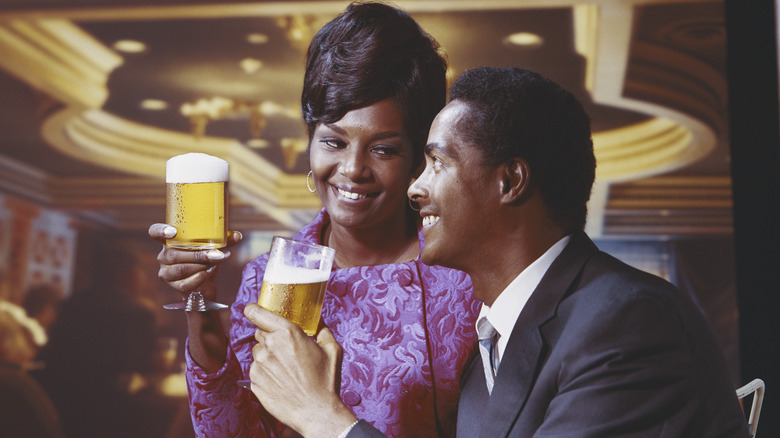
Ask a beer connoisseur what decade or era had the most impact on American brewing culture, and chances are, they will zoom in on some point in this century. They wouldn't be wrong. The aughts — and the microbrewery revolution they delivered — have drastically realigned our beer landscape. All the same, they have also been a sort of course correction from another significantly impactful period for beer drinking: the 1960s.
The swinging '60s brought some significant changes to the beer industry. An increase in refrigerated shipping, easy-to-open cans, and new avenues of marketing were all areas of new development in the 1960s. As in many post-war industries, brewing became more efficient, and technical, too. This increased capacity led to the beginning of a mass market consolidation that would last until craft brewing remerged wholesale in the 1990s and new millennium. All the same, these things didn't stop Americans from drinking beer, and there were still plenty of preferences to choose from. These beers are the ones that defined the 1960s.
Budweiser
In today's modern domestic beer market, it's easy to establish Budweiser as one of the heaviest hitters. (Even if the brand is no longer American-owned, it's still American-made.) To the surprise of, likely, no one, Budweiser also ruled the 1960s. However, its dominance as America's most popular beer wasn't easy to come by. The brew giant ran a famously tight competition with Schlitz until it eventually gained its crown just a few years before the start of the swinging '60s, becoming the top-selling beer in America in 1957. Following that, the Clydesdales were off to the races, as it were.
1960s ad campaigns promised that "Where there's life, there's Bud," and Budweiser's rate of production supported this bold statement. In 1964, the brewer's parent company, Anheuser-Busch, became the first American beer producer to send 10 million barrels to market in one calendar year. Perhaps the increase in its speed of production was a result of Budweiser's switch from Baudelot wort chillers to a specialized wort processing tool called the Strainmaster. It's also possible that with support from Ed McMahon and Frank Sinatra, 1960s Americans just couldn't drink enough of the stuff.
Rheingold
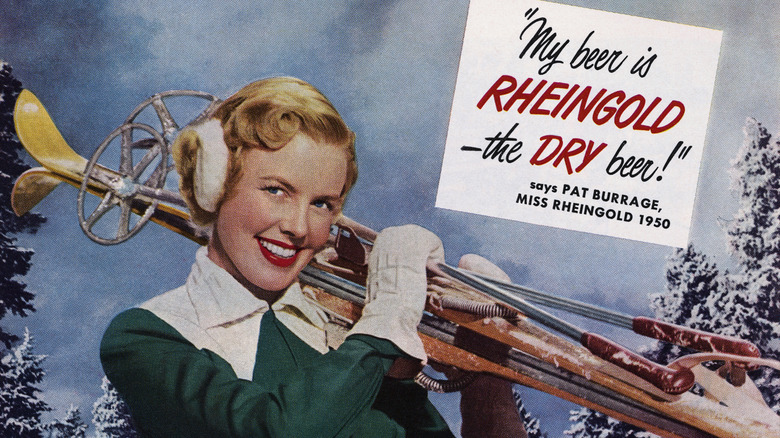
Although Rheingold beer never had much more than a regional presence, anyone from the state of New York — and especially New York baseball fans of the 1960s — will surely remember the brew as a mainstay of the decade. A million-dollar-plus sponsorship of the New York Mets gave it a high profile, and Rheingold was a common sight around both ballparks (Polo Grounds and Shea Stadium) that the Mets played at during the decade. Rheingold was well known for being a distinctively dry brew thanks to the process of being krausened, or essentially, double fermented.
Throughout the 1960s, Rheingold beer, which was produced by Brooklyn-based Liebmann's Brewery, kept its profile high by appealing to as many people as possible. Advertisements were racially integrated and often included the faces of famous folk like Jackie Robinson and John Wayne.
Despite being an NY staple, Rheingold faced pressure from brands with a national profile, like Miller and Budweiser. By 1963, Leibmann's sold to a subsidiary of PepsiCo. Even the famous competition for Miss Rheingold, which was voted on each year by the public and ran until 1965, wasn't enough to keep the brand popular. The deliciously crisp beer, which once boasted a 35% market share in New York, faced declining sales until its first disappearance in the '70s.
Miller High Life
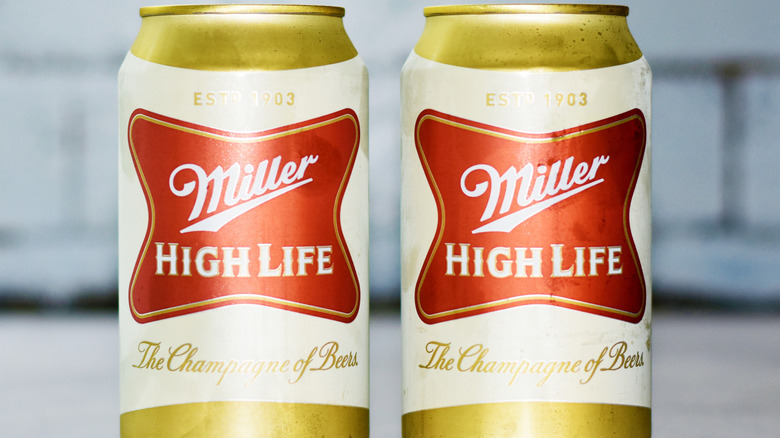
Miller Brewing Company has a laundry list of labels under its name that makes it feel like an independent, but the brand has been owned by Molson Coors since 2016. Long before the two became one, Miller Brewing had a flagship beer that dominated the '60s. It came with a little gold label you might recognize: High Life.
"The Champagne of Beers" was once called "The Champagne of Bottle Beer" until the midcentury, when its popularity began to translate to canned beer as well as glass bottled brews. In 1960, Miller ranked as America's 10th-most productive brewer, selling more than 2.3 million barrels that year. Today, Miller High Life is a cheap brew that might be considered low brow or blue collar, but it began the swinging decade as an aspirational drink that promised to help imbibers "Enjoy Life!" and sip on something that was above premium. By the final year of '60s, new ownership began shifting the beer's reputation towards how we know it today: easy to drink and easy to recommend to anyone.
Pabst Blue Ribbon
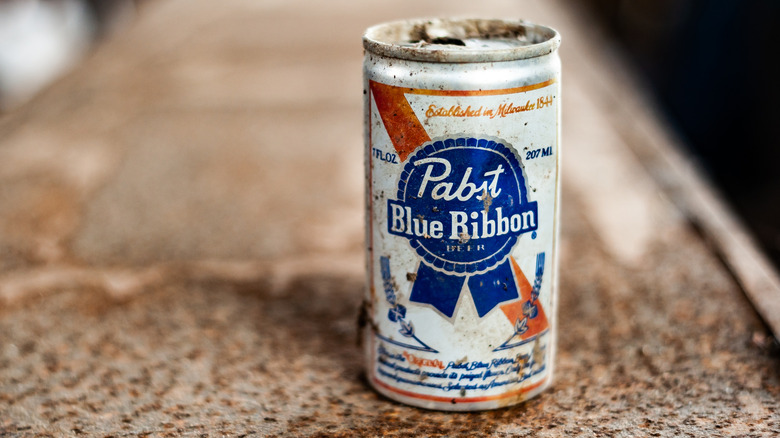
If High Life is a case of corporate execs working toward finding a broader proletariat audience, PBR is the opposite. The brand was seemingly born for its niche of the 1960s market, when it was popular with bikers, blue collars, and the everyday working folk who might remember the beer as supplying the U.S. Army during WWII. Pabst Blue Ribbon was already cooking something special prior to the 1960s. In '58, the brewery was producing 3.9 million barrels of beer. In 1960, it was 4.7 million.
Today, PBR is a well-loved cult classic, but back in the midcentury, it was simply ubiquitous. Ads emphasized its connection to hard work, genuine craft, and a beer made for relaxing conviviality. Those traits may have felt commonplace to the beer imbibers of the 1960s, but today, they equal "cool," which is why the brand was able to develop an enduring legacy that saw it through fallow decades and into rebirth through the aughts.
Coors Banquet
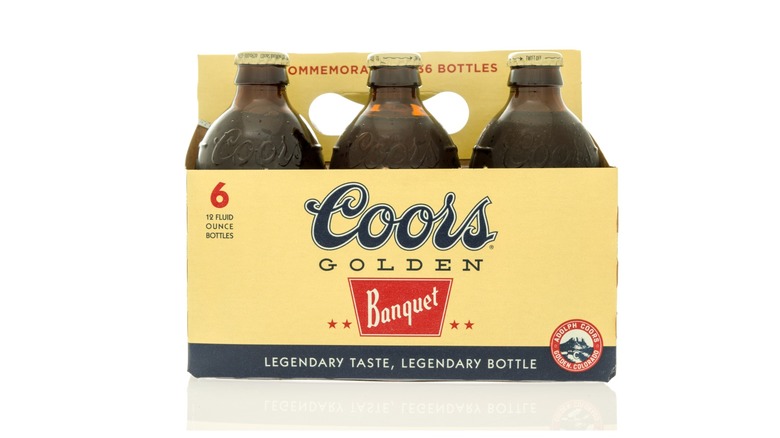
In the 1960s, Coors had the kind of reputation that could be considered a sort of amalgam of Pabst Blue Ribbon and Rheingold. The beer was decidedly working class, and it was exclusively regional to states west of the Mississippi. This helped develop deep lore, defining Coors Banquet as a prize worth smuggling to the Eastern states. Coors was so well enjoyed that it became the beer of Presidents: Eisenhower famously had it stocked on Air Force One, and Ford stuffed some in his suitcase before traveling back to D.C. Even actor Paul Newman refused to drink anything else.
Thanks to innovations in refrigerated trucking that aided the preservative-free and unpasteurized Coors Banquet, plus a growing population in Colorado, the beer boomed in the '60s and '70s, but it wasn't without trouble. The civil rights and labor movements of the '60s saw frequent boycotts and protests of Coors Banquet due to the politics and business operations of the Coors founding family. The '80s saw new ownership look to right the ship, and come 1991, the brand had national availability.
National Bohemian
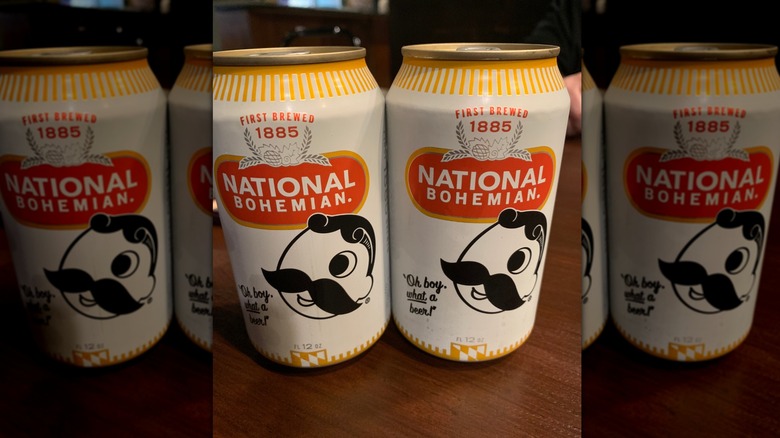
Take a survey of any Marylander you know (this writer included). Ask them what the hometown beer is. Natty Boh, or National Bohemian, is sure to be your answer. For decades, the bevvy was brewed in Baltimore. It maintained a dominant regional profile, sold across the Mid-Atlantic, along with having breweries in Detroit and Miami, too. It's no longer the case that it's a home-grown staple, but during the '60s, Boh reached its peak when its slew of breweries produced and sold more than 2 million barrels per year.
Boh was nearly 100 years old by the time it reached what would be its reigning decade. During the '60s, the brewery expanded; it was the only alcohol sold at Memorial Stadium, former home of the Baltimore Orioles; the company used Mr. Boh as some of the most successful advertisements the beer world has ever seen. It evenly famously promoted Natty Boh via the Chester Peake, a 50-year-old Chesapeake skipjack boat. Despite its powerful '60s presence, National Bohemian eventually faced the same pressure as other regional brewers, and declining sales forced a business sell-off in 1975.
Schlitz
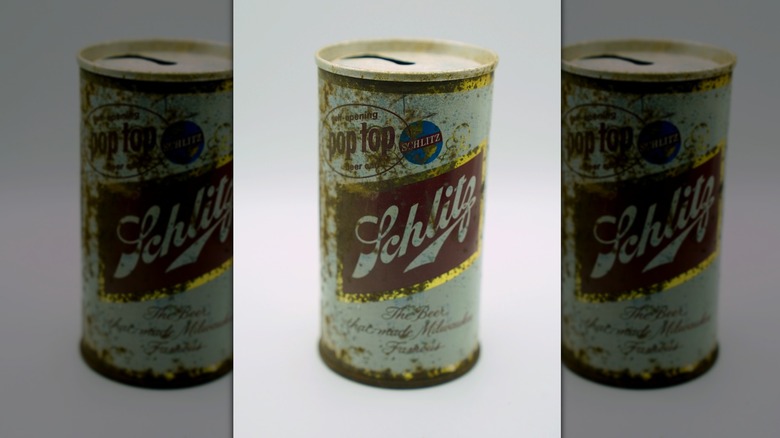
Budweiser, Miller, and Coors are the most familiar names to have ridden the post-war economic wave, and that's because, in some form, those businesses survived beyond the swinging '60s to become national powerhouses. One name that didn't make it as big, despite being massively important to the midcentury decade, is Schlitz beer. "The Beer That Made Milwaukee Famous" had a dominant first half of the century, becoming America's biggest brew in 1902. By 1960, the brewery was humming to the tune of nearly 5.7 million barrels. The brand kept its momentum going with a few key innovations that shaped how Americans drink beer.
First, Schlitz brought the first beer cans with "soft" aluminum tops to market. In '63, the brand followed up by introducing the first version of the pop-top can we all know today. Both inventions were characteristic for a brand that's also credited with being the first to sell beer in brown glass bottles to protect it from degradation. After being at the forefront of drinking vessels that would facilitate a boom in business, and beer drinking in general, it's no wonder that a Schlitz 1960s ad campaign emphasized a beer made (and consumed) with "real gusto."
Carling
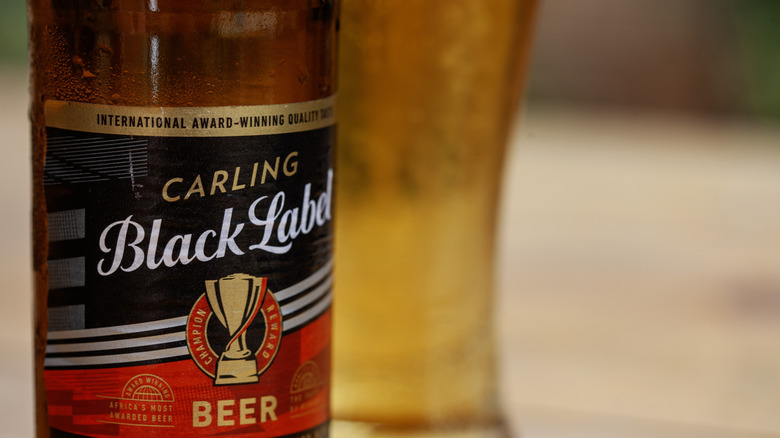
Carling beer has an interesting history that spans decades and international borders. The brewery has been under American ownership, Canadian control, and a mix of the two in the multinational brand Molson Coors. In 1960, the Carling Brewing Company was the fourth-most prolific beermaker in the country, outpacing the company that sold Pabst Blue Ribbon and nipping at the heels of Falstaff Brewing Corp. At its peak, Carling had breweries from Natick, Massachusetts, to Baltimore, Cleveland, and beyond. The brand started its success by selling a Canadian beer called Red Cap, but another one of its flagship brews would become Carling Black Label.
Like many brewskis of the day, Carling found a successful formula as the official sud of several sports teams; in this case, the Cleveland Browns and the Cleveland Indians. Other parts of its success came from standardizing the twist-off bottle cap, which one can imagine making beer much easier to drink. Carling gained more prominence in Britain than it was able to maintain in the U.S., but in recent years, it's staging a comeback.
Ballantine
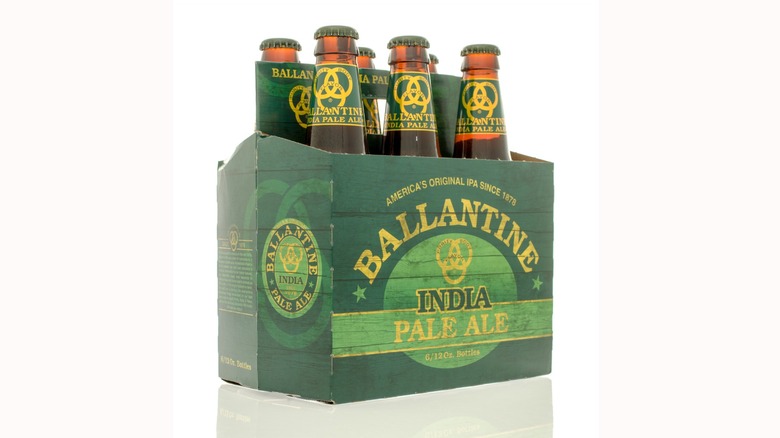
Many of the beers that were popular in the 1960s share a similar profile: light, crisp lagers or ales that were easy drinking. Knowing that, you would be tempted to look at the beers of this era and deduce that America's appetite for bitter and hoppy had yet to develop. You would be wrong, however. The makers of Ballantine, America's "original" IPA, were P. Ballantine and Sons, and they were the 6th-largest brewer in the country in 1960.
The Mets may have had Rheingold, but the Yankees were the team of this Newark, New Jersey, brewery. As a sponsor, it was common to hear the call of "Ballantine Blast" over the radio when a home run was hit. And like a ball hit out of the park, this nationally sold sud spread farther than New York and the Northeast.
Before the craft beer revolution reshaped our palate en masse, Ballantine laid the groundwork. Its strength lay somewhere between 7.5 and 7.9% ABV and around 60 IBUs. This put it in line with plenty of IPAs that are popular today. Although Ballantine started the decade hot, it was running on fumes by the end of it. With worker strikes, antitrust lawsuits filed against its competitors, and a purchase of the Boston Celtics, Ballantine's parent company struggled to make ends meet, and the business was sold in 1972.
Hamm's
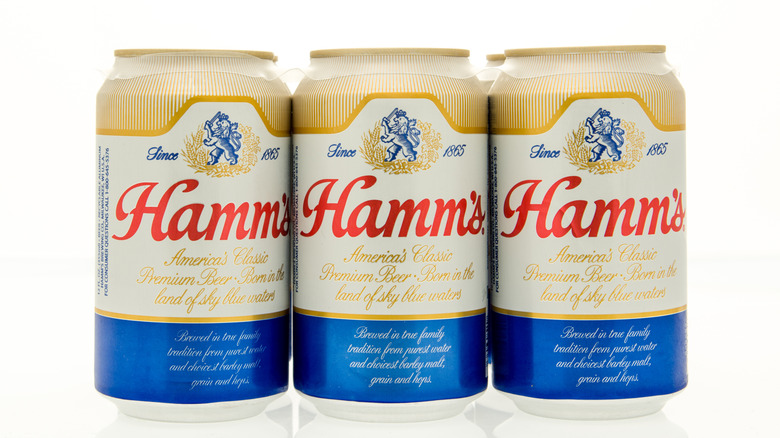
Refreshing as "the land of sky-blue waters," Hamm's beer was created in 1865 in St. Paul, Minnesota, along the headwaters of the Mississippi River. Following its survival of Prohibition and successive world wars, the brand took off. Hamm's beer did not stay exclusive to the Midwest for long, and how could it when the branding was so strong? Hamm's beer leveraged some catchy radio and TV jingles, a delightful bear mascot, and the thirst-quenching flavor of its bright German lager to turn regular beer enjoyers into "Hammpions."
America's classic lager beer remained popular during the midcentury. Unfortunately, it was not immune to the challenges that the rest of the beer industry faced around the decade's end. Mass market consolidation led to intense pressure. The brand was sold to Heublein in 1968. It went on to become property of Olympia Brewing, before it was purchased by Pabst, and then eventually by Molson Coors, which still owns and produces Hamm's today.
F&M Schaefer
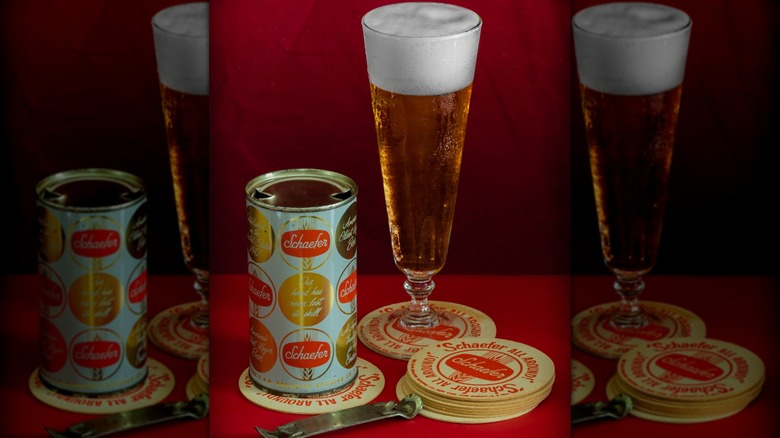
F&M Schaefer Brewing Company is the company you can thank for bringing the lager beer to America; it's widely credited as being the first commercially produced lager in the country. The company was started by two German immigrants in Manhattan, before moving to Williamsburg, Brooklyn, where it steadily grew into a popularity that spanned far across the country. Come 1960, the brewery was America's eighth-largest producer, sending out 3.2 million barrels of its beloved lager to satisfy the masses. By '68, it was 5 million. A year later, F&M Schaefer was public on the Stock Exchange.
Yes, there are a lot of beers that defined the 1960s, but F&M Schaefer is one of the few that also survived it. In fact, the beer was so popular in the midcentury that an F&M Schaefer Center was erected for the 1964-65 World's Fair. Sure, it may not be as popular as it once was. It also may be in production through a former competitor, Pabst. All the same, the flavor of Schaefer's is still a beer worth trying. After all, according to a '60s commercial jingle, it's apparently the only beer worth having if you're having more than one.
Falstaff
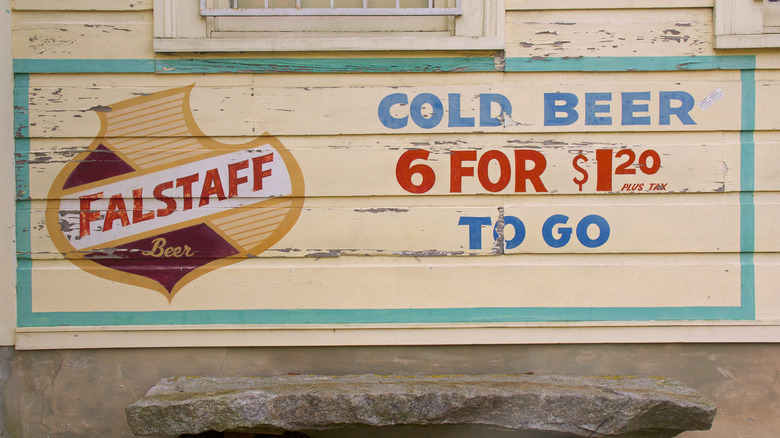
Any list of beer brands that defines the 1960s would be incomplete without Falstaff. Back then, it was the third-largest brewer, behind Anheuser-Busch and Schlitz. It pushed nearly 5 million barrels of beer the first year of the decade. Four years later, Falstaff controlled approximately 6% of the entire American beer market. Competing against the big players required a business strategy that was somewhat unique for the time: Falstaff would acquire regional beermakers and consolidate them in order to grow its footprint. One example is its purchase of Ballantine. The strategy was so conspicuous that it eventually drew an antitrust lawsuit from the U.S. government.
By all accounts, Falstaff lager was a really traditional beer for the time. It tasted comparably to Hamm's: a little bitter, a bit light, somewhat hoppy, but nothing over the top. The company ran advertising campaigns that were similarly ordinary, lacking in the catchy jingles and bold slogans that other breweries boasted, despite its outstanding presence. As it happens, the biggest thing about St. Louis-founded Falstaff was likely its expansive brew plant holdings, including Plant #11, which used to have giant silos shaped and painted like Falstaff beer cans.
Old Style
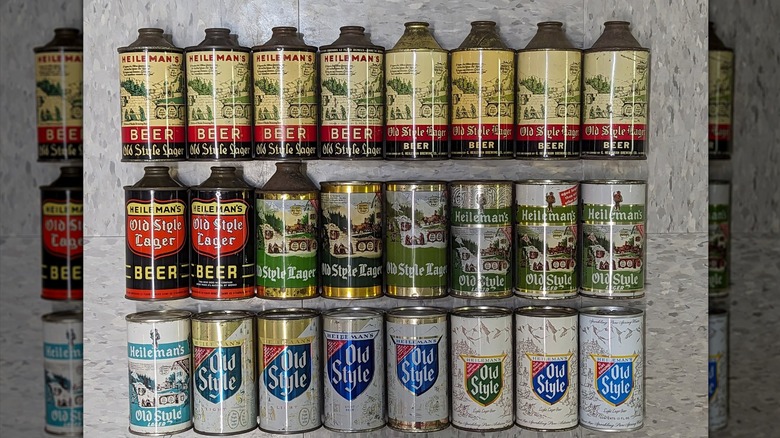
Old Style was once crafted by Heileman Brewery. The beermaker had its home in La Crosse, Wisconsin, but many know it as Chicago's favorite beer. Why did a Wisconsin beer become so popular in Illinois? Baseball, of course. In 1950, Old Style became the official beer of Wrigley Field. It rode that popularity through the next several decades. $31.9 million dollars is no small number to shake a stick at — that's how much Heileman Brewery made in 1966. One can imagine a large portion of that coming from the brand's most well-known beer of Old Style.
During its heyday, Old Style was another beer that benefited from the double-fermentation process known as krausening. The process provided it with a mildly hoppy, sweet cereal-grain flavor. Today, rumor has it that krausening has been dropped, but you can still find Old Style in limited markets. (The beer is contracted and sold by, who else, but Pabst?). It's once again being brewed in its original hometown of La Crosse. Old Style even made explicit appearances throughout the TV show "Shameless," a choice that's representative of local tastes.
Rainier
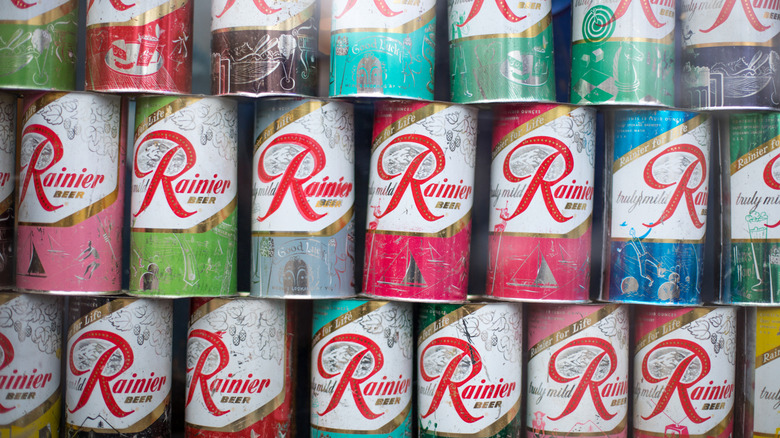
Coors Banquet wasn't the only regional beer that held it down on the West Coast throughout the '60s. High up in the North, Seattle's most famous brewery, Rainier, was pumping out enough of its flagship beer to support the business through a tumultuous decade when many other regionals went bankrupt. Rainier's draw has always been that it is a clean, crisp, smooth-drinking lager. Those were big selling points in the 1960s, so much so that late in the decade, Rainier re-imagined its signature as a trio: Light-Light, Light, and Not-So-Light versions. The company even flew the trio to Europe for a comparative taste testing, and it also ran a marketing campaign that stressed the influence and expertise of the brand's in-house brewmaster.
The 1960s proved to be a transformative time for Rainier, but it has to be noted that this decade was merely a setup for what was to come. Some of Rainier's most innovative and memorable advertisements emerged in the '70s, from galloping beer bottles that rushed the big red "R" across Western landscapes, to the motorcycle-cadenced "Raaaai-nieeeer-beeer." None of which would have been possible without the brand's defining presence in the '60s.
Stroh's
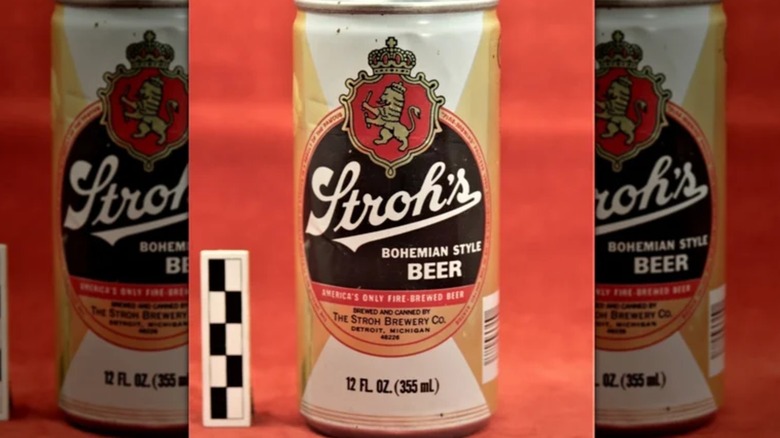
Like Rainier, old timers will undoubtedly say that Stroh's true peak was the 1970s, but the '60s were a massively important to this Detroit brand. The company began business as far back as 1850 and was able to survive Prohibition. In 1964, Stroh's consumed its local rival, Goebel's, which gained the beer its first taste of national sales outside of the Northern Midwest. Prior to 1971, Stroh's was somewhere around the 15th-largest beer producer.
Stroh Brewing Company eventually gained such prominence that it was able to buy Schlitz in the 1980s. But it proved to be a shot in the foot; a move that would eventually put Stroh's on the chopping block itself. With so much money on its balance sheet, Stroh's was unable to fend off the consolidation threats that would come from bigger national brands like Anheuser-Busch and Miller. You can still find Stroh's beer today, but its eponymous sud no longer benefits from the fired-kettle process that once imparted a deeply caramelized malt flavor.