

9 Classic Cowboy Staples Many Would Consider Inedible Today
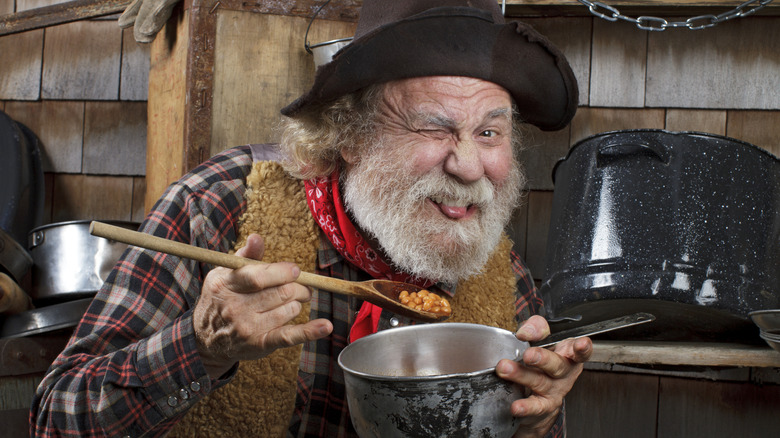
Real talk: Cowboys absolutely had it made. There's no denying the fact that saddling up a trusty horse and setting out into the vast expanses of the Wild West has more than an allure. It's calling to us like a siren song we would be more than happy to answer, consequences be darned.
Riding the dusty plains during the day, sleeping under the stars at night? That's the kind of thing that a person could get used to, but ... there is a bit of a catch. You can't exactly DoorDash some Taco Bell to middle-of-nowhere, what-state-is-this? Grocery stores were few and far between in the heyday of the cowboy, and a restaurant wasn't going to show up until the next big town. While some foods were perfectly lovely — cowboys often carried sourdough starter with them as a trail staple — others would leave something to be desired when it comes to satisfying our 21st-century taste buds.
We're going to talk about those now, and first, a disclaimer. Sure, some of these things might occasionally make their way onto menus and into food festivals these days, but we're fairly certain they'll get a polite, "Thanks, but no thanks," from many. We actually kind of know this because, along with our research into what old-timey cowboys ate, we also found some absolutely incredible writings by settlers from the East who headed west and found themselves on the ol' cowboy diet. Were they occasionally horrified? Yes. Yes, they were.
Son-of-a-gun stew
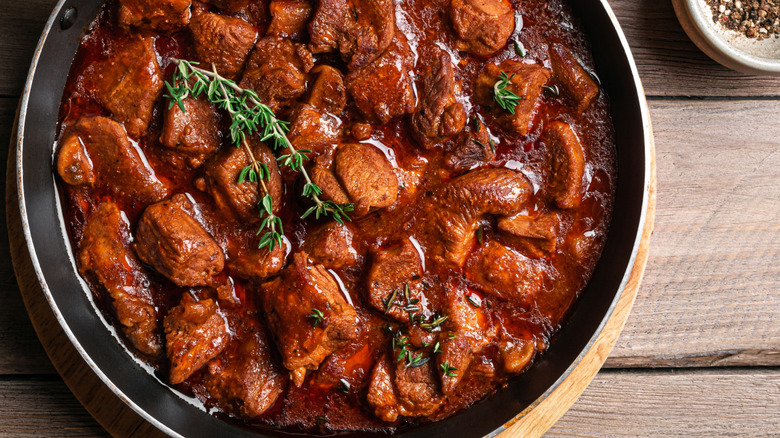
If you're like us, you probably have some hot and hearty stew recipes for days you just need a little comfort food hug. It's unlikely any are for a cowboy-style son-of-a-gun stew ... at least, not the way they would have made it in olden times. There are plenty of modern updates to this cowboy classic, with most calling for beef stew meat, vegetables like carrots and onions, maybe some barley and peas, or even venison. Tasty, right? Only, it's not entirely accurate, historically speaking.
When you're out on the range, you make the most of what's on hand — and you don't waste anything. Real deal son-of-a-gun stew was described in Alan Davidson's "The Oxford Companion to Food," and in it, he referred to it by another common yet less family-friendly name than the one we've chosen. Davidson wrote that it was a rather unique thing, made with pretty much every part of a calf — including the brain, heart, liver, tongue, and sections of the stomach called the marrow gut.
Marrow gut was particularly prized because when nursing calves were slaughtered and the marrow gut harvested, the semi-digested milk still contained in the stomach was totally delish. The old-timey recipe also included sweetbreads, and if you're wondering what sweetbreads are, you're darn tootin' we're going to tell you. That's the thymus gland, and sometimes, it's the pancreas. Sweetbreads often have a little eau de iodine going on, which honestly goes a long way in explaining why they're not super popular anymore.
Rocky Mountain oysters
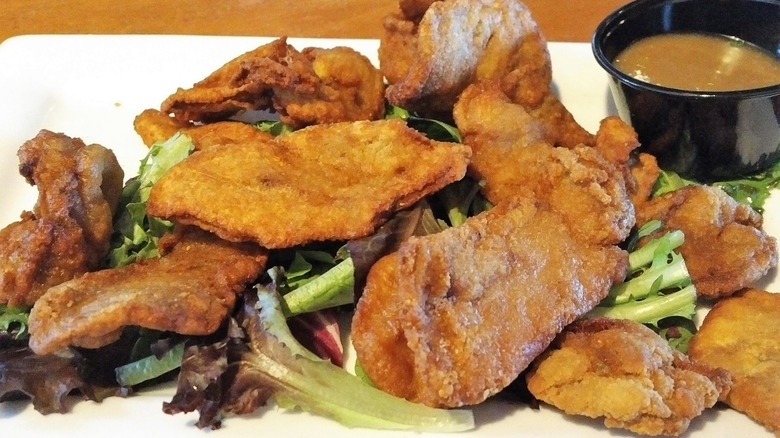
Some moments in life are to be cherished, like the moment you bring home a new puppy, baby's first steps, and the look on someone's face when you tell them what Rocky Mountain oysters really are. There are a number of other names that you might hear these old-school frontier foods called by, and while monikers like cowboy caviar, Montana tenders, and calf fries are perfectly fine, there's also swinging beef, which is extra hilarious if you know that we're talking about testicles here. (We also like huevos de toro, which literally translates to bull eggs.)
Cowboys had to deal with all stages of life for their herds, and that included that special time of year when calves were branded and castrated. The removed organs were skinned, oftentimes fried, and when they popped? Well, that's when you knew it was eatin' time! As for what they taste like, imagine something like a piece of calamari with a little bit of chicken flavor, and you've got the idea.
And yes, this deceptively named dish still has a number of festivals that celebrate it. Those who attend are likely to find these forbidden pickles served in all kinds of ways, from fried to smoked, sliced to whole. Call it a testicle festival or a nut fry; it might be a part of cowboy lore, but it's definitely not for the faint-hearted.
Anything cooked over cow and buffalo dung
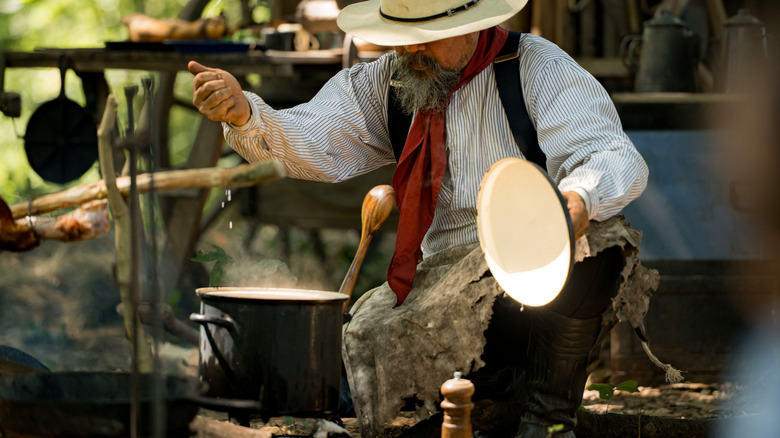
Imagine, for a moment, a group of rough-riding cowboys driving a massive herd across the open plains of the West. There are big skies and horizons that seem to go on forever, but what's missing from that picture? If you said trees, you're correct — and that means when it came time to make camp and light a fire, cowboys sometimes had to get creative. Many big cattle drives were accompanied by a chuck wagon, which would usually have a stash of dried cow or buffalo dung for those times that wood was nonexistent, but everyone still needed to eat.
To be fair, there are probably worse things that could have been used. Still, if you've ever been to a cookout, you'll know that the food can kind of take on the taste and smell of the wood you use and the smoke that comes off of it, so that could definitely be a concern.
Journals written by settlers traveling west reference just how much it was a bit of a culture shock for East Coast folk to realize they were going to be cooking over dung fires. Hilariously, some tried to improve things by renaming cow chips bois de vache, which translates to "wood of the cow." Collecting chips was the responsibility of pretty much everyone, and while some raced to try for the dubious honor of collecting the most, others found themselves carefully watching the cook for signs of cross-contamination. Yum!
Sowbelly
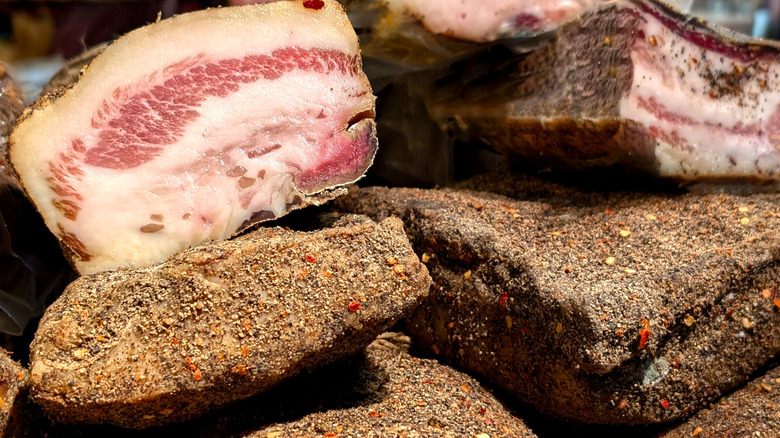
At a glance, sowbelly seems as though it would be perfectly right at home on any modern charcuterie plate. It was basically salt-cured pork, and as the name suggests, it was usually pork belly. It was such a cowboy staple that it would often make an appearance at every meal, but here's the thing: Salt pork was prepared in a way that essentially subscribed to the theory that it was impossible to have too much salt, and if you were making it and wondering if you had enough, you were better off just dumping another bag in there.
Refrigeration wasn't exactly a thing, and salt pork needed to hold up to some extreme temperatures and long weeks on the trail. Sowbelly was so salty that it had to be soaked for a long, long time before anyone could even attempt to eat it, and we're talking about hours of prep time. If it didn't soak long enough, anyone who ate it was going to be sick.
Salt pork and salt beef were also a staple for soldiers during the Civil War, and we have some records of just how awful they found it. The salting and pickling it went through was so extreme it often turned the meat a color that was somewhere between yellow and green —with an occasional rusty vibe — and as for the smell and the taste, it was so bad that it sent everyone running for them yonder hills.
Coffee
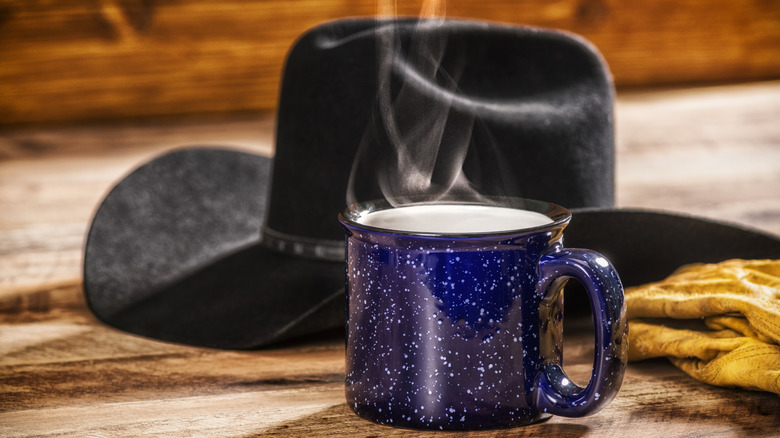
Cowboys tended to have their own ideas on coffee as well, and if you're wondering what cowboy coffee is, the short answer is it was strong and hot. That short answer is something of an understatement in both cases.
It was a case of the stronger the better, as coffee was a staple in a world where cowboys might find themselves riding for as long as 60 hours without a break. One of the ways they used to guarantee a seriously powerful brew was just to keep adding coffee grounds to the pot. No, not emptying the old ones, but rather just ... keep 'em coming. (Think of that next time you grind too much and are bummed that they're not going to be as fresh tomorrow.) Oh, and sometimes, eggshells were added to keep the grounds at the bottom of the pot.
It wasn't just expected to be powerful stuff; it was expected to be so hot that anyone who wasn't used to it would find it absolutely untouchable — and ordinary folk often couldn't stomach a cup made the cowboy way. Even if near-boiling coffee sounds like your thing, keep in mind that sometimes, coffee came with a little extra surprise. One account tells the tale of a party where cowboys and their guests danced the night away under the Texas sky. Unfortunately, it wasn't until the massive coffee pot was almost empty that someone realized that everyone had been drinking coffee flavored with some curious — and ultimately, boiled — lizards.
Two-ingredient gravy
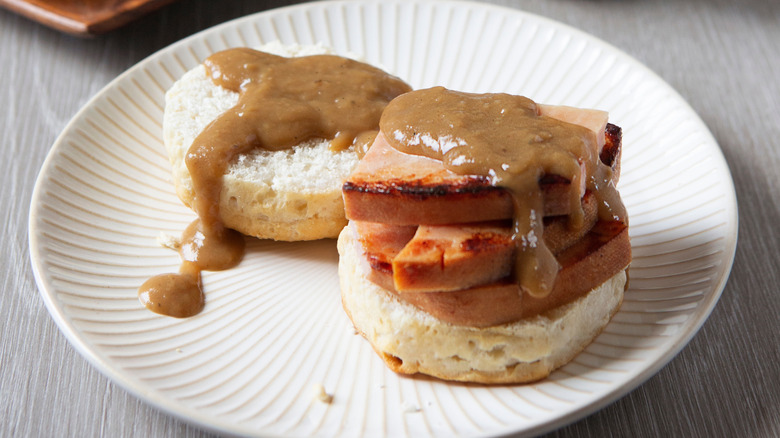
We love super easy, two-ingredient recipes as much as the next person, and when we learned that you can eat like a cowboy with a two-ingredient red-eye gravy, we were intrigued. The two ingredients in question were coffee and grease, which is definitely an interesting way to make the most of what you have on hand. Honestly, we respect that.
Red-eye gravy is still very much a Southern staple, often made with what's left in the pan after you've fried up some ham. Using ham makes sense — there's no need to add salt, after all, and we'd imagine that if you were making this after frying up some sowbelly, you'd be set on your sodium for a week. It makes sense that this would have been a convenient way to make a gravy without easy access to dairy. (Dairy cows weren't guaranteed to be a part of the herd, after all.)
Still, we also have to add that while this is still on plenty of tables in the South, making it the cowboy way might be a little polarizing. Not only is there the chance for extreme saltiness, but cowboy coffee is, well, also extreme. There would have been a good chance that the coffee grounds would have been used many, many, many times, meaning that it's safe to say that the coffee used for the gravy probably wasn't the freshest around.
Hardtack
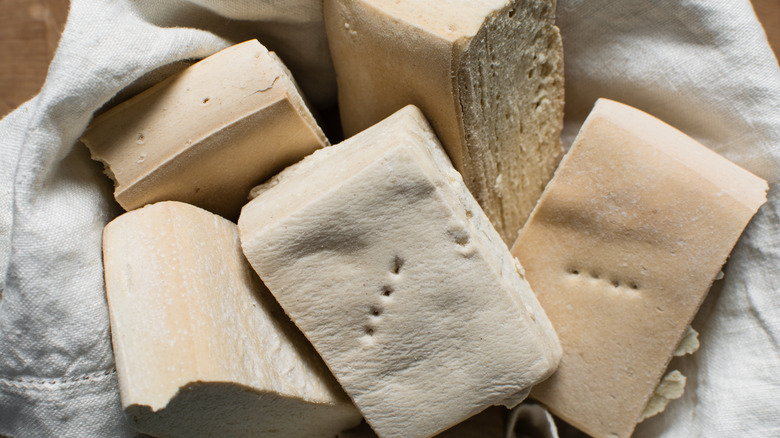
The accurately named hardtack has been around for centuries, going all the way back to ancient Egypt and Rome. It's easy to make if you want to try some: use about a 2:1 ratio of flour and water, add a little salt, roll, poke some holes in the surface of both sides to keep it flat, and bake. Seriously, that's it. Well-dried hardtack will keep for years, and since it was easy to carry and didn't spoil, it was a cowboy staple.
It did, however, take some work to make it into something edible. Often soaked in coffee or thrown in a frying pan with whatever was on the menu for breakfast, this stuff was notoriously hard. That helped give rise to nicknames like "molar breaker" and "tooth breaker," while another name was even more terribly descriptive: "worm castles."
It's precisely for the reason you're thinking. Hardtack tended to get infested with all kinds of bugs and maggots, but the good news is that when you soaked it in that super-hot coffee to soften it up, that also tended to kill most of them. The bad news is that maggots would float to the surface of your coffee when they died, so congratulations, that's disgusting now, too. Writings from Civil War soldiers give us some insight into just how bad bug infestations could get, with one recording the fact that he found 32 worms in a single piece of hardtack that measured roughly 3 x 3 x 0.5 inches.
Bear
Food safety and knowledge about things like the importance of cooking things to a proper temperature weren't really front and center in cowboy cooking, and food poisoning happened often, with a vengeance. That chuck wagon cook? They're not exactly keeping on top of thoroughly washing their hands after throwing some of those dried cow chips on the fire, are they?
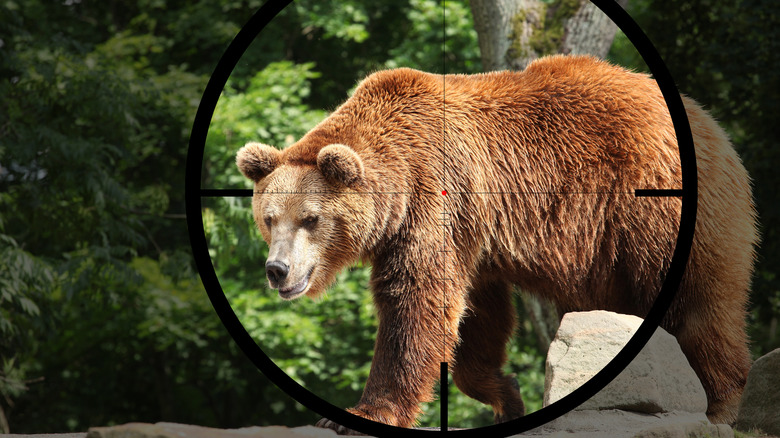
Meat contaminated with things like E. coli was a risk, and different types of meat came with an even greater danger. Some food came from the land, and sourcing eggs from the nests of wild birds wasn't uncommon. Occasionally, bears and other wild animals could make it onto the menu, and if you know anything about bear meat, you know that can be a huge problem.
A slab of bear meat can come with a not-so-healthy helping of something called Trichinella spiralis, and it's commonly found in other wild animals — like hogs — as well. It's so common that even today, it's recommended that you just kind of assume any bear meat has the parasite present, and you absolutely will get sick if you eat improperly cooked meat. It's nasty stuff that can include swelling eyes and major gastrointestinal consequences, and if the worms find their way into your heart or brain, it's deadly. Chuck wagon cooks weren't using meat thermometers to make sure they were in the all-clear, so this one would be an absolute no-go from us, thank you very much.
Meat from sick and dying cattle
There's a lot to be said about not wasting meat — or any food, for that matter — and we're all about that. However, we do feel that it's reasonable to draw the line somewhere, and when it comes to cowboy cuisine, we'd argue that it should probably be drawn at the slaughter and butchering of any cattle that couldn't keep up with the herd. That occasionally happened, and such animals' meat would of course end up on the menu.
However, there are some major problems with that, and it starts with the fact that cattle who can't walk are at a high risk of anything from carrying E. coli or salmonella to conditions like mad cow disease. Compromised cattle might also have heart disease, liver disease, or other conditions that might make the meat questionable at best, and when animals are butchered out on the range, that increases the likelihood bad things will happen to anyone unfortunate enough to eat it.
Say your chuck wagon cook is going to butcher a cow that's dropped. Slicing and dicing on the dusty ground where an entire herd of cattle and not a few horses have been doing exactly what nature intended is going to leave everything open to some serious contamination, and if you're not a fan of using cow chips for cooking fires, you're definitely not going to want a rare steak with a smear of dung and dirt. That's how you get food poisoning — and regret.