

The Classic Cowboy Dessert That Tasted A Lot Like A Modern Breakfast Favorite
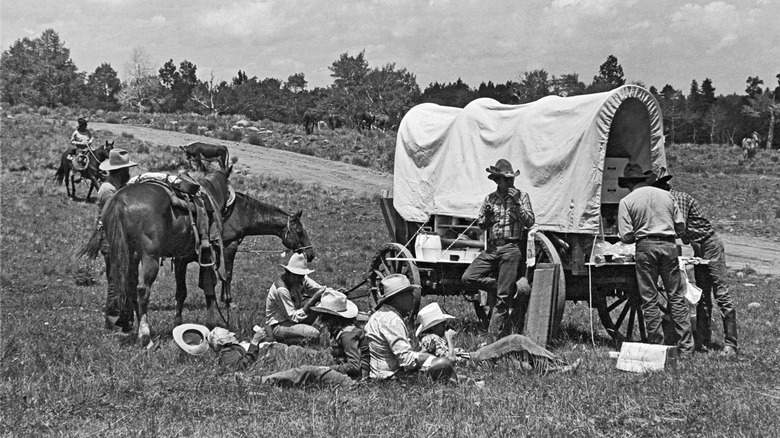
As Texan cowboy poet Red Steagall once observed, "There's nothin' in life that's worth doin', if it cain't be done from a horse." Fellow cowboys might agree, but with one exception: It's worth hopping off the saddle to chow down on some bear signs. On the open trail, desserts were a chuck wagon rarity. "Bear signs" were donut-like treats enjoyed across the Old West, consisting of deep-fried cinnamon bread sprinkled with powdered sugar. The somewhat involved preparation made this treat highly sought-after by Texas cowboys, who would make special trips out of the way just to get them. Per the lore, ranch hands may have even accepted bear signs in place of wages during times of scarcity.
Historically, bear signs were an offshoot of the modern donut, which originated across the country in New York — a confectionery creation of Dutch immigrants in the 1700s and 1800s. Considering the heyday of the American cowboy erupted across the Southwest around the early- to mid-1800s, this unique dessert's gradual westward spread aligns. Since deep-frying sugary dough is an involved recipe for frontiersmen on the move (not to mention the oft-scarcity of confectionery ingredients), cooks devised bear signs as a doughy adaptation. The donut's now-ubiquitous center hole wasn't introduced until around 1850, and aptly, bear signs were typically hole-less.
Bear signs were an adaptable offshoot of 1800s donut holes
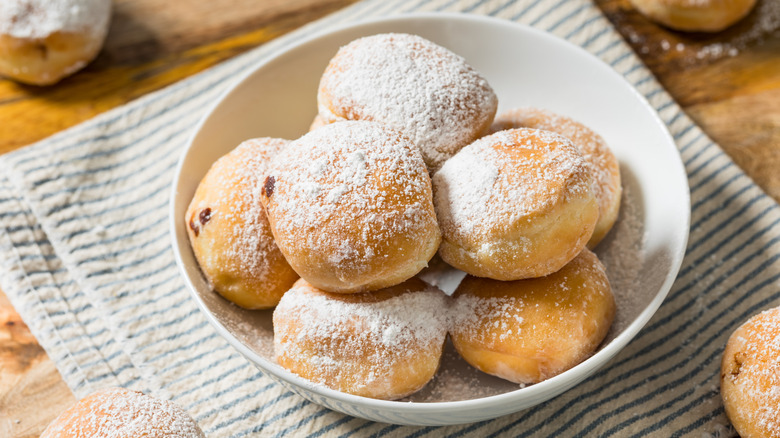
To make bear signs, buttermilk, eggs, sugar, and melted butter are whisked together in a bowl. Then, in a separate bowl, baking powder, salt, cinnamon, and flour are likewise whisked before being mixed in with the wet ingredients. The mixture forms a stiff dough, which is then rolled into coarse, quarter inch-thick pieces, then browned in a skillet of hot oil. To finish, fried bear signs are drained on a towel or brown paper bag and topped with a generous coating of powdered sugar.
Perhaps unsurprisingly, the dessert often appears in the works of renowned Western novelist Louis L'Amour, notably in "Hanging Woman Creek." In fact, in his novel "The Empty Land," one character recounted their popularity: "'I've known cowhands to ride sixty or seventy miles because they heard somebody was making doughnuts,' he said. 'We used to call them bear-sign.'" On the utilitarian front, bear signs' minimal ingredients lineup (which consists heavily of non-perishables) was also simple enough to be transported by trail cooks, if space permitted.
To complete the meal, bear signs would have paired fabulously with a cup of cowboy coffee, another rustic commonplace of the time. These cowboy donuts are just one of the various dough-based treats enjoyed in the Old West. Cowboys counted on jars of sourdough starter to fill up, a staple for making biscuits. More comparable to bear signs, cowboy bread (also called camp bread or "bread de campo") was a similarly skillet-fried, highly portable fare that could be prepared over an open fire.