

The Beautiful, Natural Countertop Material You Should Be Cautious Of Before Buying
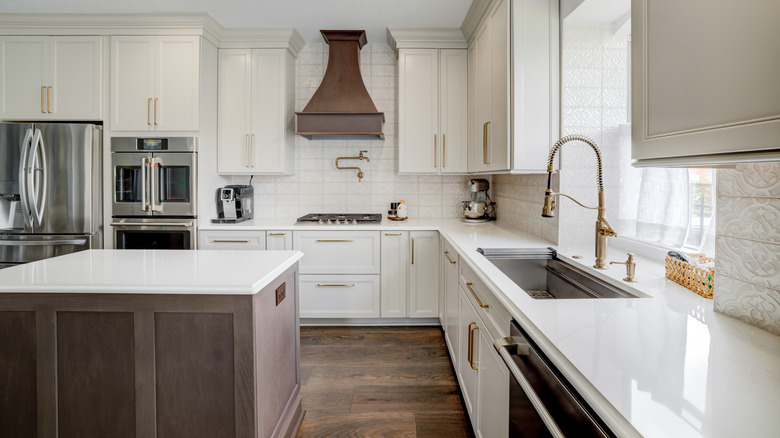
To get the most out of a big investment, like a new kitchen countertop, proactive knowledge is power. For centuries, aesthetically-minded folks have been choosing travertine – a type of natural limestone formed around freshwater mineral springs. This building material has been used since ancient Roman times, and in modern kitchens, travertine offers advantages like affordable price point and versatility, able to complement warm wooden cabinets and sleek appliances alike. Its subtle color striations create dimensionality and a sense of movement, making it a favorite among Mediterranean and farmhouse-style interior design concepts. Still, what travertine countertops offer in a naturally graceful appearance, they somewhat lack in durability.
For starters, the stone is highly reactive with acids, making it more susceptible to staining in the presence of lemon juice, vinegar, and wine. With any kitchen countertop material, acid-related surface etching or dulling occurs when the acid dissolves a trace of the stone's calcium carbonate – and because travertine is made of mainly calcium carbonate, its ability to withstand this type of exposure is limited. Owners should stick to alkaline-based cleaning agents to be safe.
The other chief liability when it comes to travertine countertops is the stone's natural porosity. Its surface can trap food and bacteria as well as absorb liquids, leading to stains or even a potential food safety issue. Due to these hazards, maintaining a strong coat of sealant is crucial to preserving a travertine countertop's lifespan.
Travertine countertops are initially low-cost, but require annual resealing
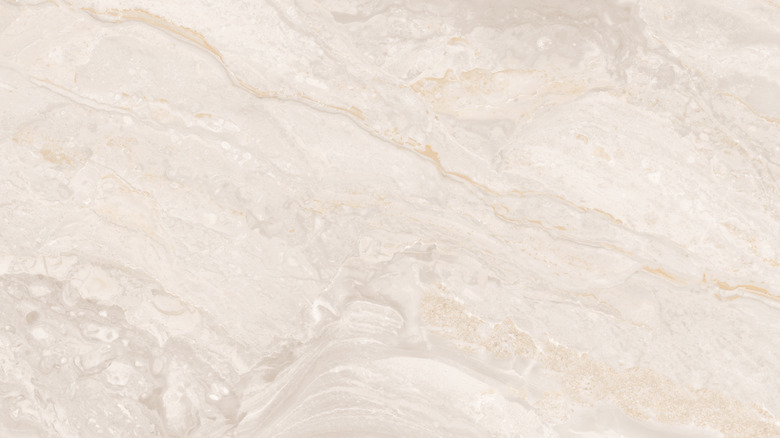
Travertine owners should plan to reseal their slab countertops every year or every other year – an ongoing maintenance requirement that can make the material's low initial cost a tad less appealing. Pro tip: If you like the soft earthy tones and organic feel of travertine, but don't want to keep up with annual resealing, consider instead investing in durable soapstone countertops that only get better with age. They're initially costlier than travertine, but have much lower maintenance over time.
Still, despite the upkeep, travertine offers just as many advantages. While it may be more liable to chips and cracks than other natural stones, travertine's hardness ranges from three to four on the Mohs scale, softer than granite (six to seven) but comparable to marble (which also falls at three to four hardness). After all, the material is good enough for the Roman Colosseum and the Willis Tower in Chicago. Travertine countertops are also much less costly than the likes of marble (roughly $25 to $60 per square foot) while offering a similarly upscale look, as well as a comparable heat resistance level. Still, sliding a cooling rack between hot pans and a travertine countertop is a good idea to prevent damage.
Aesthetically, travertine straddles the intersection between elegance and warmth, neither overly modern nor overly familiar. To enjoy its look without having to shell out for regular maintenance, consider installing a travertine backsplash instead of a countertop. Whether you call them a 2000s kitchen trend we all suffered through or the foundation of a charming Tuscan-style kitchen, travertine tile floors have also been popular, and can help preserve the stone's appearance over time compared to a high-action countertop workspace.