

If Powdery Mildew Appears On Your Cucumber Plants, Here's The Best Treatment
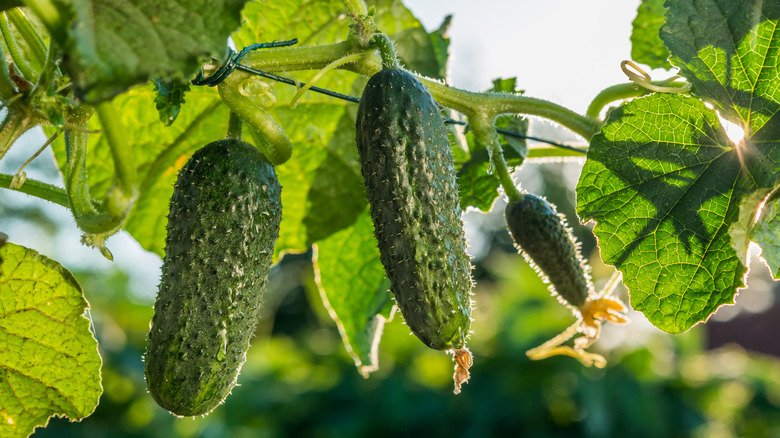
Growing cucumbers in your home garden is easy, but it's important to be aware of potential problems that could threaten the health or quality of your crop. Some of the most common issues that affect cucumbers are a bitter taste, poor berry or flower formation, small fruit, insect damage, bacterial wilt, and fungal diseases like powdery mildew. Modern cucumber varieties actually have some resistance to powdery mildew, as they have been cultivated to be disease-resistant. However, weather, plant location, and environmental factors may still increase disease risk.
The earliest signs of powdery mildew are yellow spots on the leaves, followed by white, powdery spots that expand across the entire leaf and stem. You may also notice that the cucumbers are smaller than usual, that they ripen faster than they should, or that they look sun scorched. Should you see any of these problems with your cucumber crop, act quickly, as the disease can spread rapidly to other crops and neighboring gardens. Rather than using milk to fight mildew in your garden, the best treatment for powdery mildew on cucumber plants is the application of a topical fungicide.
A fungicide is a pesticide that prevents, inhibits, or kills fungal growth and spores. A topical fungicide is applied directly to the surface of the plant, where it is absorbed into its tissues and circulated throughout its system to kill the disease and keep it from spreading. Only use a fungicide containing copper or chlorothalonil, like Daconil. Spray it on to ensure full coverage, and only apply it in dry weather. Reapply the treatment if it rains and/or as often as recommended on the product label.
The best defense against powdery mildew is preventing it from infecting your cucumbers in the first place
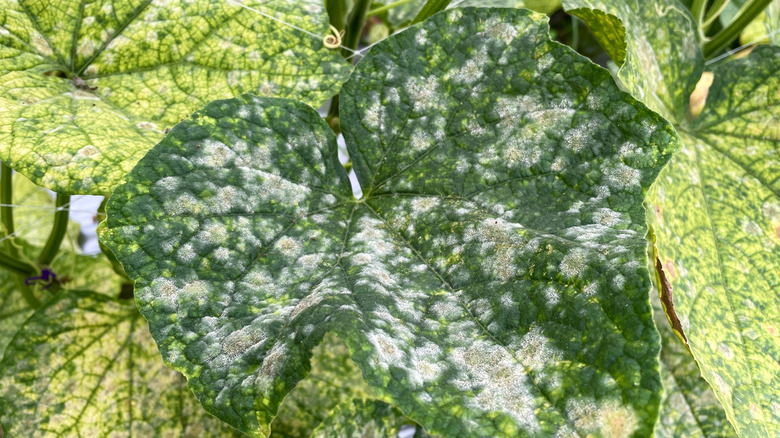
The best way to protect your cucumbers from powdery mildew is to take preventive measures to keep the disease away from your crops. Start by familiarizing yourself with the ideal conditions for disease growth and transmission. Temperatures between 68 and 81 degrees Fahrenheit, high humidity, low light, and crowded plants may create the perfect environment for powdery mildew growth. The pathogen can also be easily carried via wind from one garden to another.
Then choose a cucumber variety that has been cultivated to resist powdery mildew, such as Brickyard, Diamondback, or Lagos. Next, make sure you place seeds far enough apart and thin seedlings once they have sprouted. Cucumbers are a vine plant that requires a lot of space to grow, and planting them too close together can increase the risk of powdery mildew. If planting on hills, each hill should have four or five seeds; however, once the seedlings start to sprout, you should cut them back to two or three per hill. If planting in rows, place seeds 6 inches apart and once they have sprouted, thin the seedlings to leave 15-18 inches between each plant.
You should also keep your garden well-tended to prevent overgrowth. Overgrown or dense foliage can prevent proper light infiltration and create the perfect warm, humid environment for fungal growth. Maintain your garden by regularly removing weeds and pulling up volunteers to improve air flow, light penetration, and healthy growth. You can also use a trellis and grow bag combo that works wonders for cucumbers, ensuring better air flow.