

I Visited The Iconic NYC Steakhouse Frequented By Teddy Roosevelt
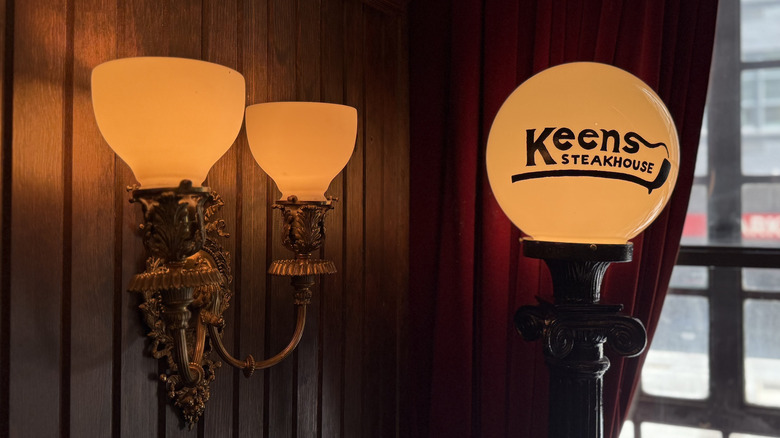
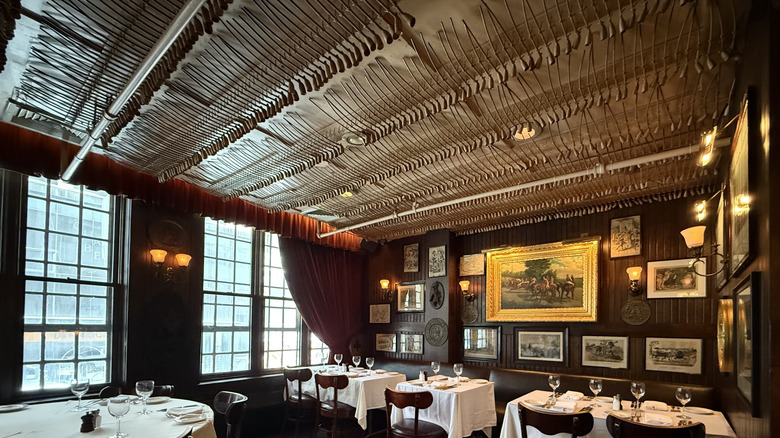
At 72 West 36th Street in New York City, where three former townhouses were once merged into a single building, an unassuming yet beautiful castle-like fortress stands. Outside on a brown awning reads "Keens Steakhouse," underlined by a long, white pipe, with the establishment date of 1885. Walk through its wooden front doors, and you're immediately transported back to a bygone era filled with pipe smoke and well-dressed folks devouring generous plates of mutton chops. White, long-stemmed churchwarden pipes cover the entire establishment from wall to literal ceiling, including ones that touched the lips of such American luminaries as Babe Ruth and Buffalo Bill. Once your eyes focus in on Keens' mahogany wooden walls, you'll notice that they fortify its numerous themed rooms, which each contain their own magical personalities. The walls are filled with almost a century and a half of theater and political memorabilia and paraphernalia, as well as glances at photos and imagery of Keens' own illustrious past.
There are words the restaurant put to print in 1941 that were true then and even truer now: "Keens has always attracted people who appreciate the best of food served in surroundings congenial to its keenest enjoyment." In 2026, I happily came through these hollowed doors, hosted by Keens' general manager Julia Lisowski, to explore its rich history. And now, I'll relay to you, dear reader, why it might not just be New York City's most quintessential dining establishment, but its edifice, as well.
How a theater club begat a New York dining institution
A group of professionals from the world of theater broke bread at Delmonico's, another New York institution, and decided to form a bohemian club called The Lambs in 1874. The club's headquarters moved over a handful of times before settling in 1896 on a four-story brownstone located at 70 West 36th Street, where architectural firm McKim, Mead, & White spearheaded remodeling. The brownstone had dining rooms, a bar, living rooms, reading and writing rooms, a billiards room, space to hold their own shows called gambols, and as The New York Times described, the clubhouse also had a "snuggery" as well as a room that was "more of an old Dutch kitchen than a café."
The story goes that Albert Rabbitts Keen, who was also once the manager of the Marie Antoinette hotel and Manhanset House in Shelter Island, held similar duties for the Lambs Club. The back of the clubhouse butted up against the Garrick Theater, and with a connecting door, actors would stream in with Keen supposedly feeding them between shows. The Lambs Club eventually outgrew the space and headed north to Times Square, and in 1905, John P. Kirwan leased the building for a new English chop house restaurant to be run by Keen. Within a year, things were already going quite well, with the Press of Atlantic City reporting, "Mr. Albert R. Keen is said to be meeting with excellent success in the management of 'Keen's' a chop house, very comfortably and desirably located at No. 70 W. 36th Street, New York."
While much has stayed the same over time, many things have changed, including losing the "English" from its "Chop House" name and even eventually ditching the possessive apostrophe to turn Keen's into just Keens, as it stands today.
Smoke 'em if you got 'em — Keens and its legendary pipe collection
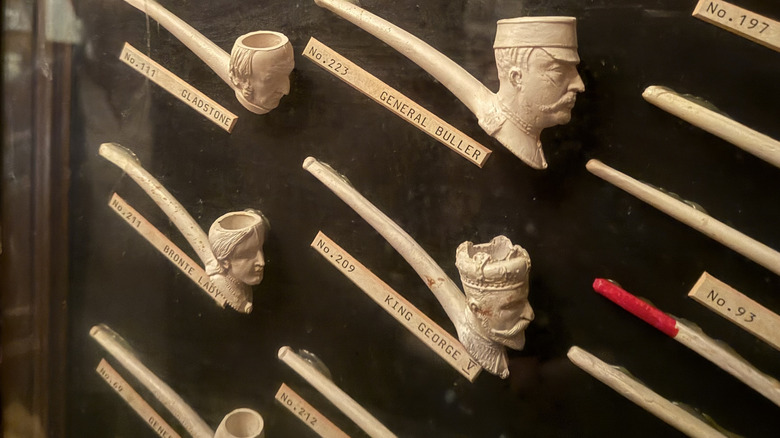
Keens is steeped in many ye olde English traditions, including storing clay pipes of customers in a dedicated room, so they don't have to worry about breaking them while traveling. Albert Keen started the tradition, and for a $5 lifetime membership, anytime one came in, a pipe boy would fetch it, along with tobacco and matches. It became so popular that over 90,000 pipes were cataloged and stored at Keens. Inactive members had theirs placed on the walls and ceilings, which would help forge Keens' unique look. Memberships were offered up until the late 1970s.
Back in the 1930s, a pipe registry book used to sit out in the open, but one bad seed swiped it, depriving the restaurant of 5,000 signatures, including the likes of Theodore Roosevelt, William Howard Taft, and Buffalo Bill. The famous pipe display case that welcomes guests in Keens' lobby used to be unlocked, but that changed after Albert Einstein's was jacked sometime in the early '80s.
The clouds of smoke disappeared for good in Keens back in 2003 when a smoking ban went into effect for New York City. While the tobacco is absent at today's Keens, the pipe tradition continues with contemporary celebrities and other notables being made honorary pipe club members by the restaurant and are sold to guests at its little gift shop. Keens orders about 1,000 a year from the same place it always has — Royal Delft of the Netherlands — making Keens one of the largest importers of clay pipes in the entire world. Relatives of deceased members still come in looking for their loved one's pipes, and Keens always tries its best to locate them.
Theodore Roosevelt still has a seat at the Keens table
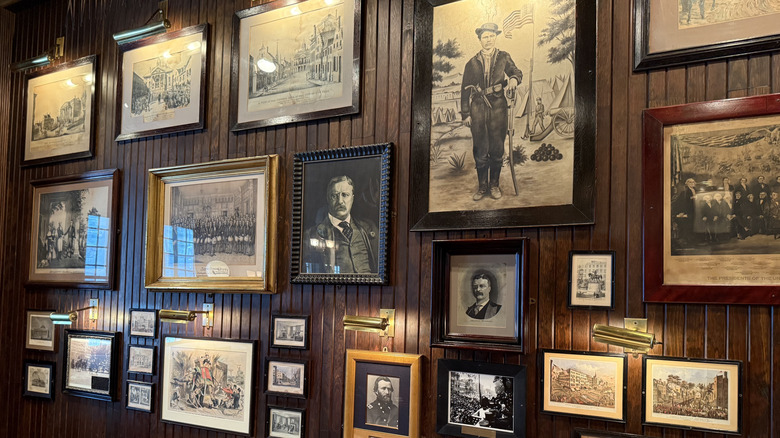
When Theodore Roosevelt was New York City's police commissioner, he reportedly held meetings and enjoyed meals at Keens. In 1901, Albert R. Keen even wrote a letter to Roosevelt asking for an autographed photo (via Theodore Roosevelt Center), noting, "I shall appreciate it more than I can tell you. And I trust you will excuse me for troubling you." Roosevelt died in 1919 at the age of 60, but even later that same year, his eldest son, Theodore Roosevelt Jr. dined there.
Today, Roosevelt's legend still looms large at Keens, particularly in a room nestled in the heart of the second floor that is dedicated to him. Today, its wood door displays a brass plate reading "Bull Moose Room." Below it, fittingly, is a small but detailed bust of the man who owned that nickname and was the Bull Moose progressive political party's presidential candidate for 1912.
Enter through its door and you'll find one of the coziest confines, and my personal favorite room in the entire building. A dark burgundy carpet covers the floor, with warm red drapes adorning the windows, and dual opal glass globes in the far corners, with the classic Keens' pipe logo etched in both. David Lynch could have easily used this room for a "Twin Peaks" setting. It also houses one of the two working fireplaces in the entire building, and the only mounted moose head as well. Naturally, there's plenty to ogle on the walls, from Roosevelt paper ephemera like an invitation to his inauguration, as well as cherubic artwork and even a fun newspaper clipping displaying a map showing rates of birth of children in various districts of New York.
Lillie Langtry breaks the mold, opening the doors of Keens for women
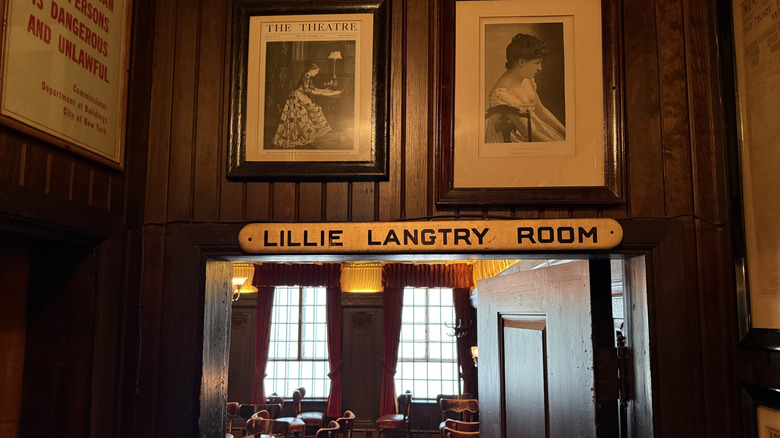
Lillie Langtry was one of the first British women of society to try her hand at stage acting. Her nickname was The Jersey Lily, and her work and beauty won the admiration of King Edward VII, audiences on both sides of the Atlantic, and even Oscar Wilde, who allegedly said (as described in "The Secret Life of Oscar Wilde"), "I would have rather discovered Mrs. Langtry than have discovered America." However, that wasn't good enough to be admitted to dine at Keens, which at the time was a men's-only establishment. After being refused service, she sued and won the right to enter its doors. This landmark moment forced founder Albert R. Keen to change his tune and advertise, "Ladies are in luck, they can dine now at Keen's."
Langtry and a party of ten, which should have included famed producer David Belasco, but he fell ill, were welcomed to a special dinner on October 10, 1906. A special menu was prepared, which included such opening numbers as clear green turtle soup, entrees like fillet of English sole with julienned potatoes, and desserts like "fancy forms," with sips of spirits like Amontillado, G. H. Mumm's Selected Brut, and Apollinaris. A copy of this menu proudly hangs in a staircase hallway that leads to a room named in her honor.
Keens had even expanded to a second location on 44th Street, fittingly next to the Belasco Theater. It was known as Keen's Ladies' Chop House, which was described as both a restaurant and hotel for bachelor girls. Actor Irene Dunne was once photographed there with friends, pipe in hand, naturally. Sadly, by the mid '30s, this location had shuttered.
Abraham Lincoln's legacy lives on at Keens
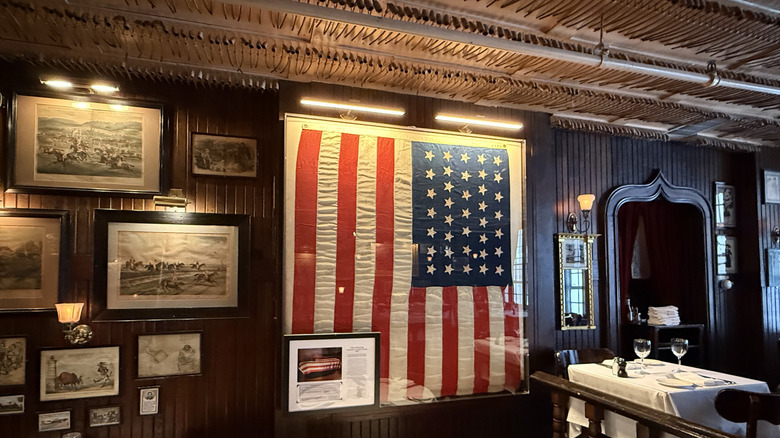
Abraham Lincoln sadly never got the chance to smoke a pipe at Keens. However, you'd think otherwise when you reach the restaurant's second floor and see an open room dedicated to his greatness. This love affair with The Great Emancipator began way back in the early days with the Lambs Club. "The actors were really enamored of Lincoln and his policies and what he was trying to do for the country," general manager Julia Lisowski explained. "So people just kept giving them different Lincoln souvenir memorabilias ... and so, the Lambs Theater Club became a magnet for all those things."
One of the centerpieces in Keens' Lincoln collection is a playbill for Ford's Theatre production of "Our American Cousin," which was the play he was watching when he met his untimely demise. This playbill was reportedly found under Lincoln's seat stained with blood in the theater box by a theater's carpenter. While it may seem sacrilege, there is also space reserved on the wall for Lincoln's assassin, who himself was an actor — John Wilkes Booth. There are photos and drawings of him, even his mother, pages from his diary, a playbill from one of his shows, a wanted poster, as well as a replica of the derringer he used in the assassination .
However, a new old item that Keens came into possession of by way of the Fertitta Foundation has perhaps eclipsed every other item of importance in the building — the United States flag, with 37 stars, that was draped on Lincoln's coffin, as it traveled on the funeral train across the country. It was fittingly unveiled on his 217th birthday, on February 12, 2026.
Keens is the King of the Mutton Chop
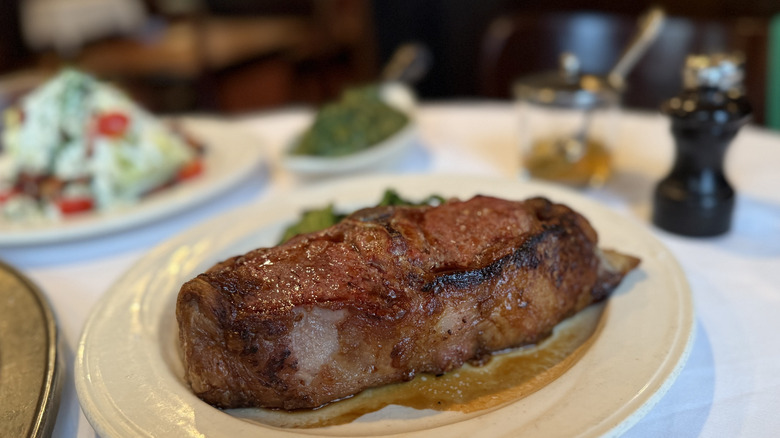
Today, Keens is most known as a "steakhouse," but up until 1995, its secondary name was the more old-fashioned "chophouse." Since the early days, Keens' signature dish has been its legendary mutton chop.
On October 29, 1935, at 7:45 p.m., according to the New York Times, Keens' one millionth mutton chop was served. The lucky recipient was a long-time patron, an insurance man (who was later jailed for income tax fraud), by the name of Warren T. Godfroy. His chop was delivered with quite the fanfare, with a blow from an English bugle supposedly used in the War of the Roses, and handed off on a platter from an employer dressed in a red beefeater costume. In the following decade, Keens was serving up to 200 mutton chops a day. While the cut has fallen slightly out of fashion with modern eaters, today almost 100 are plated in the various rooms of Keens. Julia Lisowski said, "Our mutton is 10 months to 12 months old and so it has a lambier flavor. It's a different cut also. It's a saddle cut, which is like a lamb T-bone." It's served with a side of escarole and jar of the house-made mint jelly for one to spoon at their leisure.
Beyond the mutton, make room for Keens' steaks, thick-cut bacon, French fries, creamed spinach, jumbo shrimp cocktail, wedge salad, thick Bloody Mary, and incredible butterscotch sundae. While not exactly a secret, be sure to peruse Keens' pub menu, which contains two of my favorite dishes — the braised short rib salad and George's turkey schnitzel — and an amazing potato-cucumber salad.
George Schwarz and Kiki Kogelnik save Keens from the chopping block
Since 1926, Keens had been under the ownership of the Zuch family, and after seeing rising costs, fewer young people being drawn to its doors, and even bad years by Rangers and the Knicks, the unthinkable happened — Keens called it a day on April 29, 1977. Some superheroes don't wear capes, and in our story, Keens' saviors took the form of a radiologist and his artist wife — George Schwarz and Kiki Kogelnik. The budding restaurateurs found success with One Fifth and a pair of Elephant Castle cafes, and stepped in to dust off the pipes and breathe life back into Keens.
While the two pictured Keens up and running in a matter of months with a fresh coat of paint, it took three and a half years and $1.4 million to bring the place up to speed. Walls were moved, floors were replaced, and doorways and ceilings were enlarged. They bid adieu to an air conditioning system from 1936, and in came new electrical wiring, plumbing, kitchen supplies, and even staircases. All the items from the walls had to be removed, cleaned, and then put back in place — which alone took a year.
Kogelnik acted as the main designer on the project, and after encountering the building snow-capped on New Year's Day 1978, decided to have its gray facade painted white. She told the New York Times, ”It looked like a castle in a fairy tale." It was also her idea to mount the pipes on the ceiling, which is one of the most distinguishing features of the restaurant's decor. Schwarz and Kogelnik's hard work paid off, and by the summer of 1981, Keens was back in business, with a refreshed menu modeled after London's Connaught.
Every picture tells a story, and Keens has hundreds of them
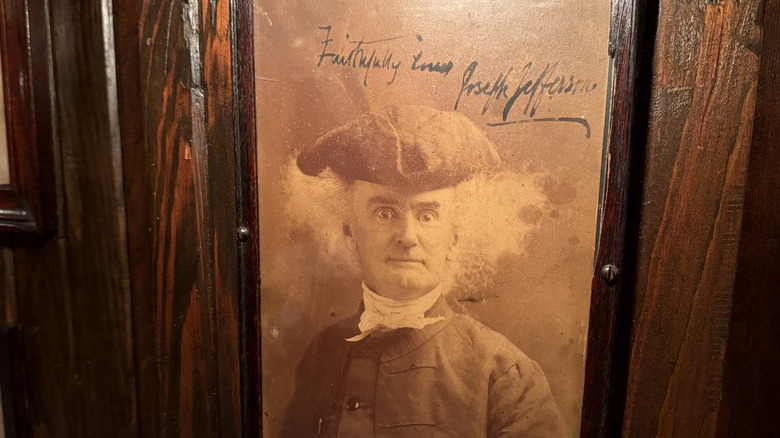
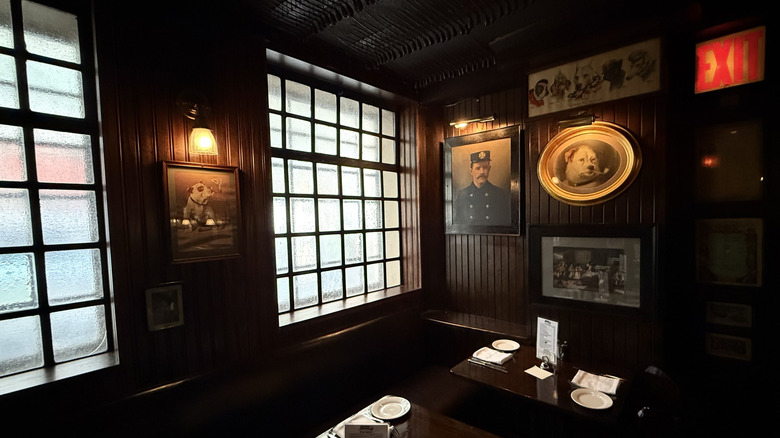
Every inch of Keens' wall has something nailed to it, beautifully arranged, as if it was a rival to the indelible Barnes Foundation collection in Philadelphia. Imagine dining in a delicious gallery, where the art on the walls ranges from old menus with laughable prices like a mutton chop with baked potato for just $1.35, to photos of large dinner parties, employee group photos, forgotten theater playbills, and sharp political cartoons.
Every piece has been cataloged by Keens, and its value is practically immeasurable. Beyond the pipes, Lincoln and Roosevelt memorabilia, be sure to marvel at the 1898 Alexander Pope tiger painting hanging in the Lambs Room. Outdoorsman and adventurer Roosevelt himself was a fan of Pope's and once owned several of his works.
Other pieces to keep an eye on are the Peck's Bad Boy lithograph in the Lillie Langtry room, which was one of the largest of its time, and the nude portrait of unknown provenance, affectionately called Miss Keens. She almost runs the length of the bar, making drinkers who peer at her blush, and she even lends her likeness to the covers of Keens' must-have matchbooks.
A scene that's also a place to be scene
Keens is the kind of place where theater impresario Florence Ziegfeld took a load off, and his bobbed-hair cast took a break from rehearsal, even arriving in bathing suits, much to the chagrin of manager Paul Henkel. In 1928, up-and-coming singer Ethel Merman was paid $10 to perform her cabaret act at Keens.
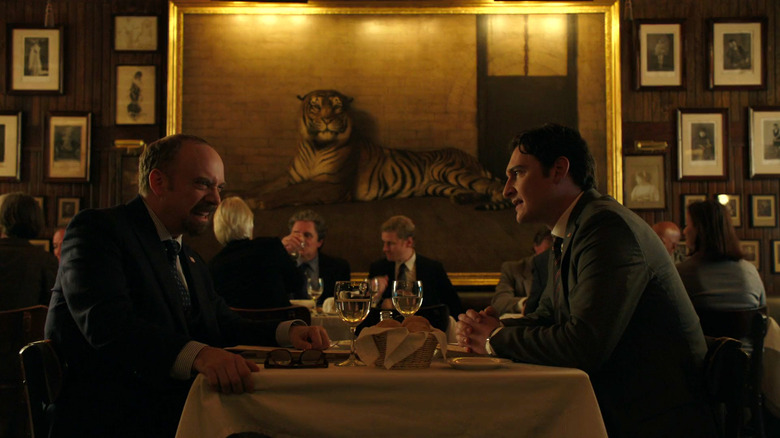
Keens has also lent its beautiful surroundings for film and TV production. Paul Giamatti chewed up the scenery, right below the Alexander Pope tiger painting for the Season 2, Episode 7 of Showtimes' "Billions," entitled "Victory Lap." After a few choice words opposite actor Toby Leonard Moore, they both take a pause to order the mutton. Keens also provided the perfect dining setting for the 1950s-set neo-noir 1988 film "The House on Carroll Street," where up the steps in the Lincoln Room, Mandy Patinkin recommends the hamburger and cottage fries to co-star Kelly McGillis, and pours a bunch of ketchup on the table to serve as a visual warning.
Private parties are commonly booked at Keens, sometimes in honor of a new product release. This is where Paul Newman and his "Own" brand held a spaghetti dinner to launch his new sauce in 1983, and a 2007 luncheon was held to celebrate the launch of what turned out to be author Norman Mailer's swan song, "The Castle in the Forest."
Keens today, tomorrow, and forever
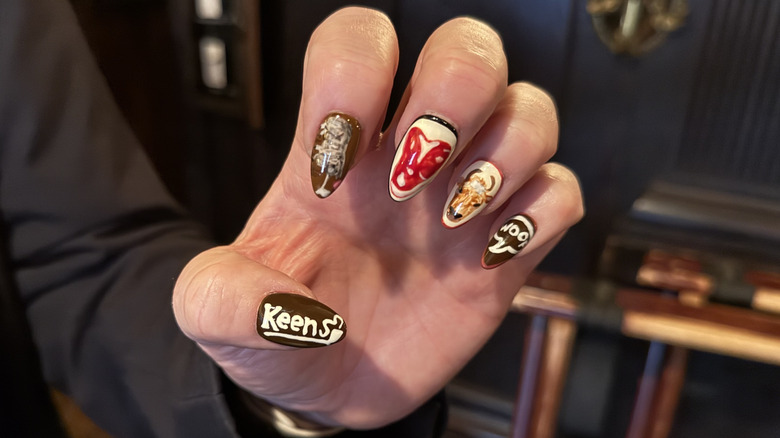
After George Schwarz died in 2016, his stewardship was carried on by general manager Bonnie Jenkins and the rest of the team. While the COVID-19 pandemic proved trying for a place that thrives on its dining experience, Keens survived, and it became even more primed to do so when it was purchased by hospitality business mogul Tilman Fertitta in 2024. For anyone worrying that the man who owns a varied portfolio ranging from Bubba Gump Shrimp Co. and Morton's The Steakhouse to the hyper-exclusive Corner Store that would reshape Keens, rest assured, it was a caveat that it remains as is.
Jenkins' successor, Julia Lisowski, is the one helping to maintain that excellent status quo, as well as carrying on the historic knowledge of Keens for the next generation. "One of our strong premises is... that we want to make sure that each guest is seen," she said. Speaking from my experience dining at Keens, it has always felt like a special event, and that the staff ensure it be so.
Keens is the kind of place Anthony Bourdain ate up, and on a 2009 episode of "No Reservations," aptly subtitled "Disappearing Manhattan," he spoke highly of the restaurant. In his own words, he perfectly summed up our feelings on Keens' future: "I like to think that if we came here in another 50 years that it would be exactly the same." Cheers to you, Bourdain, and to you, Albert R. Keen.