

It's Not Always Actual Wood Chips — The Bacon You're Eating Might Be Sprayed With This For Smoke Flavor
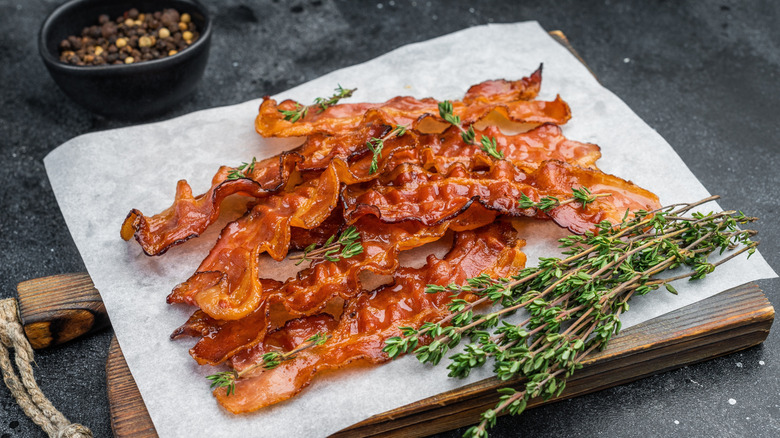
The strong, specific smell of sizzling bacon is one of the most redolent aromas that can come out of a frying pan; when it hangs in the air, it stirs feeling, memory, and usually, appetite. Most people probably imagine smoked bacon gaining its signature flavor in a fairly straightforwardl way: by being, well, smoked. And sometimes it does. But according to the USDA, bacon can receive its smoke flavor either from actual smoldering wood chips or from being sprayed with liquid smoke extract. It's not irrational to feel a little betrayed, or at least misled, by that. But the good news is liquid smoke is made from real smoke – it's simply become an applied ingredient rather than an environment or traditional food-keeping method.
Before refrigeration, smoke helped preserve meat and was often used in conjunction with salting and curing. As bacon hangs in the smokehouse, warm, moving air gradually dehydrates the surface of the meat, reducing the moisture that bacteria need to survive and thrive. Smoke also deposits antimicrobial compounds onto the meat while slowly rendering fat and building layers of aroma over time. The effects are parlty physical and partly chemical. Smoke exposure changes texture, color, scent, and the mouthfeel of the protein and fat. A slab of raw pork belly smoked over hardwood doesn't just taste smokier afterward; the process structurally alters it.
Liquid smoke approaches the same flavor from a different direction. Instead of exposing bacon to burning wood for hours, manufacturers apply liquid smoke extract directly onto the meat during processing. It's cheaper, faster, and easier to standardize at an industrial scale because it doesn't require a smokehouse, wood chips, or much labor.
Smoke gets in your brines

All smoke flavor is technically made up of tiny particles and volatile compounds– the things that taste and smell like smoke — attaching themselves to food. Liquid smoke isn't unnatural, but there is a fundamental difference between bacon hanging for hours in a smokehouse, wafting through puffs of alder, hickory, or apple wood chips, lovingly tended by a pit master, and bacon that moves through an industrial production line, receiving spritzes of brine and atomized extract from a nozzle.
Liquid smoke is created through a surprisingly literal process. Wood is burned or heated through pyrolysis, a high-temperature decomposition process that breaks organic material down into smoke, vapor, gases, and microscopic flavor particles. That smoke is then cooled so the vapor condenses into liquid droplets, which are collected, filtered, and bottled into concentrated smoke extract.
The resulting solution contains tasty compounds such as phenols, which contribute to the recognizable campfire aroma associated with smoked meat. Carbonyl compounds help create browned, caramelized flavor notes, while organic acids give smoke that tangy quality and some of its preservative effects. Liquid smoke is not an artificially invented "smoke flavor" in the way that a fluorescent blue-razzleberry gas station slushie might be. It's real smoke, captured and suspended in water for controlled, efficient redistribution later.
Lightning in a bottle
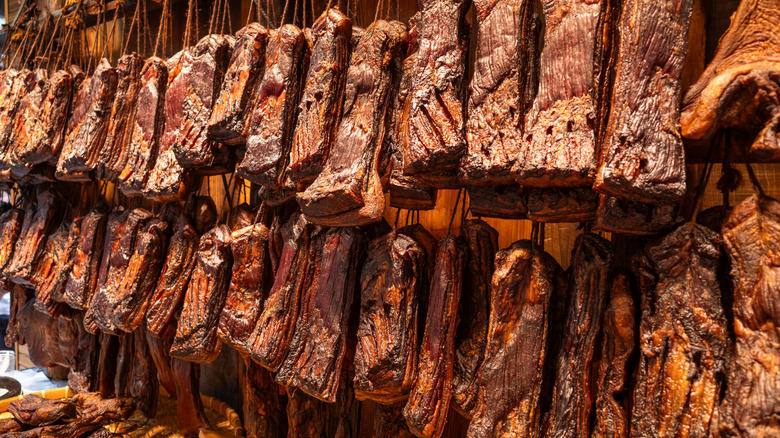
The product entered American food manufacturing in the late 19th century through Kansas City chemist and inventor Ernest H. Wright, who reportedly made note of the gunky black liquid dripping from a stovepipe. His observation led him to commercialize liquid smoke, which was also known as "wood vinegar" in the late 1890s. Food manufacturers embraced it because it solved several problems simultaneously. It produces consistent flavor, reduces the need for large smokehouse facilities, shortens processing time, lowers labor demands, and gives companies precise control over the finished product. Traditional smoking involves many variables that liquid smoke can minimize.
If you want to know whether your bacon uses liquid smoke, look for mentions of "smoke flavor," "natural smoke flavor," or just straight up "liquid smoke" in the ingredient list. You're much more likely to encounter it in mass-market sealed supermarket bacon than at a small smokehouse operation that takes pride in claiming its hardwood smoking technique. Liquid smoke is also sold as a pantry ingredient in its own right, usually in small bottles because it's highly concentrated (you never need much). A few drops can add smokiness to recipes like chili and baked beans, barbecue sauce, DIY roasted nuts, or even homemade vegan bacon alternatives, made from things like tempeh, mushrooms, or jackfruit – all without requiring an actual smoker, which is a hefty piece of equipment for home projects.
The distinction between traditional smoking and liquid smoke ends up hazier than most people expect. Liquid smoke does come from real smoke, but bacon that undergoes the transformation of the tedious, by-hand smoking process — slow exposure to hardwood fire, airflow, dehydration, labor, time, and technique — still holds qualities that a sprayed extract can't entirely reproduce and won't ever replace.