

Attract Birds To Your Yard With The Help Of An Old Coffee Mug
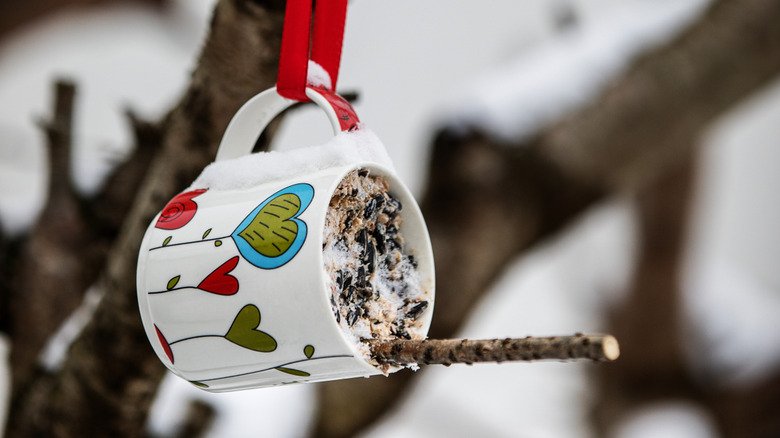
More than any other objects in the kitchen, coffee mugs can feel like old friends, which is why they seem to be hard to toss out. Mugs work hard for us, morning after morning, but even the sturdiest ones chip and crack, gradually falling out of rotation but still haunting the back of the cupboard as they're passed over for the new favorite. Maybe, if they're lucky, they're relegated to holding pens or toothbrushes, an honorable discharge, if a bit dull. Turning them into bird feeders gives them a new purpose — and the birds don't care that the rim is chipped, or that the glaze is stained. They land, peck, and fly away, showing us that usefulness doesn't require perfection.
Although mugs aren't designed for this duty, they rise to the occasion, joining the bird-friendly trash-to-treasure ranks along with old coffee cans and egg cartons. Mugs can hold a perfect serving of suet and seeds for a backyard bird population, and the ceramic is sturdy enough to handle most reasonable weather fluctuations for a good while. The handle provides a built-in hook, a way to suspend it sideways so the birds can get their meal. Compared to purpose-built bird feeders, this is a direct, low-cost substitution with few downsides.
If you're already experienced with backyard bird feeding, you know that birds will return to dependable food sources, and this is true even when the food is presented in up-cycled containers. Over time, you will recognize their patterns, and they yours. Developing a relationship with your backyard birds is a slow, but sweet and rewarding project that doesn't need constant attention, and your old mug is happy to help.
A second pour
Giving the mug a clean start is simple. Wash it out, tie a string or ribbon around the handle, and, when filled, hang it somewhere stable outside, preferably within your view. Make sure to position it correctly by tying the ribbon around the middle of the handle, so that when hung, the mouth of the cup is tilted horizontally. That angle will keep rain from accumulating as the food is eaten down, and it can give the birds a flat zone to land while they eat, instead of having to awkwardly hover. A strategically placed stick can help out as a perch, too.
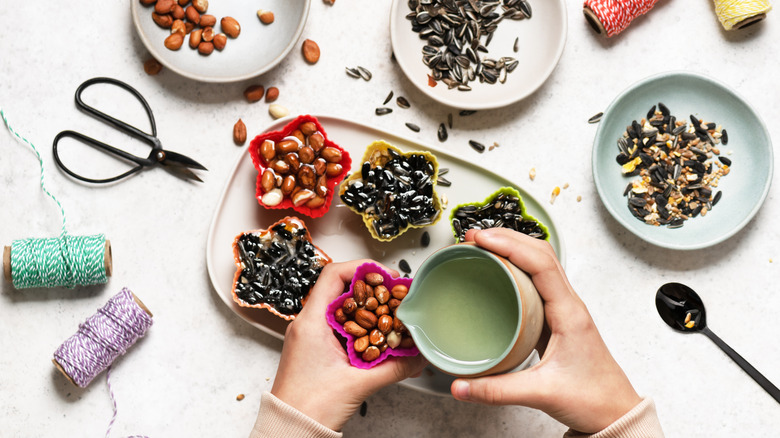
Birds are drawn to dense sources of fat and protein, especially during colder months and nesting season, when maintaining body heat and energy reserves is most demanding. Migrating birds also like nutrient-dense feed, because they need high-quality fuel for their long journeys. A classic choice is suet, which is unrendered animal fat. It's the starting point for making beef tallow, and it's similar to, but not the same as lard. Crucially, it can be easily mixed with seeds. Peanut butter can also work, and while it's a more familiar pantry ingredient to humans, birds are wild animals that don't do well with ultra-processed, high-additive foods, so you'll have to take care to use peanut butter with no added sugar, salt, or oils.
When you mix either suet or peanut butter with birdseed, it forms a thick paste that can be pressed into the curve of the mug. Combine roughly one part warmed-up suet or peanut butter and one part bird seed, place it in the mug (a silicone spatula can help), let it cool, then hang and enjoy watching your feathered friends respond to the tea party invitation.