

The Biggest Changes You'll Notice At Olive Garden In 2026
If you're seeking an authentic Italian meal, this is unlikely to be your first stop. But if you're seeking a glimpse into an uber-American take on Italian cuisine, then there's no better place to start than an Olive Garden near you. Of all the well-known facts about the popular chain restaurant, the most peculiar are its steadfast refusal to add salt while boiling pasta, and never serving its pasta al dente.
While nonna wouldn't approve of OG's cooking methods, she would be completely on board with its approach to ensuring customers stuff themselves to the brink of a food coma. Since it first fired up its burners nearly five decades ago, it's focused on delivering great value for money. From sending out unlimited bread, soups, and salads to keep hungry customers from turning hangry to introducing unlimited bowls of pasta, it has developed a reputation for marrying American quick-service ethos with Italian hospitality and generosity.
The chain, which has nearly 950 outlets in America, has big plans for 2026 — plans that will impact what, where, and how much you eat. Here, then, are the biggest changes you'll notice at Olive Garden in 2026.
Buy One, Take One gets some extra love
Olive Garden takes its motto — "When You're Here, You're Family" — very seriously. And is there anything that screams "family meals" louder than leftovers? That's right, pasta tonight almost certainly means pasta for lunch tomorrow. Now, while it's impossible for a restaurant to guarantee a doggy bag, Olive Garden introduced the next best thing: A Buy One, Take One offer, which allows diners to order one entrée at the restaurant, and pack an extra one to take home for no extra charge. Essentially, diners are buying two entrées for the price of one.
Olive Garden reintroduced the limited-time deal last year after a break for the pandemic. And in 2026, the chain has gone three steps further. It's included more pasta options in the deal, putting in more money than before to promote the deal, and extending it by one week. Guests can now order one of seven pastas as their in-store dining option on this deal, including the recently introduced Rigatoni alla Vodka. They can also order one of four soups and a salad. The take-home pasta options include Fettuccine Alfredo, Five Cheese Ziti al Forno, or Spaghetti with Meat Sauce.
With deals starting at just $14.99, Buy One, Get One was one of the biggest drivers of growth for Olive Garden in 2025, Chief Financial Officer Rajesh Vennam said in an earnings call earlier this month (via The Motley Fool). And just like having pasta for dinner and again for lunch, Olive Garden is clearly hoping to ride 2025's Buy One, Get One wave in 2026 as well. The offer runs from March 16 to May 3 this year.
Lighter Portions, across the board
While reducing portion sizes seems counter-intuitive to how Olive Garden usually functions, it's a sign of changing customer preferences, including higher price-sensitivity. In 2025, Olive Garden introduced a "Lighter Portions" section in their menu in select locations, and found enough traction to announce a nationwide rollout in 2026. This now one of several ways to get more out of your Olive Garden meal for less.
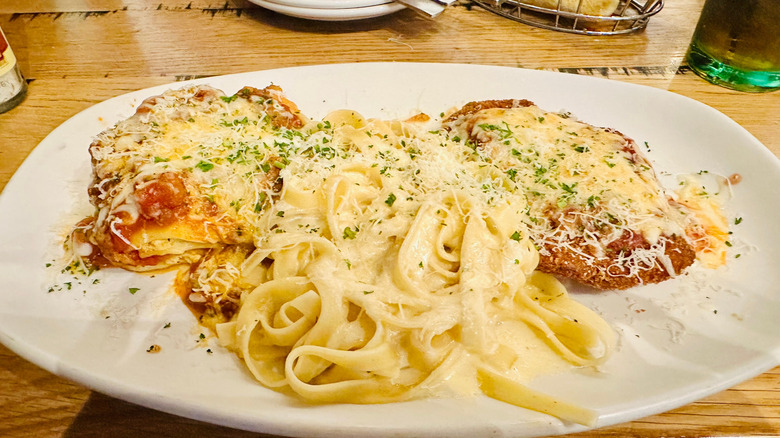
Olive Garden previously served smaller portions of their entrees at lunchtime, as a way to draw people in during low-footfall hours. The idea of the "Lighter Portions" menu was to extend this outside of lunch hours as well. A "Lighter Portion" of their Chicken Parmigiana costs $17.99 and includes 630 calories at their Times Square restaurant. A regular portion at the same place contains 1,020 calories and costs $25.99. At Yonkers, a Lighter Portion of Lasagna Clasico will set you back by $15.99, while a regular one costs $20.29. However, the regular portion is a 940 calorie meal, compared to the lighter portion, which only contains 500 calories. In case you're making a decision based on your wallet, the smaller lunch time portions cost less than the Lighter Portions at dinner time. For Olive Garden, the experiment with smaller portions can be framed as a success. The company said in a report that the move was "increasing guest frequency and perceived value", adding that portion size and value scores were significantly higher for these items.
Meanwhile, Olive Garden also brought back two fan-favorite pastas — ravioli di portobello and braised beef tortelloni — in order to meet their guests' craving for "familiar, craveable dishes".
Big appetite for home expansion
Olive Garden's parent company, Darden, which also owns other popular chains such as The Capital Grille, Yard House, and LongHorn Steak House, is continuing its massive expansion spree into the 2026-27 fiscal year. In 2025, Darden had announced plans to open 65 new restaurants across its 10 brands before May 2026, with more than 25% of those being Olive Gardens. "Looking forward to fiscal 2027, we expect to open between 75 and 80 new restaurants," Darden CFO Raj Vennam said during the Thursday earnings call.
You'd think people would be used to new Olive Garden branches popping up given that it has over 950 units, but excitement around a chain that serves unlimited breadsticks is still clearly high. For example, in Festus, Missouri, where the City Council recently approved plans for a new Olive Garden, the mayor could not contain his happiness. "I'm tickled to death that an Olive Garden is coming," Festus mayor Sam Richards told the Leader. "We need another big restaurant, and we're getting one."
Darden is also looking to convert its struggling Bahama Breeze locations into sister brands, though how many of these will turn into Olive Garden isn't clear.
More Olive Garden on your overseas trips
Olive Garden's big expansion plans aren't restricted to the United States. First up, it's about to increase its footprint in Canada in a big way. In July last year, Canadian restaurant giants Recipe Restaurant Group took over operations of eight Olive Garden locations in Western Canada. In 2026, it got plans locked in for the next phase of expansion, with new Olive Garden franchises set to open in Ottawa and Ontario. "With these upcoming openings, we're taking an important step in expanding Olive Garden's footprint into new Canadian markets," Recipe Restaurant Group's CEO Frank Hennessey said.
Meanwhile, Olive Garden has also expressed interest in entering the Czech Republic. The website for the U.S. Embassy in the Central European country put out a call for entrepreneurs seeking to pick up one among several American franchises interested in expanding. Olive Garden shares space on the list with Southwestern grill chain Barberitos and fast food giants Wendy's (who sell more Frostys per day than your wildest guess). "Owning a U.S. franchise can be an easy path to entrepreneurship, especially when representing a trusted brand and proven business model," the introductory note on the website reads.
The attempt to make inroads into the Czech market comes close on the heels of Olive Garden opening its first franchise in the Indian capital, New Delhi. Olive Garden is the latest in a long list of American food franchises thriving in India. McDonald's, Pizza Hut, Subway, KFC, Domino's, and Starbucks have all made a significant impact on India's nascent quick-service restaurant scene.
Quicker service, especially on high-volume days
Olive Garden might be winning the "value war" against Fast Food, but that doesn't mean speed isn't important for a chain that successfully treads the fine line between quick-service and casual dining. Olive Garden's CEO Rick Cardenas insisted that the quick-service restaurant was aiming to get quicker at service, even if the task seems gargantuan. "At Olive Garden, there are 50,000 servers," Cardenas said in the earnings call last week. "How do you convince 50,000 people that they have to change the way they do things?"
The trick, he said, was in giving them the tools to achieve their service targets — not just in terms of technology, but general operational efficiency. In other words, he said it was about how the servers "got the soup, salad, and breadsticks out faster — so the first course comes out faster?"
There are two reasons Olive Garden is trying to cut down time taken for service as they go into 2026. The short-term goal is to drive better revenue on high-volume days. The long-term goal, however, is to convince diners that an Olive Garden was their best choice even if they were just looking for a quick bite. The target is to convince customers they can be in and out of an Olive Garden in 30 minutes. "I want them to believe they can do it in a few years. When they can, they are going to come back a lot more often," Cardenas said.