

The 12 Most Iconic Italian-American Sandwiches
Many of the sandwiches we refer to as Italian sandwiches in America are usually not Italian at all. Rather, they are Italian-American creations, developed by immigrants from Italy or their descendants to suit a fast-paced lifestyle in their new country, joining the long sandwich tradition in the United States.
Most people grabbing a favorite sandwich during their lunch break don't give much thought to the history of these bready combinations. As someone who has written about the history of Italian food in the U.S. and in Italy, I have probably thought about it too much. I have also eaten too many hefty sandwiches over the years, which is why I wanted to create a list of some of the most popular ones and their origins.
The most iconic Italian-American sandwiches span both hot and cold, and both widespread and obscure. A few can be found coast-to-coast, while others are a specialty of just a particular region or even a neighborhood. What these diverse sandwiches have in common is that they are robustly flavored, usually meat-centric, and show their Italian-American heritage. Although their ethnic origin is the same, many have been assimilated into all facets of American culinary life and have become not just Italian-American sandwiches, but true American sandwiches. Here are the ones you should know.
Italian sub
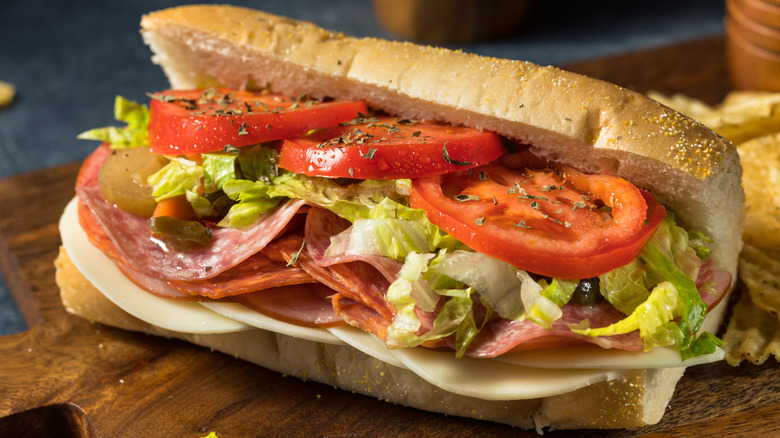
The most widespread type of Italian-American sandwich is the sub. Depending on geography, you may hear it called an Italian sub, sub, hoagie, hero, grinder, spuckie, zep, or torpedo. They typically feature a 10- to 12-inch loaf of bread that's about 3 inches wide and sliced lengthwise.
The splayed bread is filled with a copious amount of Italian or Italian-style cold cuts or boiled ham, slices of cheese (usually provolone), tomatoes, often shredded lettuce, maybe slices of peppers or onion, plus a dash of olive oil and another of vinegar. Subs feature tartness from the vinegar, a bite from peppers, satiating meatiness, and the crispness of the lettuce, paired with the aroma and flavor of recently baked bread, and residual oil on both hands and clothing.
The sandwiches, which are often stuffed to the brim and wrapped in paper, reflect the abundance of America, not the restraint of Italy. When served full-sized, it's easy to see their origin as a laborer's lunch. The sandwich was believed to have first appeared in Hell's Kitchen in New York in the late 19th century at a grocer to serve Italian immigrant laborers.
Eventually, fairly similar regional variations appeared elsewhere in the Northeast, courtesy of southern Italian immigrants and their offspring. Italian subs of various forms are now found throughout the country, courtesy of the business magic of franchising. Not all of these chains do the sandwich justice, though. These chain Italian subs resemble the ones that first appeared in northern New Jersey in the early 20th century. That nomenclature is to the dismay of many in Philadelphia, a city justifiably proud of its version, the hoagie.
Muffuletta
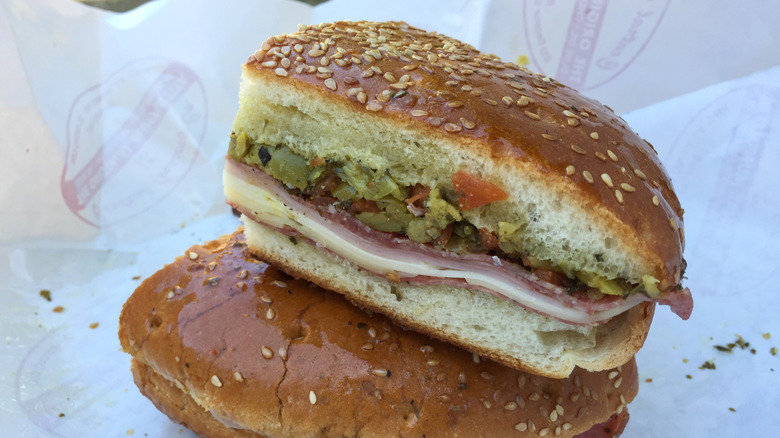
Another one of the great Italian-American sandwiches comes from New Orleans: the muffuletta (or muffaletta). Unlike the far-flung sub, this is still largely a local and somewhat regional treat. Sliced Genoa salami, mortadella, ham, and sliced Swiss and/or provolone are complemented by an olive salad inspired by those in Sicily, and are fitted between a distinctive, dense circular loaf. Since the bread is fairly large, a normal order is a half or quarter of a muffuletta.
The muffuletta might be the most enjoyable preparation of the Sicilian culinary legacy in the Crescent City. It was first assembled in an import store in the French Quarter in the early 20th century. Legend has it that the muffuletta was invented by Salvatore Lupo at what became known as the Central Grocery, which opened in 1906. The sandwich takes its name from the unique bread, muffuletta (or a similar name), which has long been baked in towns and cities around western Sicily. Muffulettas can also be served warm, with the cheese melted, for a slightly different take.
Italian beef
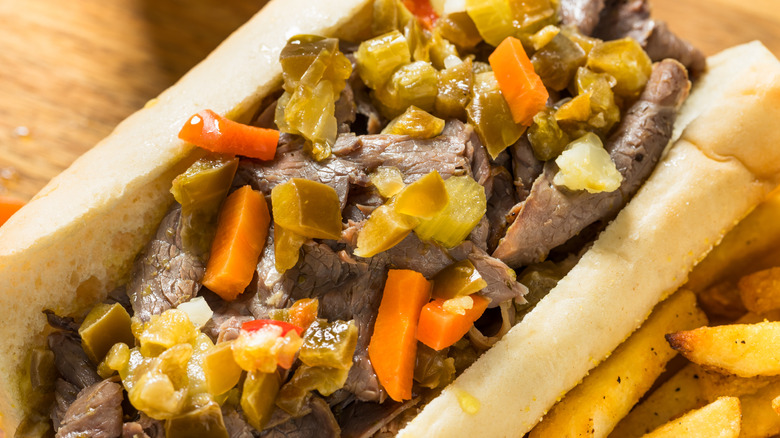
The leading hot Italian-American sandwich comes from Chicago. It's meat-centric and appropriately from what was once the "Slaughterhouse of the World." Italian beef sandwiches feature thinly sliced, slow-roasted and seasoned beef, piled into a fresh, chewy French loaf, often dipped in the roasting juices and topped with sweet roasted peppers or locally popular, often piquant giardiniera. The inherent messiness of Italian beef sandwiches and their plentiful jus has even induced a proper way to eat them: standing.
Italian beef likely originated in the homes of Italian-Americans living in Chicago, who had ready access to inexpensive beef. The dish became popular at weddings in the 1920s due to its affordability. The tasty beef eventually made its way into sandwiches, and the sandwich became a Chicago staple by the end of the 1970s. As tasty as the sandwich can be, it was long rarely found that far outside of Chicagoland. That changed with the debut in the summer of 2022 of the popular show, "The Bear," set at a drama-filled Italian beef sandwich shop in Chicago.
Roast pork
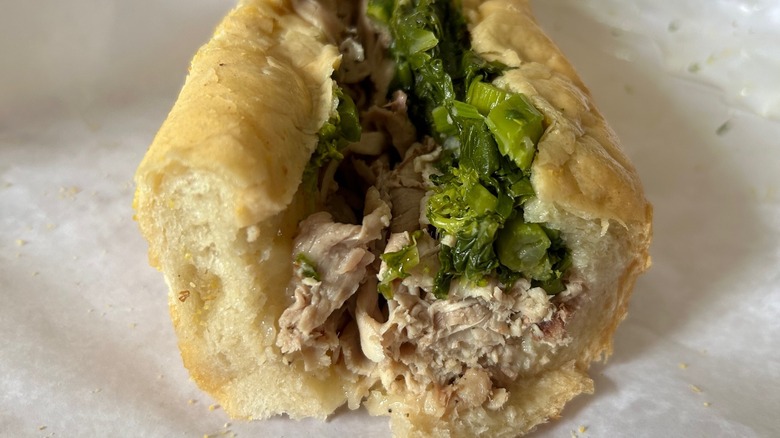
Though not as famous as the cheesesteak, the roast pork sandwich is another Philadelphia creation, but one that has a much clearer Italian lineage. Many locals also find it tastier. It features sliced roasted or braised pork shoulder that has been seasoned with popular Italian staples like garlic, rosemary, thyme, and red pepper flakes. The meat is placed into a crusty roll with the juice from the pork, slices of sharp provolone and, in recent decades, also sauteed broccoli rabe or spinach. Roasted long hot peppers, another Philly favorite, are also an option.
The oldest purveyor, and possibly the originator, is believed to be John's Roast Pork, which has been in operation since 1930. The shop was even named one of America's Classics by the James Beard Foundation in 2006 — and its cheesesteak is no slouch, either. DiNic's in Reading Terminal Market is another iconic stop for a roast pork sandwich; it was even named the Best Sandwich in America by the first season of Alan Richman's show.
Meatball
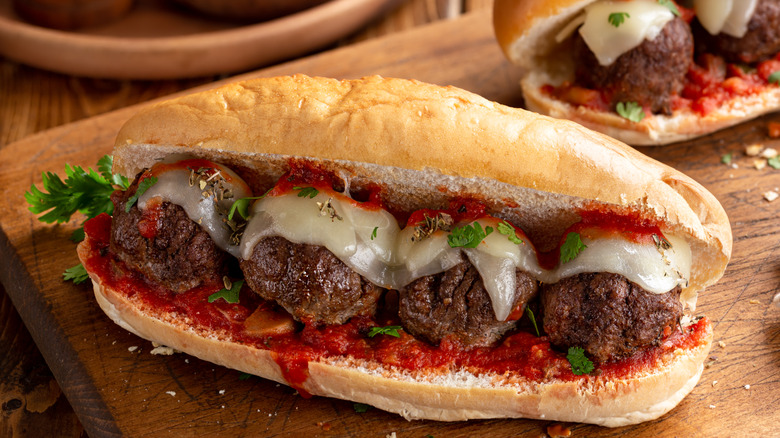
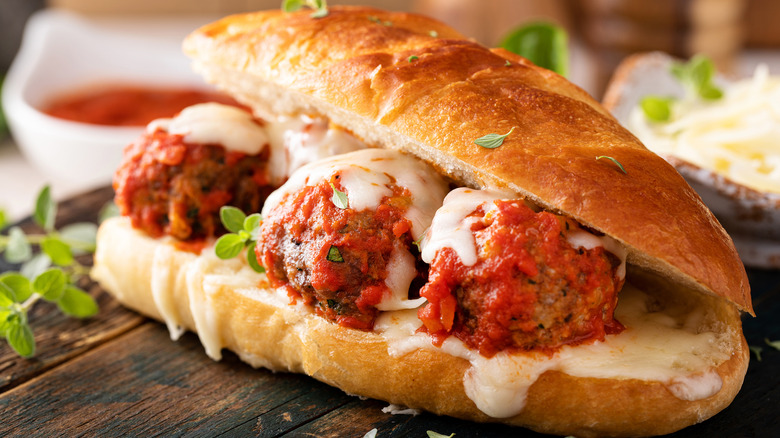
Everyone seems to love meatballs. Spaghetti and meatballs has been an American classic for decades, and meatballs are on the appetizer menu at most Italian restaurants. And, of course, meatballs are also stuffed between bread to create the meatball sandwich. That bread is usually a crusty Italian roll, the same type used for cold Italian-American sandwiches. The meatball sandwich is served warm with a tomato sauce and cheese, usually mozzarella, which is often quickly melted underneath a broiler before serving. It might bear the name "meatball sub," "meatball Parmesan," or even "meatball Parmigiana" to denote some additional fanciness.
The meatballs are made from ground meat, breadcrumbs, and maybe binders like eggs and grated Romano cheese. That meat might be the traditional Italian-American blend of beef, veal, and pork. The mix can be found in supermarkets in the Northeast as "meatball and meatloaf blend." Other parts of the country make theirs with ground beef and pork or just beef. Easily the largest sandwich chain in the country, Subway, uses both beef and pork in its meatball sandwiches.
Chicken Parm
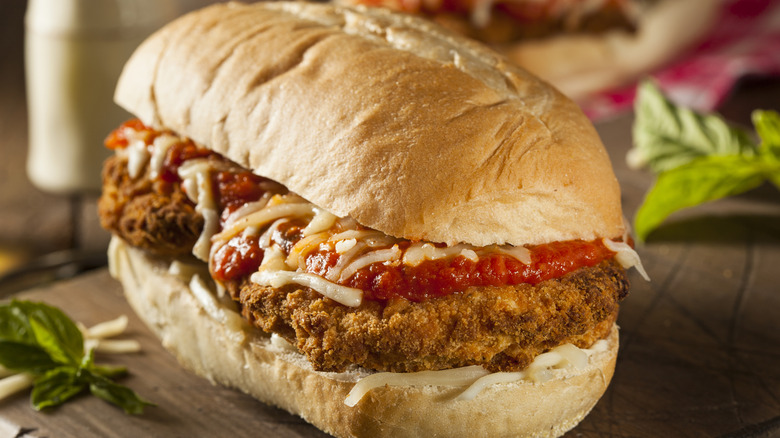
Like the meatball sandwich, the chicken Parmesan or chicken parm sandwich, made the seamless transition from the dinner table to sandwich duty. It wears the familiar Italian-American food colors of red and white. Assembling a hoagie-style chicken Parm sandwich takes a few steps. The sandwich features boneless, skinless chicken breasts that are flattened, breaded, and fried before being doused with tomato sauce, mozzarella, and grated Parmesan or Romano, placed in a crusty roll, and quickly broiled to melt the cheeses.
The sandwich's origin began with the popular southern Italian dish, melanzane alla Parmigiana, which features fried slices of eggplant. Eggplant Parm eventually became an American sandwich, then veal Parm sandwiches caught on. Veal has largely become a relic of simpler, less chicken breast- and sandwich-chain-laden times. Industrial processing made chicken breasts much more inexpensive beginning in the 1980s, and these eventually took over in Parm applications. Chicken Parm sandwiches are now the most common variation of the Parm sandwich today.
Stromboli
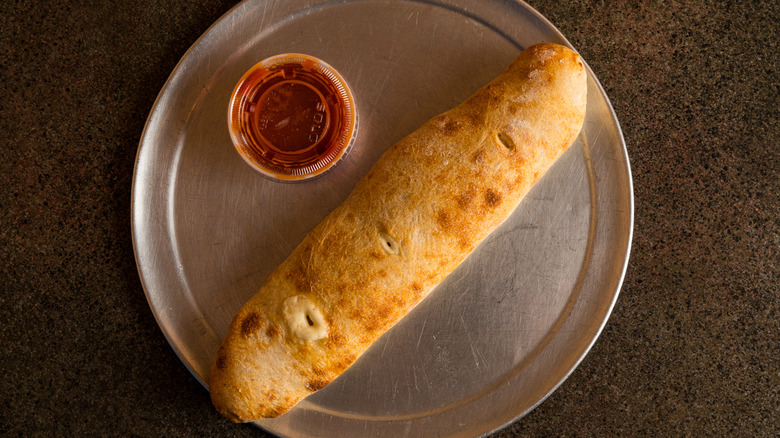
Strombolis are usually found in pizza joints and are often confused with calzones. The two are similar in most places, the difference often just being that the calzone is half-moon-shaped while the stromboli is long. But these dishes actually have two disparate heritages. Calzones come from the pizza tradition of Naples, while the stromboli began at a bakery in America.
Nazzareno "Nat" Romano, originally from the Italian region of Abruzzo, devised this sandwich-like construction of bread dough encasing ham, capicola, American cheese, and peppers at his store in 1950. His creation took the name of a well-publicized film by Roberto Rossellini. The restaurant, called Romano's today, is not far from the runways of Philadelphia International Airport. Its strombolis are crafted in batches with dough made in-house before being par-baked and heated to order. It now sells 16 different filling options and is a great stop before an Eagles game.
Maine Italian
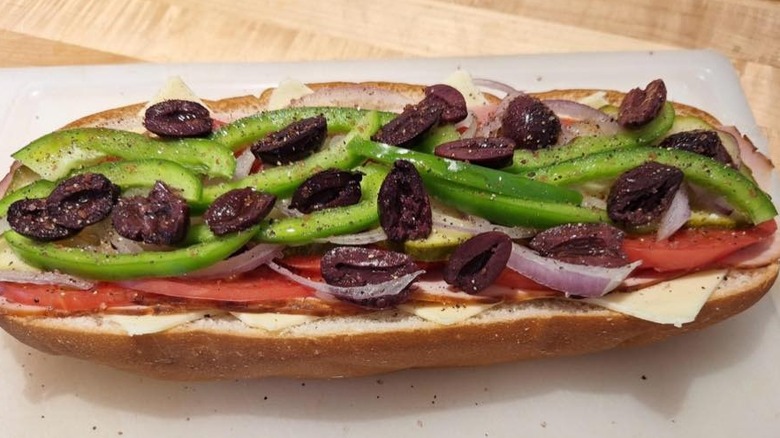
Though those not familiar with it might consider it just another sub sandwich, the Maine Italian is distinct enough to deserve a separate mention. Many a proud Mainer thinks that, though there might be similar sandwiches, nothing is quite like a Maine Italian sandwich. For one, rather than the familiar sub rolls, the Maine Italian uses a light and soft roll. This is broadly akin to the large split-top buns used for hot dogs in New England.
In 1902, in the unlikely town of Portland, Maine, the Maine Italian sandwich was born. That moniker highlighted the heritage of its creator, Giovanni Amato, who initially sold the sandwiches from a cart before opening a shop. The original sandwich consisted of a soft fresh bread casing slices of what could be readily found: boiled ham, cheese, tomatoes, green peppers, olives, pickles, onions, and oil with salt and pepper. Amato's found success and continued in the business. Its original sandwich was updated in the 1970s with a new owner, who upgraded the olives and pickles and infused the oil with some spices. Amato's is still open today and serves this classic sandwich. It has many locations in Maine and nearby states and has been joined by competitors also serving Maine Italians.
Breaded steak
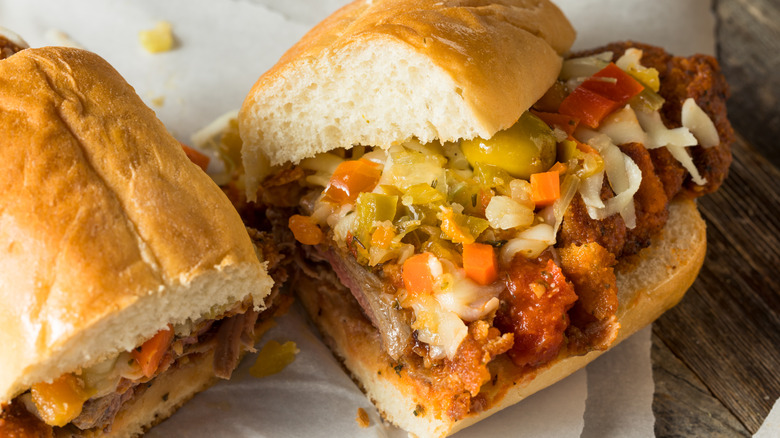
Longstanding Ricobene's take on Chicago's breaded steak sandwich was featured in an episode of Anthony Bourdain's "Parts Unknown." It was also, rather provocatively, once named as the world's best sandwich by a sports writer at USA Today. Even with this notable national attention, this sandwich has remained fairly unknown, even in the greater Chicago area where it originated. The breaded steak sandwich is confined mostly to and around the Bridgeport neighborhood on the city's South Side. It's a sandwich for Sox fans.
Like Chicago's much more well-known Italian beef sandwich, this sandwich is beefy, hearty, and messy. The breaded steak sandwich includes familiar touchstones of local Italian-American fare. A good-sized, thin piece of tenderized steak is breaded, fried, and stuffed into a long, chewy roll with tomato sauce, mozzarella, and giardiniera or sweet peppers. The resulting construction is filling and usually sloppy, and is tough to finish in a single sitting.
Spiedie
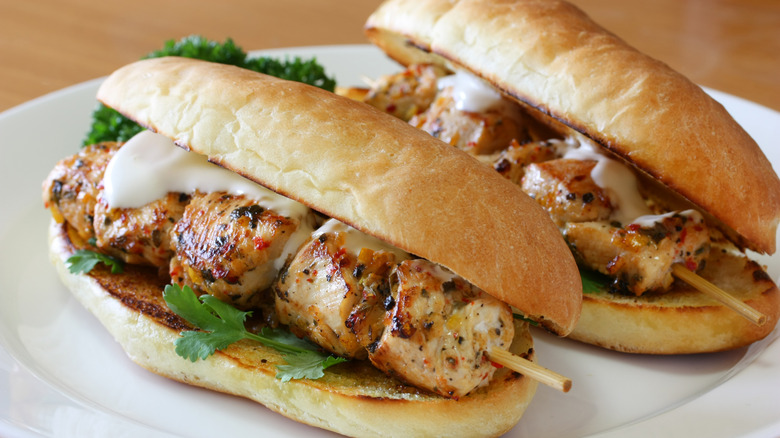
The spiedie might be the rarest of tempting Italian-American sandwich creations. Pronounced "SPEE-dee," it consists of cubes of meat — chicken, pork, and occasionally beef or lamb — that have been marinated in an Italian dressing-like concoction, skewered, grilled, and placed in a soft long roll or sliced white bread. It's usually eaten without condiments. Spiedies are a specialty of the small city of Binghamton in the Southern Tier of New York, where bottles of spiedie marinades are popular and an annual Spiedie Fest is held. But the sandwich has not traveled very far from the immediate area.
Augustino Iacovelli, a native of Abruzzo, is attributed with creating this sandwich at Augie's Restaurant in 1939 in the neighboring town of Endicott. It takes its name from "spiedo," Italian for "spit." There was more meat available stateside than in Italy, so a spiedo could be used much more frequently. In the American tradition, a sandwich was an easy step. Unfortunately, by the 2020s, several longtime spiedie sellers had closed, making this fairly labor-intensive sandwich an even more difficult find.
Sausage and peppers
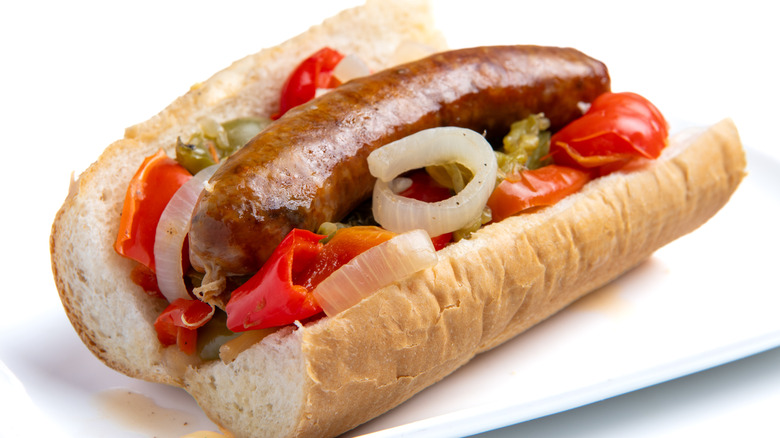
Sausage and peppers is the last member of the hot Italian-American comfort food sandwich trio, alongside the meatball and chicken Parm sandwiches. Sausage and peppers are mostly associated with Italian festivals, but they are a welcome find at any street fair, ballpark or stadium, or a casual Italian sandwich shop when hunger, along with the enticing aromas and sizzle of the grill, overwhelms any fear of indigestion.
A sausage and pepper sandwich usually includes onions sautéed with the bell peppers. Minced or sliced garlic, too, are necessary for any Italian-American dish rooted in the south of Italy. The sandwich features a plump and juicy, fennel-spiked Italian pork sausage — either sweet or hot — with the cooked vegetables and possibly some tomato sauce. This is all ladled into a sturdy Italian roll for support, and to soak up its sauce to create a zesty and invariably greasy treat.
Cudighi
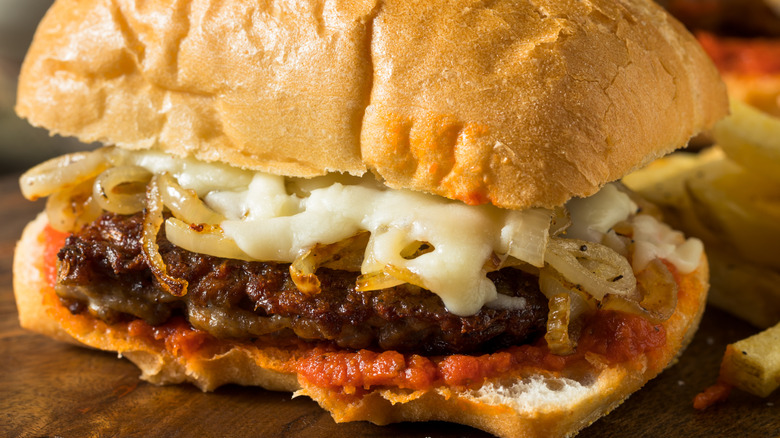
This sandwich, with the odd name and pronunciation — "COO-duh-ghee" – is a specialty of the Upper Peninsula of Michigan. The cudighi is traditionally made with fresh pork sausage, formed into patties and pan-fried, and often served warm on a hard roll. Tomato sauce and mozzarella are common in the sandwich, as are grilled onions, peppers, mushrooms, ketchup, and mustard.
The sausage may be seasoned with garlic, clove, paprika, cinnamon, nutmeg, allspice, red wine and more. The seasonings are different than those in the familiar Italian-American sausage, which comes from the southern Italian tradition and often included fennel. The cudighi's possible origins in northern Italy, and the northern Italian immigrants to this part of the Upper Peninsula, help explain that.
Cudighis were first sold in the 1930s and gained popularity in and around Marquette County. Today, cudighi are made at home and found in restaurants and pizza joints, mostly in the Upper Peninsula.