

Here's What Happens To Shake Shack's Leftover Burgers
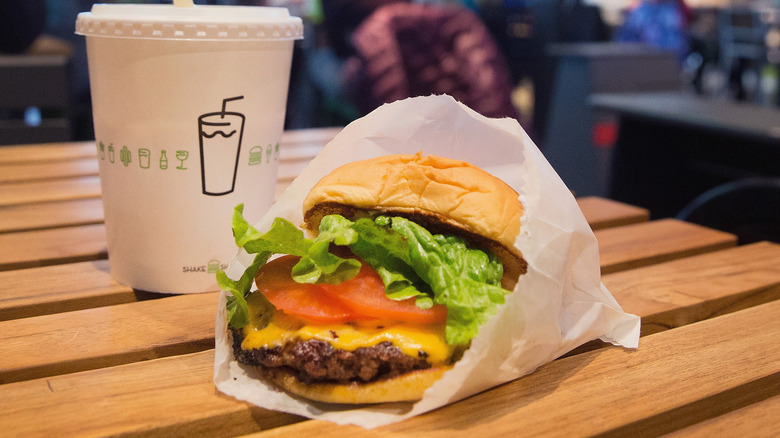
Food waste is a huge problem in the American restaurant industry. Around 40% of America's food waste comes from food-related businesses, from restaurants to grocery stores (per RTS). In fact, restaurants generate over 11 million pounds of food waste every year according to a National Restaurant Association report. The industry isn't blind to this problem. A booming food waste management industry has sprung up to tackle the issue in creative ways. This includes solutions such as using landfill-bound food to tackle climate change and hunger.
Shake Shack tries to tackle the leftover problem differently — by cutting down on food waste to the point where it's not a problem. "While Shake Shack does not have a formal food waste policy, the company works diligently behind the scenes to minimize waste across operations," a brand representative told us, when Tasting Table went seeking information on what happens to food waste at 10 chain restaurants. "Because all Shake Shack food is cooked to order, the amount of food waste generated is minimal, particularly compared to full-service restaurants, which tend to have significantly more prep-related waste."
Outside of running efficient operations, Shake Shack contributes in other meaningful ways in fighting hunger and food insecurity in America. The burger giant supplied nearly 3,000 pounds of ingredients to Feeding America In 2024. It also partnered with Mill, which produces food recyclers for both home and commercial use. During the pilot, it used one of Mill's machines to convert food waste into a natural additive that independent farmers could use to add nutrients to chicken feed.
Shake Shack's mission: Stand for something good
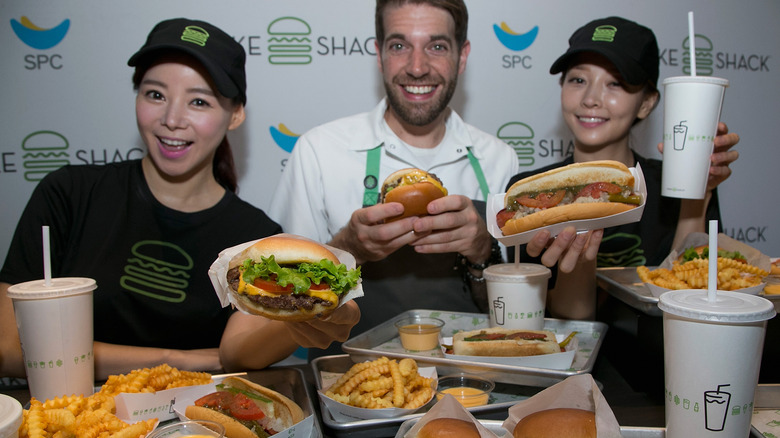
However, of course there are some leftovers to deal with. The chain partners with Restaurant Technologies Inc. to recycle 1.75 million pounds of used oil, which is converted to biofuel and sent to gas stations around the country. Shake Shack also has a long-term partnership with Food Recovery Network, a nationwide, student-led movement dedicated to building sustainable, equitable food ecosystems. Food Recovery Network has 200 chapters with 8000-plus students, as well as 100 partners in the food business, who are fighting hunger and climate change by donating surplus food to local community organizations.
The chain has always believed in giving something back. When it set up its first cart in Madison Square Park 25 years ago, selling hot dogs (its hot dogs are still the best fast food hot dog you can buy), its goal wasn't world domination, but to raise funds for a public art project. Today, it's one of the best-known burger chains globally, with 596 outlets around the world generating nearly $1.5 billion in revenue in 2025. Despite this meteoric growth, its mission to serve the communities the outlets are a part of has remained at the heart of operations.
From comprehensive audits to better inventory management, more thoughtful menu design, and joining food-waste schemes, many restaurants are actively trying to move towards a zero-waste philosophy. Two years ago, London-based Silo became the world's first zero-waste restaurant, successfully building a complex operation all the way from responsible sourcing to fermenting scraps for a sauce. While Shake Shack may not have a fermentatrium like Silos does, the chain does take its environmental footprint and role in the community very seriously.