

How To Use An Immersion Blender The Right Way And End Splattering For Good
We may receive a commission on purchases made from links.
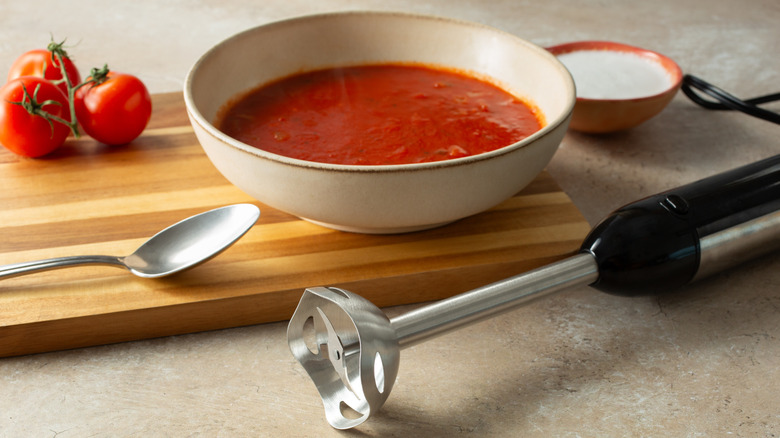
Some kitchen appliances get purchased, used once or twice, and then are mostly forgotten — in other words, you don't really need them. Others can be game changers and find frequent use. Wherever an immersion blender falls in that spectrum for you, it really helps to know the best way to use one in order to make the most of it. As helpful as they can be, one of the big problems with immersion blenders is the inevitable mess. But it doesn't have to be that way. You can blend soup and keep your kitchen clean. You just need a few tips from an expert to get you there — and the key one is full submersion.
To get to the bottom of immersion blender mastery, we spoke to Alana Kysar, author of the cookbook "Aloha Veggies: Veg-Forward Recipes Celebrating the Flavors of Hawai'i. Kysar has made plenty of soup, and says, "I find the key to success with an immersion blender is to start on low and work your way up to a higher speed. You also want to make sure it's fully submerged before you turn it on." When it comes to blending in general, she adds, "If you have something difficult to process, give it some pulses, which will help to break things up."
Kysar also offers a tip for ensuring you finish things up as cleanly as possible, since that's usually where potential mess comes in. "Make sure it's off before you lift it out of whatever you're blending," she reminds us.
Immersion or another version?
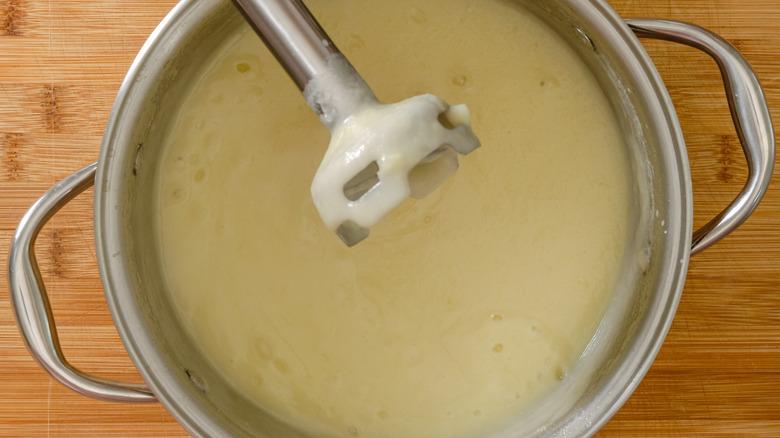
There are plenty of uses for your immersion blender other than blitzing soup. However, as with any job, there may be occasions when the immersion blender isn't the best option — which could be why you're making a mess. While an immersion blender is key for creamier dips, you can always choose a different option. "Transfer your mixture into a blender if you're worried about the mess," Kysar suggests.
The container you use also contributes to how messy things get with an immersion blender. Blending in a large, open saucepan may lead to more splatters than using a tall, narrower container, which will prevent the spatter. Part of that involves making sure the container is not overfilled. No matter what container you are using to blend your ingredients, if it's too full, that increases the chance of the liquid escaping and sticking to nearby surfaces.
Another technique tip is to not use your immersion blender straight up and down if you're blending in a larger bowl or saucepan. Hold it at a slight angle so that the blades mix downward. You don't want a deep angle here, just about 10° or so, so that it's still completely immersed but cannot form that powerful vortex right beneath the blades that can cause a splashing whirlpool effect. Once you get the hang of it, you'll be mess free in no time.