

Give Scotch Eggs A Vegetarian Spin With This Middle Eastern Swap
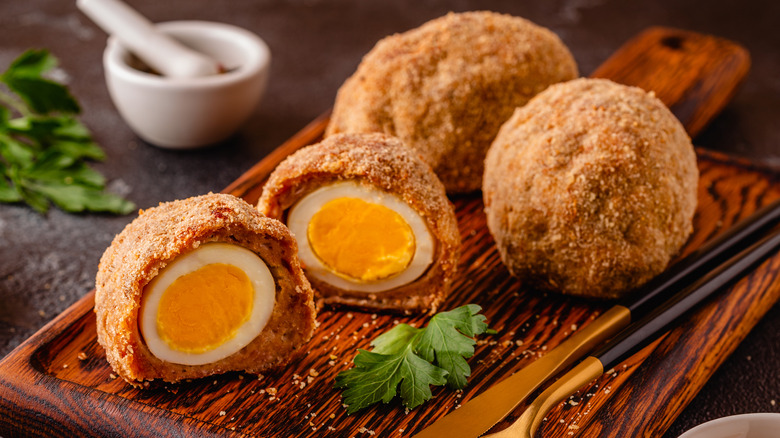
Scotch eggs are a pub food delicacy — a soft-boiled egg wrapped in a thin layer of sausage, coated in breadcrumbs, and then deep fried until crisp and delicious, ideally with a yolk in the center that is still runny. They are as heavy in the hand as they sit in the belly, a classic British dish that sticks to the ribs and girds one against the cold grey drizzle. There is, however, one simple substitution that you can make to this iconic snack that both lightens it and makes it vegetarian-friendly. Instead of coating the eggs in sausage and breadcrumbs, next time you have a hankering for a Scotch egg, consider using falafel for the outer layer.
This is, of course, a deviation from the norm, as even the most progressive Scotch eggs typically rely on just a vegan sausage substitute. But it might not be as unusual as it sounds. The origin of Scotch eggs does not, as you might expect, actually begin in Scotland. A centuries-old London corner shop called Fortnum & Mason claims to have made the first Scotch egg in 1738 as a snack for travelers heading out of Piccadilly. But the dish may actually have its roots in South Asia.
There is an Indian dish called nargis kebab or nargisi kofta that bears a striking resemblance to the Scotch egg. In this dish, hard-boiled eggs are wrapped in spiced ground meat, often lamb, and then deep fried and served in a creamy, spiced tomato gravy. It is quite likely that this was the inspiration for the first Scotch egg in London, with employees of the East India Company bringing home knowledge of the dish.
Falafel is the key to vegetarian-friendly Scotch eggs
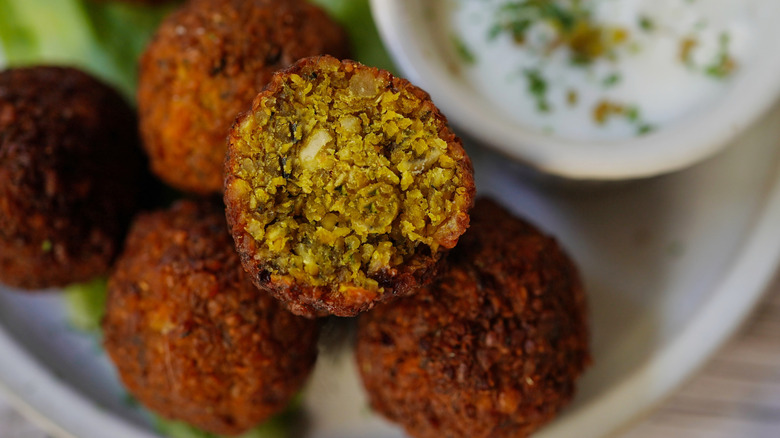
Regardless of how the first Scotch egg came to be, the existence of dishes like nargisi kofta in India, bolovo in Brazil, and vogelnestje — or "bird's nests" — in Belgium should make it clear that Scotch eggs are ripe for creativity.
Falafel is a Middle Eastern street food consisting of fried balls or patties of ground chickpeas or fava beans mixed with fresh herbs like parsley and cilantro, alliums like onion and garlic, and spices like cumin and coriander. By using falafel mix instead of ground meat to coat your eggs, you not only give the dish interesting new layers of flavor but also reduce its heaviness and invite an array of Mediterranean dipping sauces to serve alongside it. Rich, tangy tahini sauces are common with falafel, but so too are sauces centered around pungent garlic or cool yogurt. You can even serve these falafel eggs with hummus for a protein-packed and vegetarian-friendly snack.
Much as falafel itself can be baked, so too can your falafel-coated eggs make a trip to the oven instead of the deep fryer. It is important to mind the timing with Scotch eggs if you want to maintain that jammy yolk, but baking will still deliver a crisp exterior while significantly reducing the quantity of fat.
By all accounts, the Scotch egg was most likely born of a touchpoint between two culinary traditions. It found a place in British culture, but the original recipe lives on, and others have popped up around the world. The next step, it certainly seems, is continued creative growth, and falafel is begging to enter the picture.