

Waffle House Bacon Is Sourced From This Controversial Brand
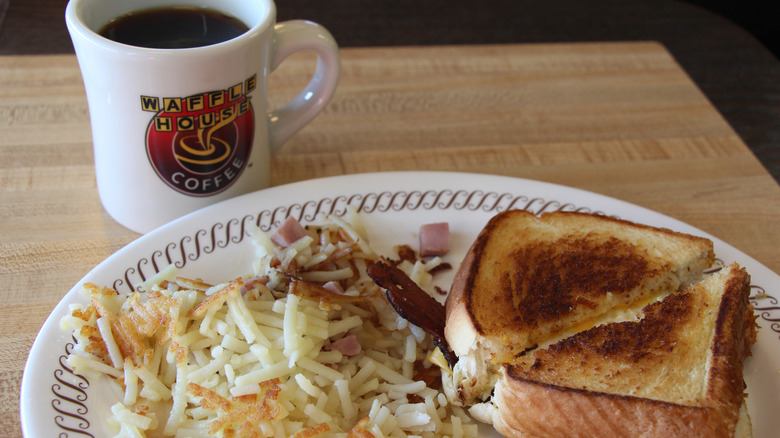
"I choose Waffle House for its high-quality food sourcing," said no Waffle House patron, ever. When an Atlanta location failed its health inspection in 2017, comedian @KevOnStage posted a video response to the news. "Anybody who's been to a Waffle House already knows that they're failing that health inspection," shouts the poster. "I know it's dirty, and I'm still eating it cause it's $4.70. Give me my All-Star Special [...] I want somebody behind the grill with a felony." Indeed, this vignette artfully captures the greasy, unpretentious Waffle House dogma, which seems to remain fairly consistent from one chain location to the next. Here at Tasting Table, we get it. After all, it was good enough for Anthony Bourdain, an outspoken Waffle House fan. What we don't get, however, is a glaring, fairly deceptive hole in the House's "what-you-see-is-what-you-get" tenet.
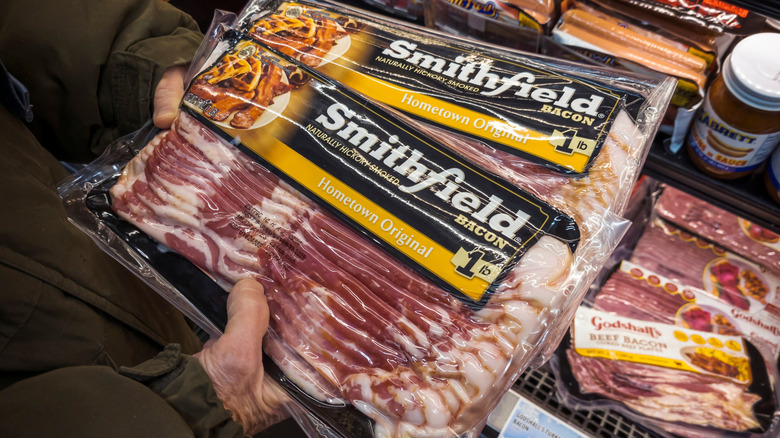
The restaurant's official site has an entire page dedicated to verifying that its bacon comes from Smithfield Foods. Waffle House seems to proudly emphasize the brand's "American-ness" (which isn't exactly true) and repeatedly insists that Smithfield is "a great American success story" and "the name Smithfield equate[s] to quality." In reality, however, the meat producer has long been mired in numerous, varied controversies that tell a very different story.
Serving up Smithfield at the Waffle House ... if anyone's paying attention
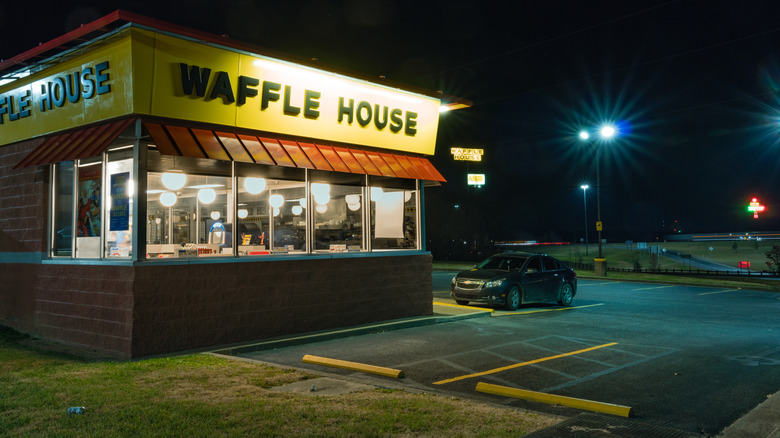
According to Waffle House, "All of Smithfield's U.S. fresh and packaged pork products are produced in the USA. They raise their hogs domestically," and all of the 17-million-plus pounds of bacon, ham, and pork chops served at Waffle House locations every single year come from Smithfield facilities in Clinton, North Carolina, and Middlesboro, Kentucky. What Waffle House neglects to mention is that the largest pork producer in America has been owned by a Chinese company since 2013. Purchased by Shuanghui International (now WH Group, one of China's largest meat producers) for $4.7 billion, it was the largest Chinese acquisition of an American company in history. Still, more than grayed national identity depictions, our chief issue with Waffle House's gilded portrait of the Smithfield brand is its erasure of the meat producer's well-documented shady ethics.
In 2024, an investigation by The Minnesota Department of Labor and Industry (DLI) discovered that Smithfield Packaged Meat Corp. illegally employed at least 11 minor children between the ages of 14 and 17 from 2021 to 2023, working late-night hours after 9:00 or even 11:00 p.m. on school nights (how ... American?). Smithfield had to pay a whopping $2 million in penalties, the largest sum ever collected by the DLI regarding child labor compliance. But, hey, surely Smithfield's sketchy business practice days are behind them now ... right? Wrong.
Waffle House's ultra-flattering depiction of Smithfield brand at odds with the restaurant's unflinchingly-open dogma
Also in 2024, industrial animal agriculture legal advocacy organization FarmSTAND filed a lawsuit in the Superior Court of the District of Columbia against Smithfield Foods, alleging chronic worker abuse during the COVID-19 pandemic, "as outbreak after outbreak swept through communities of meatpacking workers, who are mostly people of color." Then, last August, Smithfield was sued by the U.S. Equal Employment Opportunity Commission (EEOC) for workplace discrimination, including denying accommodation to and firing a pregnant employee at a North Carolina facility, one of the two states where Smithfield operates, where Waffle House sources its bacon.
Again last summer, independent nonprofit investigative journalism outlet Sentient Media reported that "Congress is being lobbied by Smithfield and other pork industry groups to slip language into the Farm Bill to gut the animal welfare protections of California's Proposition 12." Prop 12 is a livestock protection rule that bans the sale of meat products from animals raised in extreme confinement. So, yeah — it's bad. Employee and livestock welfare issues aside, lobbying for reduced confinement restrictions at the legislative level would almost certainly lead to a significant decline in pork product quality, resulting in worse bacon at Waffle House. Although it may be an apt fit. Waffle House sources its coffee from a historical 130-year-old roaster, and by our count, it still tastes pretty bad.