

9 Rules Hell's Kitchen Contestant Chefs Must Follow

It's been more than 20 years since "Hell's Kitchen" first aired, but the show is still going strong. And despite the fact that there is more competition than ever (thanks to streaming services) it is still one of the most popular shows around. In Q4 of 2025, YouGov ranked the series at number 79 in its list of 100 most popular contemporary TV shows. That might not initially seem that high, but it still managed to beat other firm favorites like "Top Chef," "The Voice," and "The Handmaid's Tale."
One of the key reasons why viewers keep tuning in, of course, is culinary icon Gordon Ramsay. But "Hell's Kitchen" wouldn't be anything without its contestants. If you've looked at the cast of the show and thought: "Maybe I could give it a go." But are a few rules you have to know about before you dive into an application (and maybe become one of the beloved winners of "Hell's Kitchen").
You have to give up contact with the outside world, keep a cool head, and consent to being mic'd up all the time. And that's not all — keep reading to find out more details about some of the important rules contestant chefs on "Hell's Kitchen" must follow.
No contact with the outside world

Most reality TV shows like to cut contestants off from reality during the filming process. Shows like "Love Island" and "The Traitors" don't allow their cast members phones or internet access, and "Hell's Kitchen" is much the same. In fact, one former contestant told the Akron Beacon Journal that they had to replace their smartwatch with an analog watch during their time on the show, and another reported to The Record that they weren't allowed a wallet with them while they were filming. On his personal blog, Season 10 runner-up Justin Antiorio even once suggested there were some similarities with "Hell's Kitchen" and the prison documentary series "Lockup."
There are a few reasons why reality TV shows are strict on outside contact. Firstly, it helps to avoid spoilers getting out before the show goes to air, but it also helps contestants focus on the show without any big distractions. In the past, some reality TV cast members have said that not having any contact with the outside world contributed to building up tension. This adds to the drama, which, of course, is the lifeblood of any reality TV show. "Hell's Kitchen" is not an exception to that rule. From Ramsay puking in trash cans to on-the-spot eliminations, the show runs on dramatic moments.
No TV, unless it's a Sunday

"Hell's Kitchen" contestants aren't just banned from talking to the outside world, they're also banned from finding out about current events. Well, at least most of the time anyway. According to the Akron Beacon Journal, contestants have said that while television was banned for most of the week while they were filming, they were allowed some down time on a Sunday to kick back in their hotel rooms and watch their favorite shows.
But if it's not a Sunday, the rules aren't getting broken. In fact, even talking about television seems to be a no-no. Cheyenne Nichols, who finished in fifth place on season 21 of "Hell's Kitchen," remembers that she once begged to find out who had won the Super Bowl, because it had fallen on a filming day. The production team stuck to their guns, though, and wouldn't tell her the result.
If you're thinking, well, maybe they should read instead? That's also a big nope, per reporting from the New York Times. According to Jen Yemola, who came in third place on season 3, she also had books, newspapers, and CDs confiscated from her prior to filming.
You can't run for office until one year after the show has broadcast

Sometimes, reality TV stars do go on to pursue political careers. One particularly obvious example is that President Donald Trump, of course, once hosted "The Apprentice." But what about cast members or contestants? It's rare, sure, but it has happened. Clay Aiken finished in second place on "American Idol" before he decided to run for congress — twice.
If you apply to go on "Hell's Kitchen," though, you'll need to be prepared to put any political ambitions on hold until at least a year after the show has broadcast. Yup, it's actually listed in the eligibility requirements that no contestants can become a political candidate within a year of their series making it to TV. And if you're already a candidate for public office, you won't be able to apply at all. Just something to bear in mind, in case you had dreams of becoming a politician and a chef at the same time.
That said, most contestants aren't interested in a political career, and many stay in the food industry in some capacity. Season six winner Ariel Fox went on to release a cookbook, for example, while season two winner Christina Wilson went on to work for several of Ramsay's restaurants.
If you know someone who works on Hell's Kitchen, you have to disclose it

There are actually quite a few eligibility requirements that you have to meet before you can even consider applying for "Hell's Kitchen." You have to be 21 years of age, for starters, and a legal resident in the U.S. It's also important that you declare it if you know anybody who works on the show in any capacity. This could mean someone who works for any "Hell's Kitchen" production companies or even any of the networks it might get broadcast on.
If you've got a family member or housemate who is involved in the development, production, or distribution of "Hell's Kitchen," that's also something you have to flag up. If the producers find out that you actually do know someone and you didn't let on, you might get kicked off the program. That said, if you disclose your connection, they might let you stay (depending on who they are and how well you know them, for example). In short: Honesty is the best policy.
You can't have appeared on more than two reality shows already before you apply

Reality TV has been around for decades. In fact, the very first reality show, "Candid Camera," actually aired before color TV was even a thing, in the 1940s. But it wasn't until the 2000s that reality TV turned into the juggernaut that we see today. "Hell's Kitchen" was a part of that boom; its very first episode aired in 2005.
Since the 2000s, reality TV has turned into a bonafide career path for some. It's not unusual to hop from show to show; Heidi Pratt, for example, has been on everything from "The Hills" to "Celebrity Big Brother" to "Famous Food." But if you want to go on "Hell's Kitchen," you'll need to keep your reality TV career to a minimum, at least until you've been on the show.
The eligibility requirements dictate that nobody can apply for the show if they've been on more than two TV shows with games or contestants in the five years beforehand. And they can't have been on more than one in the 12 months leading up to the first taping. After the show has aired, contestants are free to do as they please. Several contestants have gone on to appear on other cooking and hospitality-focused reality TV shows, like "Masterchef," "Chopped," and "Bar Rescue."
Hygiene and food safety must be taken seriously

It might seem obvious, but hygiene and food safety must always be taken seriously on "Hell's Kitchen," just as it would be in any other restaurant environment. Contestants who don't manage this will, without exception, face the wrath of Ramsay.
Unfortunately, though, there have been several incidents throughout the many series of "Hell's Kitchen" where contestants have failed to follow proper food safety protocol. In episode four of season four, for example, Ramsay was furious after one of the contestants served raw chicken to a child. The contestant was given a serious telling off (which isn't a surprise, as raw chicken is a serious salmonella risk), but he wasn't dismissed from service.
Other contestants had to face more severe consequences for poor food safety practices, though. Garret Telle, for example, a contestant who appeared on season two, was eliminated for serving raw meat on several occasions. In season 20, contestant Matthew Francis Johnson was booted off the show after serving up several raw dishes and shrimp that hadn't been cleaned.
Things can't get physical

Filming "Hell's Kitchen" is an incredibly tense and stressful environment. Contestants aren't allowed to see their families, they're under immense pressure to succeed on the show, and they have to deal with Gordon Ramsay shouting at them (which happens a lot, although he is nice sometimes). This might be enough to make some people crack and resort to violence, but, of course, getting physical with anyone is a big no-no.
That doesn't mean it hasn't come close, though. On episode three of season six, former marine Joseph Tinnelly actually squared up to Ramsay. After the celebrity chef's bodyguards stepped in to defend him, Ramsay instructed Tinnelly to leave the kitchen immediately. Unsurprisingly, he was eliminated from the show after that.
The "Hell's Kitchen" production team is well aware that things could come to blows on the show. In fact, according to former contestants, Ramsay is always flanked by bodyguards for that reason. Season 6 contestant Robert Hesse told the New York Post that Ramsay's bodyguards are "Suge Knight-looking guys waiting to break some necks."
Microphones are mandatory, 24 hours a day
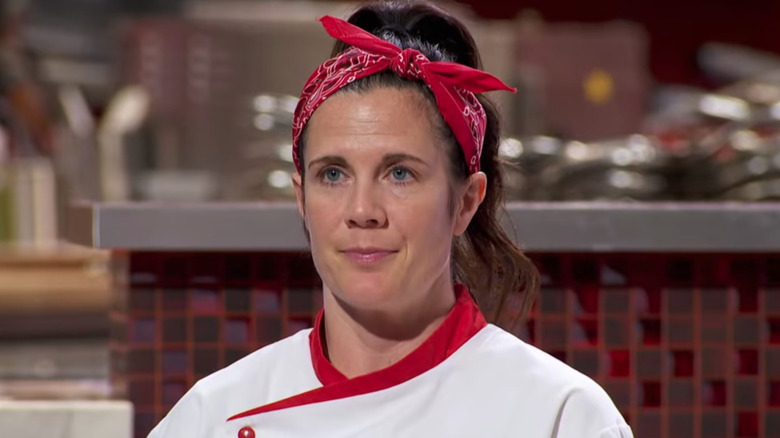
You might think that, given how stressful filming "Hell's Kitchen" can be, the contestants might be given a break when it's time to sleep. According to former cast members though, that's not entirely the case. In fact, according to Dana Cohen, who finished third in season 10 and also appeared again on the show in season 17, microphones have to be worn constantly. Yup, like, even when people are trying to catch some shut eye.
Cohen explained to The Record that production staff would actually reach into their shirts to change microphone batteries while contestants were asleep. "You get so used to not being in control," she said.
The former contestant added that there was no relief from the cameras, either. She explained that they would even be followed to the bathroom by camera operators. But contestants did get pretty savvy. Cohen said that because they knew "Hell's Kitchen" couldn't air copyrighted songs, they would sing whenever they wanted a private moment alone.
After elimination, you have to see a psychiatrist
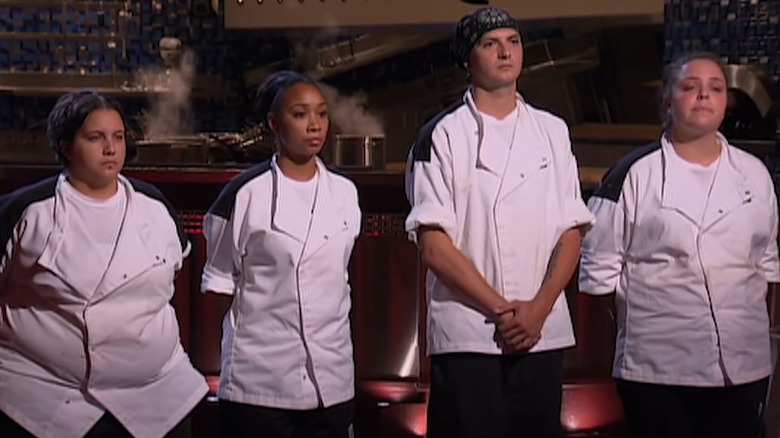
After care has become more important in the reality TV world in recent years. The industry is under pressure for the serious impact it can have on people's mental health. Tragically, there has been more than one suicide associated with the industry.
After coming out of "Hell's Kitchen," contestants don't go straight back into the real world. According to reporting by the New York Post, people who have worked on the show, they must instead visit a psychiatrist for a full mental health evaluation. After that, they then go on to a separate house, away from their hotel accommodation, to decompress. While they are there, they have access to everything from haircuts to massages.
That said, things can still be pretty tough for former "Hell's Kitchen" contestants. Multiple people have spoken out against the conditions on the show. Jen Yemola told the New York Post that she was extremely stressed and "borderline suicidal" after she was eliminated from season three.