

7 Things You Need To Know Before Investing In Stainless Steel Countertops
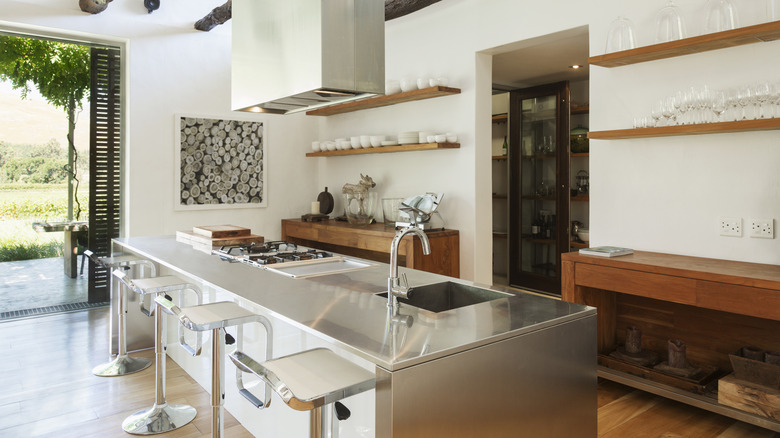
Peek into any industrial kitchen and you'll likely find top-to-bottom stainless steel. From countertops and appliances to cookware, the sleek, sturdy, easy-to-clean material is abundant in commercial kitchens for a reason. So if you're in the process of finding the perfect countertop material for your own home kitchen, stainless steel may feel like an obvious choice. After all, it works for the pros, so why not bring the look home?
As with any material, there are advantages and disadvantages that may make you think twice about installing stainless steel countertops in your home kitchen. Factors like cost, customization, maintenance, and durability can influence whether the choice fits into your personal cooking habits, lifestyle, and overall kitchen design goals. We spoke to experts Artem Kropovinsky, interior designer and founder of New York design firm Arsight Studio, Joe Hunnisett, president and CEO of Ridalco Stainless Steel, and Jennie Bishop, founding principal at interior design firm Bishop Studio, to learn more about the benefits and pitfalls of the material for residential kitchen countertops.
Stainless steel countertops are heat resistant
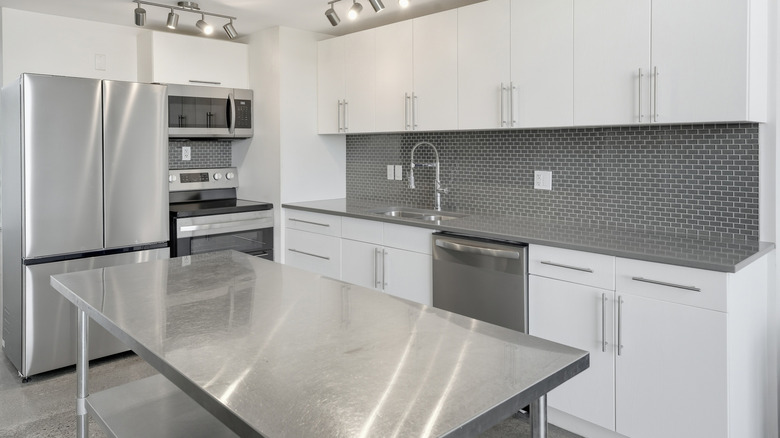
The most compelling argument in favor of stainless steel countertops is their natural heat resistance. "Hot pans are generally not an issue in the way they can be for many engineered surfaces," says interior designer Artem Kropovinsky. Unlike materials like quartz or laminate, which can crack, warp, and discolor when they come in contact with high heat, stainless steel countertops absorb heat well and without any adverse side effects. According to fabricator Joe Hunnisett, it is safe to place the hot pans directly onto the stainless steel.
There is a limit to this heat resistance, of course, but the material's max temperature (up to 2,000 F for standard grades) is far hotter than the average home cook's pans — or professional cook's, for that matter — will ever need to reach. So if you're on a mission to retire your worn-out trivets, stainless steel countertops may be the solution.
The material is low-maintenance
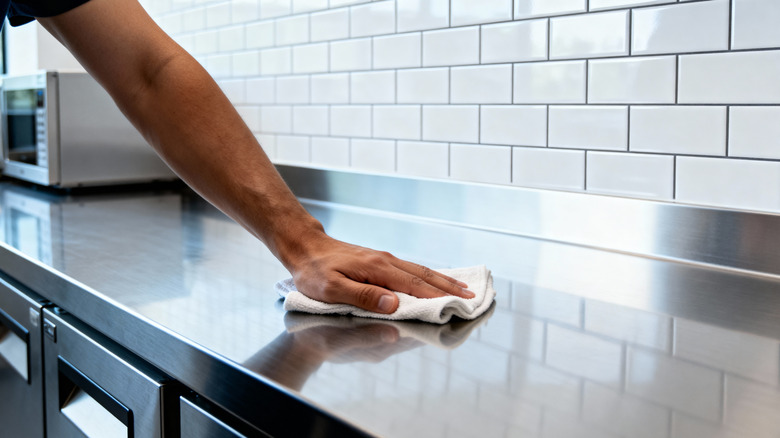
Another major advantage of stainless steel? The material has a smooth, non-porous surface, which means there are no holes that can harbor food particles or bacteria. "Stainless steel is a true [highly functional] surface," says Artem Kropovinsky. "It does not absorb oils, wine, or acids," he says, noting that spills are easily wiped away, with no staining or odors left behind. Pro tip: You can make your stainless steel sparkle with a mixture of olive oil and vinegar.
More porous materials, like marble and concrete, require higher levels of maintenance to keep clean. Granite and marble, for example, need to be sealed immediately after installation and re-sealed annually to keep countertops in good condition; concrete countertops are also porous and require sealing to prevent water absorption and staining. Stainless steel countertops do not require any of that.
"Daily care is simple," Kropovinsky says, advising that all you need is warm water, a mild dish soap, and a soft cloth to keep them clean. "For streak-free results, wipe in the direction of the grain and dry after cleaning," he says. You can even try wiping them down with club soda to tackle fingerprints fast.
The countertops scratch easily
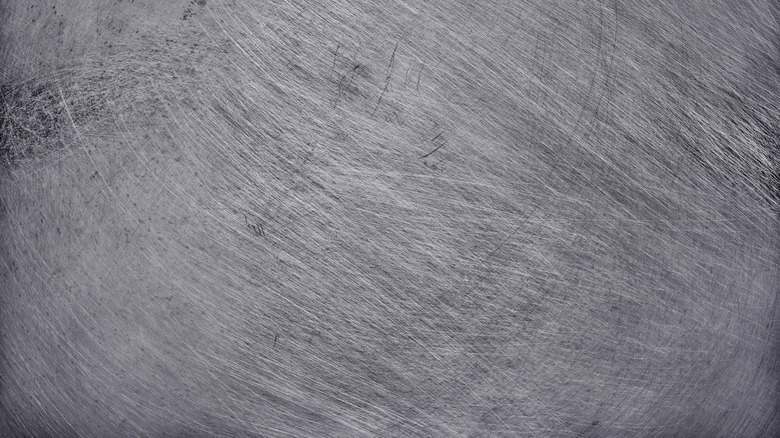
Despite its stellar heat resistance and limited daily maintenance, stainless steel is not actually indestructible. Joe Hunnisett says that they can show scratches, although he notes that those scratches do not affect the countertop's integrity; they are merely aesthetic. According to Artem Kropovinsky, the material is also prone to dents, especially in thinner gauges. But for some homeowners, those marks and dings may add to the charm. "Stainless steel is a lifestyle choice as much as a material choice," he says. "If you like materials that age honestly and tell a story, stainless is fantastic."
If scratches are a concern, however, interior designer Jennie Bishop says homeowners can opt for intentionally worn finishes. "If you are not someone to handle patina and inconsistency with wear," she says, "consider radial stainless steel (sometimes vintage stainless) with a pre-textured surface," she says. It's pre-buffed, which helps minimize the appearance of new scratches.
For whatever finish you choose, Kropovinsky advises that homeowners clean stainless steel countertops with a microfiber cloth and stainless steel cleaner rather than using abrasive sponges and powdered cleansers, which can create uneven scratching. "But the best maintenance is accepting that this surface is meant to be lived on and will develop a consistent patina," he says.
Stainless steel may be a sustainable option
According to Joe Hunnisett, "stainless steel is recyclable and fabricated countertops are usually made from recycled stainless steel." Data gathered by Team Stainless suggests that as of 2019, 95% of all stainless steel is recycled once it reaches the end of its life, and 70% of that recycled material is used to make new stainless steel. But according to Artem Kropovinsky, metal production requires high energy intensity, so if you're considering bringing stainless steel home and are concerned about sustainability, it is worth asking fabricators about their material's recycled content and sourcing to ensure your new countertops were created responsibly and transparently.
The material's eco-friendliness doesn't end at its recyclability. Stainless steel countertops can last a lifetime. This matters, says Kropovinsky, because "the most sustainable countertop is the one you do not replace." Fewer replacements means fewer materials sourced, manufactured, transported, and ultimately discarded over time, so be sure to keep yours pristine.
It's a modern addition to your kitchen
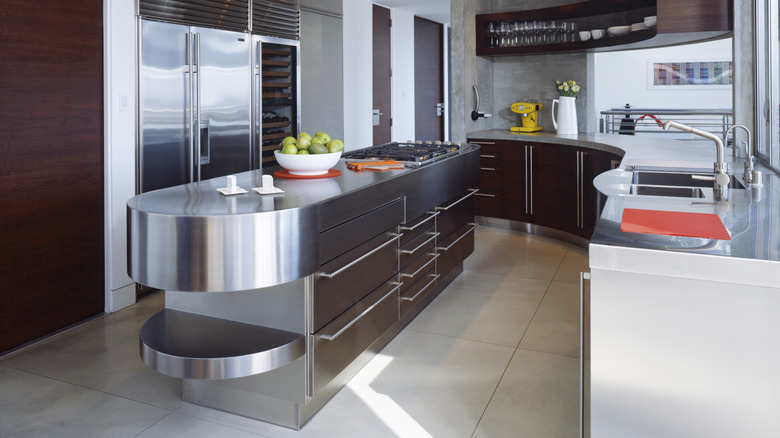
One of the biggest draws for homeowners is stainless steel's sleek, restaurant-kitchen aesthetic. Artem Kropovinsky calls it a "clean and professional look that pairs beautifully with modern and minimalist kitchens." Joe Hunnisett applauds the material's versatility, pointing out that it "reflects light, making spaces feel larger and brighter," and adds that it easily pairs with all types of color and decor.
"Design-wise, stainless steel can look incredibly refined when it is detailed well," Kropovinsky says. "Integrated sinks, seamless backsplashes, and crisp edges create a sculptural, monolithic effect that is hard to achieve with stone." But there are limitations, he says, cautioning that stainless steel appears cooler in color. Without warm elements, like wood and soft lighting, the space can feel clinical. As with any space, mixing textures and materials makes for more balanced design.
"Some find the look too commercial, cold, or sterile," adds Hunnisett, while "others like the sleek, modern, 'working kitchen' look." It's all about personal preference and the right styling. Kropovinsky's advice? "Choose the right finish and thickness, work with a strong fabricator, and balance it with warmer materials so the kitchen feels inviting, not sterile."
Installation is simple, but fabrication is not
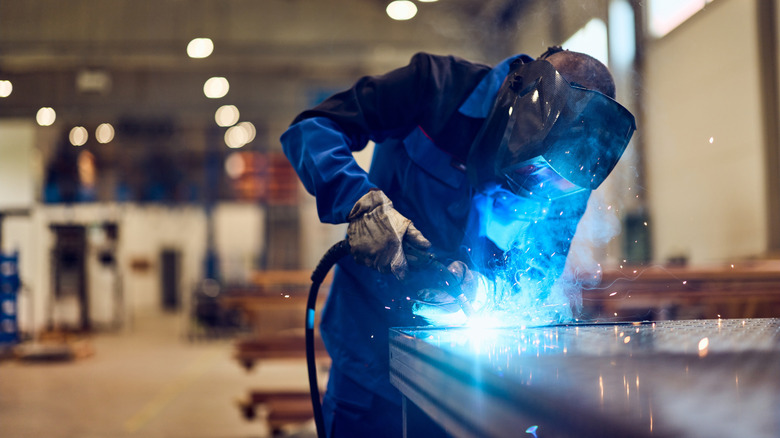
Stainless steel countertops typically call for professional fabrication because they require specialized welding and custom edge detailing that beginner DIYers may not have the skills to execute. "Installation is not a casual DIY item. It is typically fabricated to precise templates, often wrapped over a substrate, and it needs proper support, clean transitions at seams, and thoughtful edge detailing," says Artem Kropovinsky.
However, this custom fabrication may not be entirely a bad thing, as it allows for greater personalization. "Countertops can be fabricated to fit almost any size, shape or design and can include integrally welded in stainless steel sinks as one seamless unit," says Joe Hunnisett.
Once the countertops have been fabricated, installation is relatively simple, says Hunnisett. "Sit the countertop on the cabinets, [level and shim] if necessary and install some screws from the cabinets below into the wood core of the countertop to hold securely in place." So if you're on a mission to DIY your kitchen renovation, you may want to consider professional fabrication and save the amateur work for installation.
Fabrication may drive up costs
According to Joe Hunnisett, because stainless steel countertops are custom fabricated and handmade — rather than cut — they can be more expensive than other types of countertops, depending on features like the edge profile, shape, and if there are integrally welded sinks or not. "Steps in the fabrication process involve a significant amount of specialized equipment and skilled tradespeople," he says, sharing that steps like templating, computer drawing, cutting, bending and forming, fitting, welding, and polishing all add to the overall cost.
Artem Kropovinsky agrees, cautioning that costs can range widely. "Price is driven by thickness and gauge, finish, edge complexity, whether you add an integrated sink or backsplash, how many seams are required, and the level of craftsmanship from the fabricator." He adds: "A simple rectangular run costs very differently than a fully integrated, custom piece."