

What Happens To Leftovers At 10 Chain Restaurants
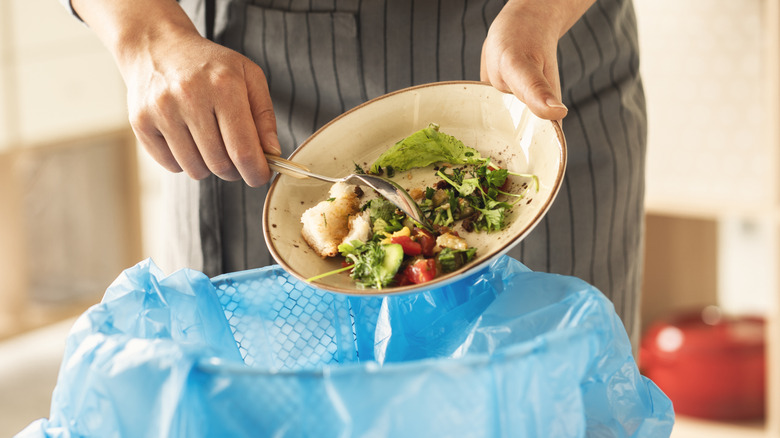
Food waste in America is a significant and persistent problem that often goes unnoticed. According to a 2010 USDA study, 30-40% of our country's entire food supply winds up in landfills each year — almost 70 million tons. That's about $161 billion worth of food, meaning the average family's food waste totals around $3,000 a year. And while an enormous portion of our food supply is simply thrown away, roughly 48 million Americans — including one in five children — experience food insecurity (per Feeding America).
It's not just spoiled groceries that are contributing to the huge amount of food waste. Expired supermarket goods and unused restaurant ingredients are also a big part of the problem, with many large companies claiming they fear being sued if their donated food makes someone sick. While this may be true to some extent, we can't ignore the fact that some retailers dispose of perfectly edible food that doesn't meet their aesthetic standards, or that throwing food out is cheaper than repackaging it for donation.
Fortunately, some American restaurant chains have recognized the impact of unnecessary food waste and have taken steps to address the problem. To learn more, we reached out to the representatives of some popular U.S. restaurant chains to discuss their food waste practices. Along with information gathered from public statements, these discussions helped us get a better idea of how exactly these beloved institutions are tackling the catastrophic — yet largely overlooked — food waste problem in our society.
Shake Shack
On top of its acclaimed burgers and milkshakes, Shake Shack is also known for taking its environmental footprint more seriously than the average fast food chain. The company adheres to strict animal welfare standards, uses sustainable materials in its restaurants, and takes steps to reduce food waste by working to avoid it in the first place.
"While Shake Shack does not have a formal food waste policy, the company works diligently behind the scenes to minimize waste across operations," explained a brand representative. "Because all Shake Shack food is cooked to order, the amount of food waste generated is minimal, particularly compared to full-service restaurants, which tend to have significantly more prep-related waste." However, the representative noted that Shake Shack tries to recover food and reduce waste where possible.
Shake Shack also works with national food assistance organizations to supply thousands of meals made from excess ingredients to those facing hunger. In 2024 alone, the company supplied nearly 3,000 pounds of ingredients to Feeding America, the largest hunger-relief organization in the country. Plus, whenever a new location opens, Shake Shack partners with Food Recovery Network, a student-led nonprofit devoted to saving and redistributing food within local communities. Shake Shack also joined forces with Mill — a company that produces food recyclers — to pilot one of its machines at the chain's West Village location, converting food waste into a nutrient-rich feed additive for independent chicken farmers.
Chipotle
Chipotle doesn't operate like a typical fast food eatery, which is a big part of the chain's appeal. Ingredients like tender barbacoa beef, zesty guacamole, and fresh pico de gallo are prepared in large batches and added to burritos, salads, and bowls upon request. This service model seems like it could produce an excessive amount of waste, especially if business is unexpectedly slow. However, according to Chipotle, the company takes steps to minimize waste as much as possible.
Laurie Schalow, Chief Corporate Affairs and Food Safety Officer for Chipotle, told us that the company takes specific measures to reduce food waste as part of its mission to "Cultivate a Better World." "Employees are trained to prepare fresh food in small batches throughout the day, ensuring optimal quality while minimizing overproduction," says Schalow. "In addition, precise inventory management and meticulous forecasting help us purchase only what is needed for each restaurant."
Through Chipotle's Harvest Program, edible food is donated to local charities and distribution centers to prevent it from going to waste. In 2024, the company donated a whopping 405,000 pounds of fresh food via this initiative.
Chick-fil-A
Chick-fil-A's iconic chicken sandwich is beloved across America, but most fans of the chain are unaware of its impressive efforts to mitigate food waste. About 30 years ago, franchise owner-operator Marshal Wilkins made a modest food donation to a local Knoxville soup kitchen. Inspired by Wilkins' small act of kindness, more and more Chick-fil-A locations followed suit. In 2012, the company made the Shared Table program an official corporate social responsibility initiative.
According to a Chick-fil-A representative, over 2,500 locations take part in the Shared Table program, which has served over 42 million meals since it launched. "The concept behind the Chick-fil-A Shared Table program is simple: restaurants package surplus food, such as biscuits, Chick-fil-A nuggets, and other prepared items. Nonprofits and organizations schedule a time to pick up the donated food, which they then transform into new meals." The company claims the program has managed to save nearly 62 million pounds of food from landfills since 2020.
Chick-fil-A even created a cookbook, "Extra Helpings," containing recipes developed by its donation partners over the years. Wholesome dishes include a waffle potato fry frittata, a chicken pot pie, and an apple cobbler — all stretched out using Chick-fil-A's unsold ingredients.
Starbucks
Stores that primarily serve baked goods are at risk of wasting a lot of food. After a day or so, most of these items aren't fresh enough to sell, even if they're still perfectly safe to eat. In 2016, Starbucks employees had grown concerned about the quantity of food waste in their stores and called for the company to launch a food donation program. Their efforts weren't in vain: Starbucks launched its FoodShare program that same year, providing ready-to-eat food to those in need.
"Through FoodShare, Starbucks equips 100% of company-operated stores in the U.S. and Canada to donate eligible unsold food rather than sending it to landfills," a company spokesperson told us. "They execute this through a unique backhaul model where Starbucks partners [employees] package the food, the brand delivers unsold food to a distribution center, then the food is reallocated to local food banks and pantries." This approach helps Starbucks' partner organizations by allowing them to concentrate solely on food distribution, rather than packaging and logistics.
Since launching, the FoodShare program has diverted over 111 million meals' worth of food from landfills to the tables of those who need it most. The spokesperson told us that while Starbucks receives a federal tax benefit for donating food, every penny is reinvested back into its food waste initiatives. To date, the company has put more than $100 million toward its food waste reduction and hunger relief efforts.
The Cheesecake Factory
The Cheesecake Factory is famous for its massive menu, which contains over 250 dishes, mostly made from scratch — it's safe to assume that the chain is no stranger to food waste. However, according to Alethea Rowe, Senior Director of Public Relations and Global Branding, the company makes substantial efforts to prevent its restaurants from contributing to the billions of pounds of food thrown away every year.
The Cheesecake Factory has teamed up with Copia — a company that builds software tools to help businesses redistribute unsold food – to develop its Nourish Program. With the help of Copia's tech, the Nourish Program matches excess food with local nonprofits, who are better equipped to allocate it to those in need. "In 2025, working with over 700 local nonprofits across the country, we donated more than 1 million pounds of food to local communities through our Nourish Program," says Rowe. "Since 2007, we have donated more than 9.7 million pounds of food to local nonprofits, helping to not only alleviate hunger, but also combat greenhouse gas emissions, reduce water consumption, and send less material to landfill."
The Cheesecake Factory also allocates funds from the sales of specific cheesecakes directly to Feeding America, the country's largest hunger-relief organization. Since 2008, the company has donated nearly $7 million to the nonprofit, helping to stock and staff food banks and fund programs that provide millions of meals to Americans in need.
McDonald's
When most of us think of fast food, McDonald's is usually the first place that springs to mind. The chain epitomizes America's love affair with fast food, boasting nearly 14,000 locations across the country. With that many restaurants, there's sure to be plenty of wastage, but McDonald's has tried to divert its food waste from landfills to hungry Americans.
McDonald's has adopted a version of the U.S. Environmental Protection Agency's (EPA) Food Recovery Hierarchy to mitigate waste at its restaurants. This system aims to create a list of food waste priorities, which begin with avoiding waste in the first place. For example, if waste is inevitable, donation should be prioritized, followed by upcycling into other food products, then using it as animal feed. Food should only be incinerated or sent to the landfill as a last resort.
During the COVID-19 pandemic, McDonald's found itself with a huge surplus of ingredients at a time when food insecurity was soaring. In response, the company worked with Food Donation Connection, The Global FoodBanking Network (GFN), and Feeding America to distribute this excess to those who needed it the most. Between March and June of 2020, the beloved brand donated over 9 million pounds of food to food banks around the country. However, post-pandemic, it's unclear whether McDonald's has continued its efforts.
Wendy's
Famed for its Baconator burgers and Frosty desserts, Wendy's claims that its operations are so efficient that it rarely creates enough food waste at its restaurants to be worth donating. The chain regularly evaluates products for quality assurance at its Restaurant Support Center, but says that it is always working to reduce the overall volume of food required for sampling to minimize waste. Wendy's says this means it's able to cut down on excess ingredients before new menu items ever reach its restaurants, which reduces food wastage across the entire business.
Wendy's reports that when there is food leftover after testing, it is redirected rather than discarded. Unused product samples from Wendy's Four Corner Café, Quality Assurance Kitchen, and Innovation Test Kitchen are donated to local hunger-relief organizations, including the Mid-Ohio Food Collective and the Plain City Food Bank. These groups are based near Wendy's corporate operations, allowing food to move quickly from its test kitchens to its community partners.
In 2019, Wendy's committed to reducing food loss and waste by 50% in company-operated locations by 2030, matching the national target set by the U.S. Department of Agriculture and Environmental Protection Agency in 2015. In Wendy's latest Corporate Responsibility Report, the company notes that it has made improvements in collecting food waste data and that it is embracing artificial intelligence to improve inventory management; however, it is still unclear whether Wendy's is actually on track to achieve its waste reduction targets.
Dunkin'
Like Starbucks, Dunkin' may have a higher potential for food waste than other chains on this list. Although there are plenty of creative ways to use up extra donuts, companies that primarily offer baked goods don't typically resell items after a certain timeframe. Pastries tend to be noticeably less fresh after just a day, even if they're still edible. To prevent thousands of donuts and other food products from going to waste, Dunkin' franchisees can opt in to an End of Day Donation program, meaning unsold, ready-to-eat items can be collected by local nonprofits instead of being tossed in a dumpster.
One Dunkin' franchisee who operates 10 locations around Portland, Maine, has also launched a highly successful composting initiative. Over the course of eight years, Kim Wolak and her employees have diverted around 3.7 million pounds of waste — predominantly spent coffee grounds — away from landfills. The compost is donated to local Maine schools and community gardens, with the remainder sent to regional garden centers and landscapers. Dunkin' has acknowledged Wolak's efforts and says it is committed to giving franchisees the resources required to pursue environmental sustainability initiatives; however, it remains unclear what these resources are.
Olive Garden
Darden Restaurants, the parent company of Olive Garden, says that food accounts for more wastage at its restaurants than anything else. Besides attempting to minimize wastage through accurate forecasting, the company focuses its efforts on keeping edible food out of landfills. Darden tracks food waste across the locations it owns and operates, and reports that a significant portion is recycled, composted, and reused. This includes the recycling of used cooking oil at all of its U.S. restaurants.
One of the company's most notable food waste-reduction initiatives is its Harvest food donation program. Through this initiative, Olive Garden sets aside leftover food that's still safe to eat — primarily vegetables, proteins, soups, and sauces – and donates it to local nonprofit organizations. The program has been going strong since 2003, and has resulted in more than 146 million pounds of food going to hungry people rather than a landfill.
Panera Bread
Panera Bread only offers freshly baked goods at its restaurants, but this can result in a lot of waste at the end of each day. To combat food wastage, the company's Day-End Dough-Nation program donates unsold bread, bagels, and other baked goods to local nonprofit organizations each night, instead of throwing them in the trash. The program is in place at Panera Bread locations nationwide, and focuses on food that has a short shelf life but is still safe to eat. While the program doesn't completely eliminate overproduction, it does keep large volumes of food out of landfills by putting it in the hands of local food-access networks.
Panera Bread partners with thousands of community-based nonprofits across the U.S. to distribute its food donations. Rather than distributing food to a single type of organization, the donations are routed through a wide range of local programs, including food pantries, soup kitchens, emergency housing shelters, and food rescue agencies. Donations are also sent to after-school programs, backpack meal programs, domestic violence shelters, veteran services, and various housing and support services.