

Forget About Joe — Why Soldiers In WWI Called Coffee A 'Cup Of George'
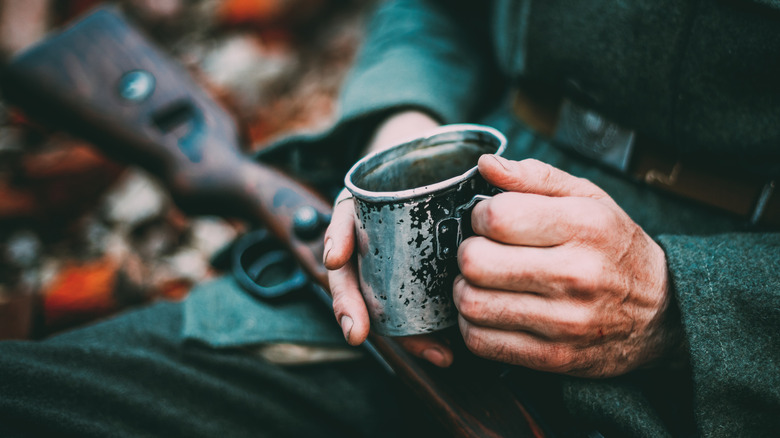
War may deal more with destruction than creation, but countless thrifty culinary geneses have resulted out of wartime, from Spam musubi to "emergency steak." Today, we're shining the spotlight on one ingenious, convenience-centric epicurean invention that came from World War I, and that many foodies on the home front likely still have stocked in their kitchens right now. Originally, instant coffee was invented as a tool for making hot coffee possible for soldiers on the battlefield — portable, shelf-stable, and requiring only water to prepare. Coffee is famously known by the moniker "cup of Joe," but for soldiers on the front lines of the Great War, it was first called a "cup of George."
In 1853, U.S. food scientists developed a cake-form instant coffee product, which was released to Civil War soldiers on both the North and South sides of the fight. During this war (and seemingly every conflict thereafter), coffee became an important tool for morale and camaraderie. According to a New York Times article by Jon Grinspan, a curator at the Smithsonian's National Museum of American History, Union soldiers were issued a whopping 36 pounds of coffee beans as part of their annual rations. "Men ground the beans themselves (some carbines even had built-in grinders) and brewed it in little pots called muckets," writes Grinspan. "They spent much of their downtime discussing the quality of that morning's brew," as recorded in diaries from the time. The advent of powdered instant coffee would have increased accessibility exponentially.
George Washington Coffee Refining Co. dominated the instant coffee market in the early 1900s
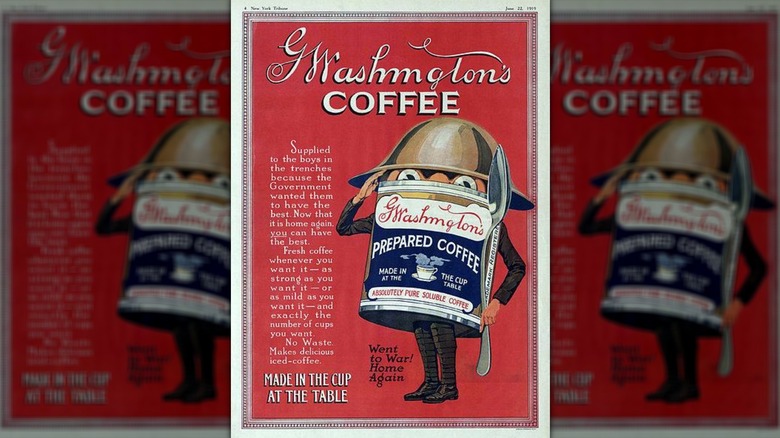
Fast forward to 1901. After decades of research and development, Dr. Satori Kato, a Japanese chemist based in Chicago, successfully manufactured instant coffee in a soluble powder form. Kato introduced the product at the Pan-American Exposition in Buffalo, N.Y., secured a patent in 1903, and joined forces with Brooklyn-based inventor George Washington (disambiguation from the Father of America) to distribute the product on a commercial level. 1910 saw the debut of the G. Washington Coffee Refining Co.'s "Red E Coffee." Then, on June 28, 1914, Archduke Franz Ferdinand was assassinated, and World War I erupted across the globe.
Thanks to Kato's invention, servicemen worldwide could start their days with a cup of coffee — which, under the George Washington brand name, quickly gained the nickname "cup of George." During WWI, sales of instant coffee skyrocketed. According to the U.S. Army, the Department of Defense bought up to 37,000 pounds of powdered instant coffee every single day, which were distributed to soldiers in ¼-ounce envelopes. To pair with their cups of George, the Salvation Army led an impressive front of its own by frying donuts for WWI soldiers. Indeed, George filled innumerable cups as the brand continued to dominate the market ... that is, until 1938, when Nestlé launched Nescafé. As for the colloquialism, by the start of WWII in 1939, servicemen had adopted "cup of Joe" into their lexicon as the prevailing term for their beloved brew.