

8 Old-School Food Customs That Have Nearly Vanished

Customs are part of what ties families, communities, and cultures together. Food is an important element of daily life, so it's only natural for us to develop traditions and habits centered around meals and eating. Over the years, customs come and go, with some spanning generations and others more fleeting. They're typically regionally specific since they are intrinsically tied to culture. It's no surprise that visiting other countries often leaves travelers curious, perplexed, and unsure of the right etiquette in a given dining situation.
Nowadays, food traditions in the U.S. often revolve around the recipes and dishes themselves, but in the past, they were more intertwined with the context and circumstances. Some had to do with brand new products that briefly overtook the market, whereas others became customary due to practical reasons. These old-school food customs may still be occurring in small pockets of the country, but nowhere to the extent they did in the past. You might recognize some of these traditions from family stories or movies, but for the most part, they've nearly vanished.
1. Having community hog killing suppers
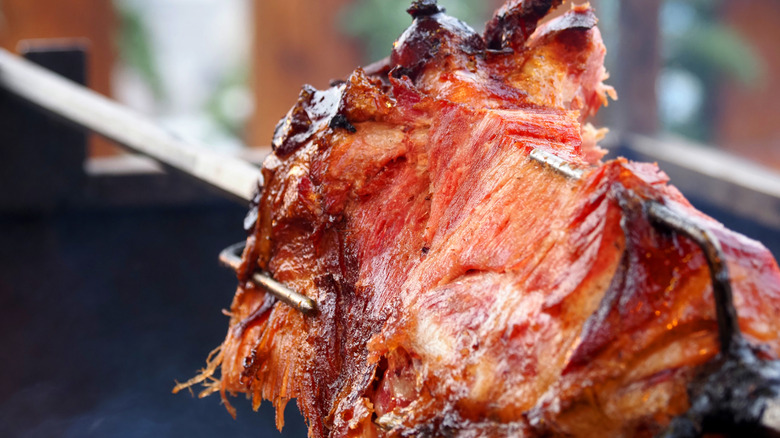
Hunting has been customary since, well, the hunters and gatherers, but it's looked different over time. In the deep South, hog killing was a wintertime community tradition that brought families together, leaving them with sustenance for months to come. It typically occurred during this season to guarantee extended cold temperatures to keep the meat fresh. In a time before refrigeration existed, and even into the 1950s, when it was not yet commonplace across the country, it was essential to preserve and make use of all parts of the animal (or animals — often multiple hogs were killed). The meat was pickled, smoked, cured, and prepared among the community to ensure it would last.
Aside from the practical aspect of this tradition and nose-to-tail butchering, hog killing united rural communities around this particular task. People shared skills, lent each other a hand, and spent time together working on a collective effort that would benefit them all. By the 1950s, hog killing customs began to die down, and today it is no longer a mainstay of rural communities. Nevertheless, it remains an occasional culinary tradition in some parts of the country and world, highlighting the farm-to-table movement.
2. Hosting fondue nights
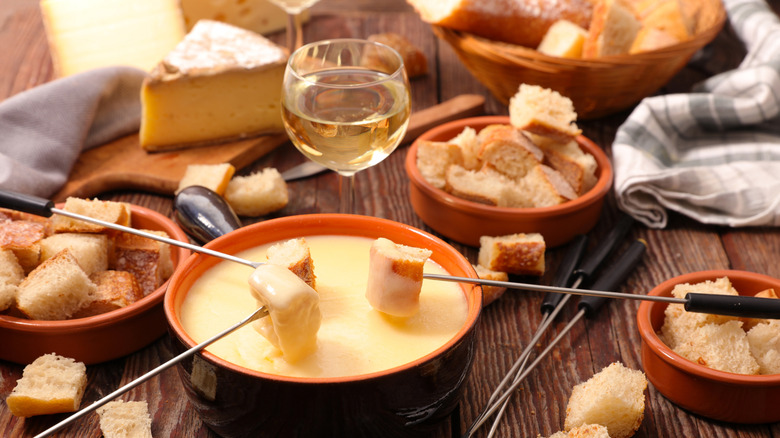
Although people still eat fondue occasionally, such as at Chinese hot pot restaurants, it's nothing compared to the meal's heyday in the 1960s and 1970s. At the time, it was customary to invite friends and family over for a fondue party. While there are several types of fondue, the cheese version became especially popular in those years, thanks to Swiss influence. At the New York World Fair in 1964, the Swiss pavilion consisted of an alpine-style restaurant complete with cheese fondue. The rich concoction became an instant hit, bolstered by the increase in communal dining traditions at the time.
For hosts eager to enjoy time with their guests while offering a simple and satisfying meal, cheese fondue was the perfect solution. The packaged format came together in no time, and hosts could sit around and savor the meal instead of having to spend half the time preparing and serving food. Meanwhile, broth or oil fondue, similar to Japanese shabu shabu or Chinese hot pot, were other ways to enjoy the hands-off meal. Hosts just had to set out a spread of raw vegetables, thinly sliced meats, and sauces, and dinner was served. To cap off the night, fruit dipped in chocolate fondue was a no-brainer. The extra equipment required to pull off a fondue party has made it less common among modern generations, though this custom hasn't entirely vanished.
3. Making fruitcake for the holidays
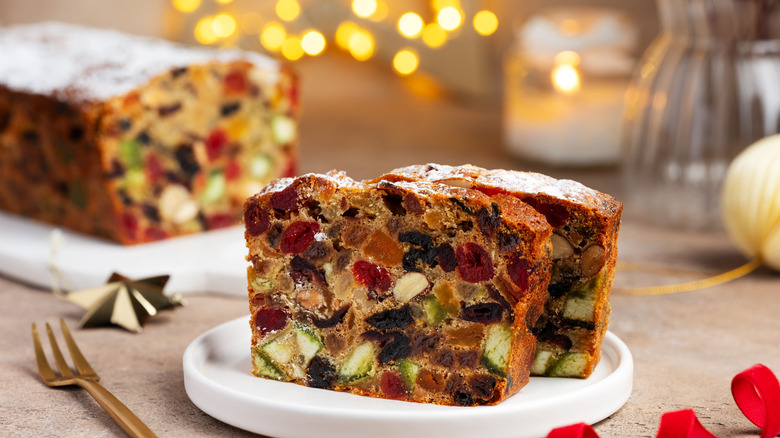
Some recipes are inherently linked to certain holidays, seasons, or occasions. This is certainly the case with fruitcake, which has its origins in England, first known as a plum cake and served at Christmas. The recipes have varied over the past few centuries, with the cake crossing the Atlantic and becoming a holiday and wedding tradition in the U.S.
Per its name, the cake is made up of plenty of dried fruit soaked in wine and brandy, and it's often brushed with more brandy once baked. For longer storage, it's wrapped in cheesecloth and soaked in even more brandy. These components certainly boost the shelf life, and fruitcake can last a surprising amount of time.
Fruitcake was traditionally served at Christmas, in part because it was packed with luxurious, sweet ingredients that would have been hard to come by in Victorian England when it was initially rising in popularity. Furthermore, the process of making fruitcake is long and requires some planning ahead, due to the soaking and curing stages, so preparing it for a celebration would make sense.
4. Receiving milk daily on your doorstep

Once upon a time, Americans had the convenience of a milkman delivering fresh milk every day. During a time of transition, when families were living in more urban settings yet still wanted to consume dairy on a daily basis, regular milk delivery was the solution. It allowed people to receive and consume milk before it spoiled, in a time when refrigerators did not exist or were only just beginning to enter homes. Initially, customers had to fill milk from a collective container, but by the 1870s, personal glass bottles were the standard.
Different systems were used, but the gist of it was that families would leave out empty bottles, sometimes in insulated containers, along with cash. The milkman would take his pay and fill the bottles in return. This custom continued into the '60s, though it was already on the decline as refrigerators became more commonplace in homes, and supermarkets began to be the go-to spot for fresh, now-pasteurized milk. Nowadays, most people pick up milk at the store, but online dairy delivery services are popping up once again, especially in rural regions that have access to dairies.
5. Making gelatin salads for special occasions
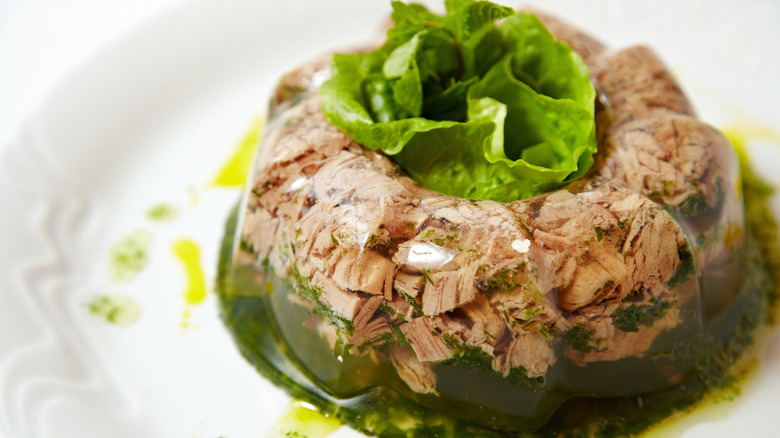
Jell-O is a pretty standard dessert even nowadays, but in the past, it played a far more complex role. Forget about basic bowls of colorful Jell-O with a whipped cream topping; gelatin salads were once all the rage. In 1904, Mrs. John E. Cook from Pennsylvania won a recipe contest and inspired a generation of home cooks. Her Perfection Salad recipe consisted of the usual suspects, like cabbage, olives, red peppers, and celery, but instead of serving the ingredients with a vinaigrette, she suspended them in a gelatin mold.
Over the years, this led to creations that included anything from tuna fish and eggs to sweet variations with candied fruit and nuts. This unique concoction was quick to make and an easy way to use up leftovers in a creative manner, making it a hit among housewives, especially when rationing ingredients was common. Elaborate molds were often used to set the gelatin, resulting in wobbly dishes in an array of shapes. By the '80s, the trend of savory gelatin salads had mostly died out, and nowadays these recipes are often the butt of jokes.
6. Hosting Tupperware parties
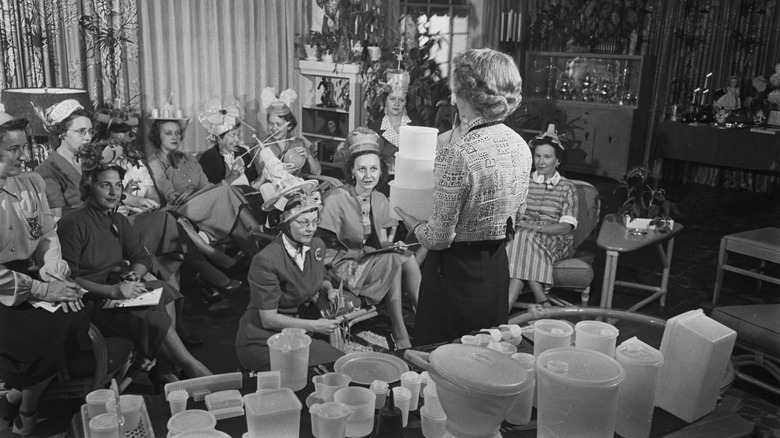
Tupperware has long become a genericized trademark, but the brand that started it all was once the subject of countless parties. The first plastic containers were invented in the early 1940s, enhancing the ease with which people could store leftovers. Throughout the decade, different designs and styles were released on the market, but consumers weren't interested. Everything changed at the start of the '50s, when a housewife named Brownie Wise decided to host parties to sell the plastic storage containers.
She was so successful, that Tupperware could only be purchased at parties hosted by sellers (at one point there were around 20,000 of them), complete with demonstrations and product displays. Aside from decking out kitchens with an array of resealable containers, the parties helped many women gain some financial independence, in a time when it was anything but the norm. At the end of the decade, Wise was fired by the inventor of Tupperware, but the parties continued for several decades. Eventually, with the rise in competition and concerns about plastic, sales declined and Tupperware filed for bankruptcy in 2024.
7. Eating classic TV dinners as a family

Packaged frozen food is certainly nowhere close to disappearing, but the original trend that started it all has mostly vanished. Although there are some conflicting accounts of the specific details, in the early 1950s, Swanson's developed frozen dinners served and packaged on trays. The convenient products were marketed as TV dinners, combining two timely factors: Women had begun working outside the house more than ever before, and televisions were a new form of entertainment, captivating families across the country.
The frozen TV dinners were sold on aluminum trays, so consumers simply had to pop them in the oven and reheat them for less than half an hour. The meals were inexpensive, featured a variety of foods, and were consistently portioned, making them a good option for a wide crowd. A few decades later in the mid-'80s, Campbell's produced microwavable meals, and the convenience factor increased dramatically. Nowadays, frozen meals are still consumed (in fact, there was an uptick in sales during the COVID-19 pandemic), but the custom of sitting in front of the television as a family with tin trays of heated food is no longer the novelty it once was.
8. Regularly eating offal
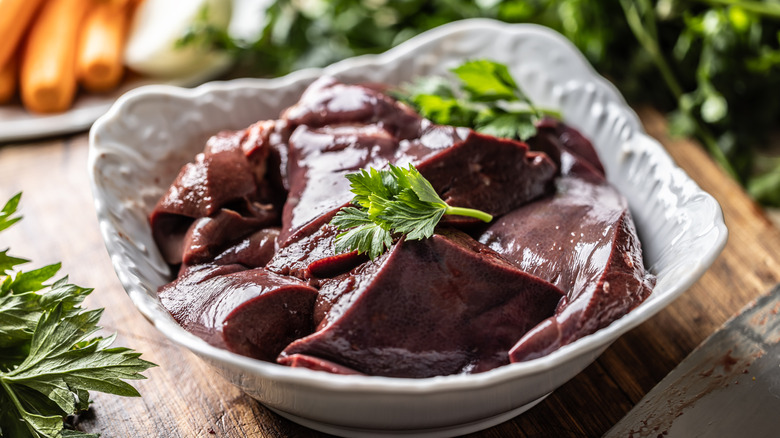
Offal has had a spotty presence in American history. In colonial times, organ meats were commonly associated with enslaved people who were given these cuts after enslavers butchered animals and kept all the best meat for themselves. During World War II when food was being rationed, people with less resources were stuck consuming offal, since demand for it wasn't as high. Following the war, its association with poverty as a cheaper cut stuck, making it undesirable. That said, if the offal was used to make pâté or foie gras, the perception was one of luxury.
Aside from the socioeconomic and racial associations, eating offal eliminates the blinders many people have when it comes to eating meat. It's hard to disguise the animal on your plate at that point, further decreasing its popularity. Nevertheless, eating organ meat is incredibly nutritious and a sustainable practice that can help balance some of the country's meat consumption.
You'll definitely come across proponents of organ meat these days, but they're often trying to mimic past customs and follow what they deem to be an ancestral lifestyle. So, people are still eating organ meat, and in some cases singing its praises publicly, but on the whole, the American population doesn't consume offal like it used to.