

Sourdough Vs Whole Wheat Bread: The Nutritional Differences To Know Before Buying Your Next Loaf

In the cult-classic comedy "Scott Pilgrim vs. the World" (2010), Scott rhapsodizes about his love for bread: "I could honestly eat it for every meal, or just eat it all the time without even stopping." While we can't recommend non-stop chow-down, some types of bread work to help foodies meet their daily health goals. Breaking down the nutritional benefits of two popular sandwich breads — sourdough and whole wheat — can help consumers determine which offering is better-suited to their dietary needs.
Sourdough is made from flour, salt, and sourdough starter packed with live active yeast cultures (namely Lactobacillus bacteria). As that starter ferments, it creates the acidic byproduct that gives sourdough its signature tangy, "sour" flavor, functionally replacing commercial baker's yeast as a leavening agent. Whole wheat bread is made from a base of wheat flour, and as the "whole" in its title indicates, it contains all the parts of the wheat kernel, including the bran, germ, and endosperm. By comparison, white bread gets stripped of its germ and bran during manufacturing.
Happily, both sourdough and whole wheat breads land in roughly the same ballpark for protein (about 8 grams per 60-gram serving), calories (160-180), fat (1.5 grams), and carbs (30 grams). Although, whole wheat bread is significantly higher in fiber (4 grams per serving versus sourdough's 1.83 grams), which can help promote feeling fuller longer. It's also more nutrient-dense. Sourdough, however, boasts easier digestibility and gut-biome-boosting properties, and is better for blood sugar management.
Sourdough is easier to digest

Tangy, chewy sourdough bread is naturally-leavened by fermented, wild microbes. As those yeasts cultures feed on the carbs in the flour, the organisms' activity yields complex flavor and gut-health boosters. More specifically, sourdough starter's lactic acid releases beta-glucan prebiotic in the belly, stimulating digestive probiotic activity. These gut-healthy properties are shared by other fermented foods like yogurt, kimchi, kombucha, and more.
Sourdough's natural fermentation process also helps break down some of the gluten bonds in the bread, making it a more easily-digestible choice for foodies with gluten-sensitivity or IBS (and generally for everyone). Even better, fermented sourdough can help stimulate nutrient absorption, helping the body gather maximum essential minerals such as iron and zinc. The bread itself is packed with the minerals copper, manganese, riboflavin, folate, thiamine, and niacin.
That acidically-low pH also gives sourdough bread antioxidant properties and a longer shelf life. Meanwhile, its low glycemic index makes sourdough less likely to spike blood sugar levels than other types of bread. According to Colorado State University, this is because "the acids produced during the sourdough fermentation process inhibit the enzymes that metabolize starches, causing the starches to be more slowly digested when consumed." From a culinary vantage point, those tangy loaves can also be infused with other flavors like our savory kale pesto-swirled sourdough recipe, or our hot honey sourdough bread. Here at Tasting Table, our go-to store-bought brand of sourdough bread is the crusty loaves from Panera, for the record.
Whole wheat bread is higher in fiber and nutrient-dense
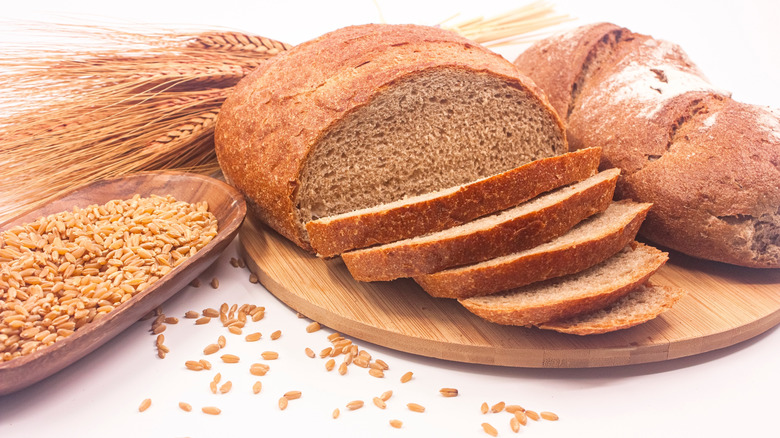
Nutty flavor, rich weight, and brown hue — it has to be whole wheat. Since it is baked with intact bran and germ, whole wheat bread yields both a denser, coarser texture and a significantly more nutrient-packed loaf compared to regular wheat bread. In particular, it retains high levels of essential elements like fiber, iron, potassium, calcium, magnesium, phosphorus, and B vitamins. Those extra vitamins and minerals also have the beneficial side-effect of reducing inflammation in the body, helping maintain overall cellular homeostasis with optimized oxygen transport.
Also notably, whole wheat bread is made entirely from wheat kernels, not a blend of different types of grains, like some products labeled "multigrain" (which, in reality, are often not as nutritional as whole wheat). Whole wheat bread consists dominantly of complex carbs, which break down more slowly in the digestive tract, providing the body with fuel for longer and promoting a feeling of satiety — and, subsequently, weight management. Foodies may opt for whole wheat bread to meet their nutrient goals and feel fuller longer. Its high levels of dietary fiber ease and regulate digestion, as well as promoting heart health. Although, due to its higher gluten content compared to sourdough, it can still be tougher on the belly to digest than sourdough. Here at Tasting Table, our favorite store-bought brand of whole wheat bread is Sara Lee, which offers subtle hints of molasses and dark honey.