

The Simple Mistake That Can Leave Brussels Sprouts Firm And Mushy At The Same Time
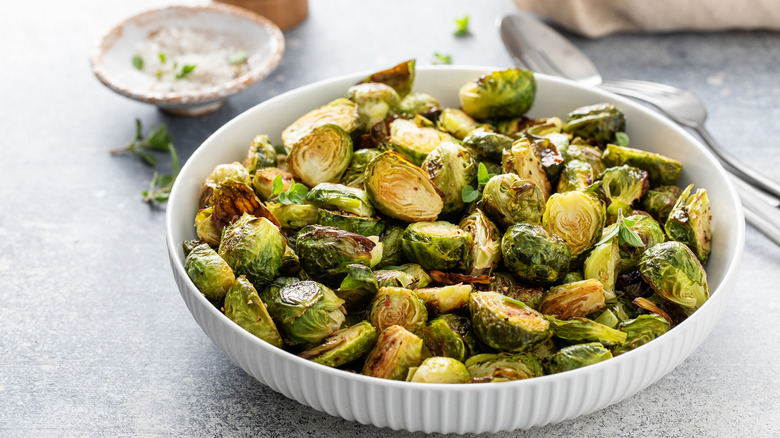
When you pull a tray of roasted Brussels sprouts out of the oven, you might find two very different bites staring back at you. Some will collapse on the fork, while others resist with an unwanted, al dente defiance. What has happened is explained by the simple physics of heat applied to disparate sizes. Brussels sprouts, which are selectively-bred cousins of cabbages, may look cute and uniform in the bag, but they're internally inconsistent. A tiny sprout might be loose and airy, whereas a big one is a more mature part of the plant, with tougher, denser layers. When both go on a tray without a plan, you get a disorganized chewing experience, when what you're really going for is a perfectly balanced interplay of tender-crisp.
Cutting widens the gap dramatically. Whole sprouts steam inside as they brown on the outside, and halving a sprout exposes the cut side to the heat and allows direct heat to reach the tight inner leaves, speeding cooking and caramelization. Quartered sprouts are smaller, have even more surface area and will cook the fastest, and so on. When you mix these shapes and sizes, you're mixing different cook times, which guarantees the dreaded double-texture problem. Put simply, this is one of the biggest mistakes ruining your Brussels sprouts.
The way out of this is common-sense simple, but it starts before you reach for the oil or crank up the flavor of your Brussels sprouts with seasoning. It starts with noticing the sprouts themselves and how different they are from one another. Once you're aware of the variety, you can choose cuts that give them an equal chance in the oven, so they stop fighting each other and start roasting into cohesion.
Cut to the chase with your Brussels sprouts
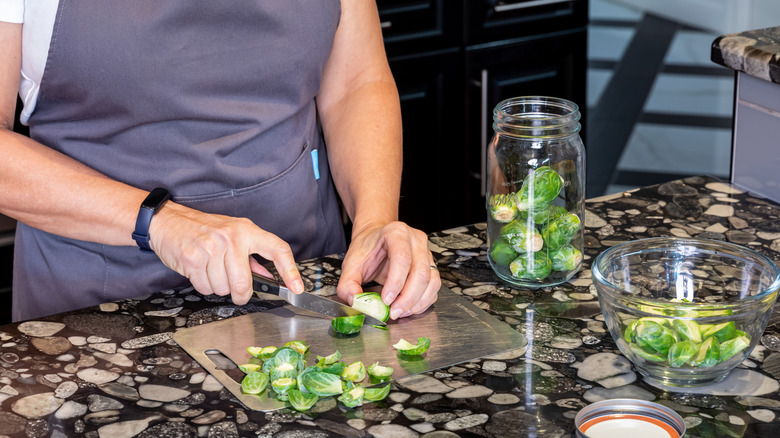
The easiest way to get Brussels sprouts to cooperate is to sort them into two small piles first. You'll notice immediately that some are marble-sized and some are borderline ping pong ball-sized. Once separated, the next steps just make sense. The little ones only need a quick halving so the cut sides can take on color. The big ones should be quartered, which will open up their cores, let heat work its way in, and make for a more mouth-sized bite. You're not aiming for perfect symmetry, but for similar thickness across the assorted pieces, which is what actually evens out the roasting.
The art of knife cuts is the underlying rationale of almost every vegetable preparation. Knife cuts determine both how fast heat travels, how much plant cell membrane is exposed to the marinade or dressing, and how much surface area gets exposed to browning. Thick pieces take longer to soften; thin ones go faster. Flat sides caramelize faster than round ones, because they touch more of the cooking surface. A wedge cooks differently than a coin. Once you start noticing this, you'll train yourself into choosing shapes with intention instead of autopilot.
Carrots, for example, roast evenly when cut on a bias because the angled surface gives them more room to brown. Zucchini is best in thicker half-moons, so it doesn't steam too much and collapse into mush before there's a chance for the Maillard reaction to kick in some color. Potatoes crisp differently depending on whether you're using the brunoise knife cut, smashing them, or slicing them into coins; each shape dictates its own ratio of crispy edge to creamy middle. Choose cuts that cook at the same rate and support the texture you want. With consistency, the oven will stop giving you mixed signals.