

How To Master The Hardest Part Of Cooking: Getting The Timing Right
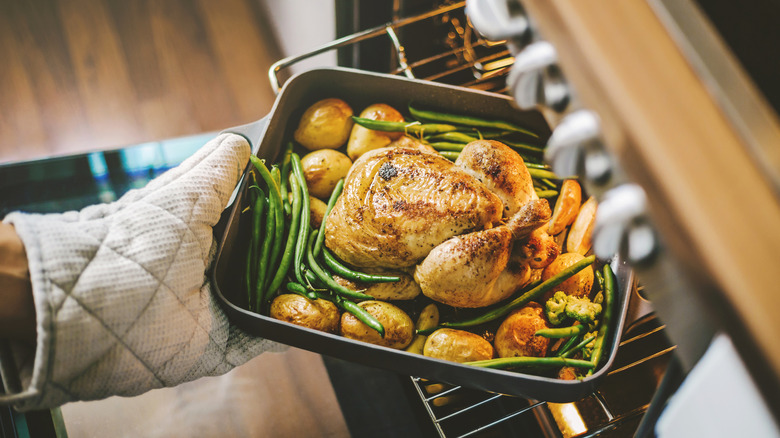
For some gifted individuals or professionally trained chefs, cooking seems to come easily. For others, however, the multiple steps and different elements of creating a complete meal are a real challenge, especially when it comes down to properly timing those elements to be ready simultaneously. There are plenty of cooking tips that translate perfectly from a fine dining kitchen to home, but it's important to start with the basics and understand the timing of things before you plan to whip up an elaborate dinner party spread.
In general, preparation is key. It's easy to make things ahead of time that can sit out for a while — like salad dressing, toasted nuts, or a yogurt sauce — as those are tasks you can check off and not have to worry about towards the end of cooking. Getting small tasks out of the way first lets you focus on the bigger jobs ahead. Other tips include setting yourself up for success and prioritizing the timing of what needs to be the hottest or most fresh.
Carefully read the recipe all the way through before you begin

No matter the dish or meal, the first step should always be to read the recipe thoroughly to get a realistic sense of what's required and how long things will take, from the first ingredient to the last step. If it's a particularly complex recipe, we encourage you to read it twice in case there's anything you may have missed. Reading comments left by others on online recipes is an excellent way to learn from people who have already cooked the recipe so you don't repeat their mistakes, and you can also usually learn some helpful tips or tweaks too. Reading through the recipe also gives you the opportunity to look up any terms you're unfamiliar with. Check out our tips for reading a recipe before you cook.
Remember that there are usually time-consuming steps hidden in the recipe that aren't indicated the way specific cooking or chilling times are. Actions like chopping vegetables, preheating an oven or cast iron skillet, and measuring ingredients all add to the recipe's total time, not to mention any time required for making or prepping garnishes requested in the "to serve" section at the end of the ingredients, like steaming rice. Yes, these actions may sometimes be accounted for in the "total time" section of the recipe, but those estimates are usually made by professional chefs and recipe developers who likely work much more quickly and efficiently than a home cook.
Mise en place isn't just for professional kitchens

There's nothing quite as helpful during the actual cooking process as having every item you'll need prepped, ready to go, and within arms reach, to which Anthony Bourdain wholeheartedly agreed. Mise en place is French for "everything in it's place," but it means more than that. Generally used as both a noun and a verb in professional kitchens and usually referred to as simple "mise," the process of diligently prepping all of your ingredients (including measuring things out) is an essential step for pros, and it should be at home as well.
Mise not only includes the specifics for your ingredients listed in the recipe, but other staples that may not be overtly mentioned before the instructions (like cooking oils, salt, pepper, etc.), and everything should be accessible in your immediate vicinity. By setting yourself up for success in this way, you'll be able to keep your focus on the actual cooking instead of rushing around grabbing ingredients from your pantry or sloppily slicing vegetables in a hurry to get them in the pan at the right time. Cooking without having to scramble for last-minute needs allows you a clearer headspace to focus solely on the cooking tasks in front of you. Check out more of our best tips for how to efficiently plan your food prep and cook like a pro.
Think about the final temperatures needed

Consider the temperature needs of finished items before you begin. For example, a pot of rice can sit finished on the stove for 15 minutes or longer with no problem, whereas a stir fry needs to be served immediately. In this scenario, you can cook stir fry while the rice is cooking, but you want to make sure that by the time your stir fry is finished cooking, the rice is also ready to be served. When formulating your cooking game plan, it can be helpful to work backwards and plan from there. If you know your pasta sauce will need 30 minutes to simmer, you can bring a pot of water to a boil about halfway through, then drop your pasta in when the sauce has about 7-10 minutes left to cook.
Take steak, for example. You already know that you need to let steak rest after cooking, so factor that in when preparing other elements of your dinner. Conversely, it's also smart to remember when foods should be taken out of the refrigerator, especially for items that benefit from warming a little before cooking, like steak. Foods like potatoes or roasted vegetables can always be thrown back into the oven to keep warm or reheat as you finish the rest of the cooking. You'll eventually gain a sense of how long specific foods need to cook for, and how long they can sit out or rest. As you become more comfortable and confident, you'll be able to properly time out cooking various parts of a dish or meal.
A kitchen timer is your best friend

Another key rule to get the timing right: Set timers for everything. Temperature-sensitive items like pine nuts and breadcrumbs tend to be the worst offenders, as small or delicate foods can quickly go from perfectly golden to burnt and unusable in a matter of moments. It's especially important to set a timer for things that will only need a few minutes, as you'll likely think you'll remember to check as it's only a moment or two away, but inevitably these short-cooking items are the ones you tend to forget.
On the opposite side of the spectrum, foods that braise for hours also desperately need a timer. For longer cooking times, I like to set an alarm on my phone for a specific time (rather than letting a timer run for three hours). Setting a designated time to return to the kitchen gives you a better sense of when other cooking steps may need to be started or completed.
In addition to having a timer and using it frequently, it's also a good idea to have a clock somewhere else in your kitchen to periodically peek at the time. You can depend on your stove's timer, but that can sometimes take the place of the clock, which is also essential to keeping a general idea of the pace and timing of your cooking. Set your timer a few minutes earlier than you anticipate to help you avoid overcooking food.
Keep things simple

Keep things simple if you lack confidence in the kitchen. It's so much easier to build your skills by tackling the basics first before leaping into tackling a beef Wellington. By starting with simpler recipes and techniques, you can grow both your skills and confidence in the kitchen and then continue to expand upon that knowledge.
Of course it's fun to succeed in the kitchen, which gives you a sense of satisfaction and achievement, and you can always learn from what went right and repeat that indefinitely. But equally as important, if not more so, are your failures in the kitchen. You learn so much from finding out first hand what works and what doesn't work in the kitchen, and it's essential (and inevitable) to make mistakes when you're cooking. Just remember to take a deep breath and not take yourself too seriously in the process.
One of the most important parts of cooking is learning from your experience and improving upon it next time. In that vein, it's imperative that you start with approachable recipes, ingredients, and techniques. Then slowly, as you master (or at least become competent in) certain dishes, you can begin to expand your culinary repertoire indefinitely. Even after cooking professionally for over a decade, I am constantly learning new methods and insights from fellow chefs and I view this process as a lifelong journey that will never be perfected.