

8 Tips You Need To Make The Absolute Best Prime Rib, Every Time
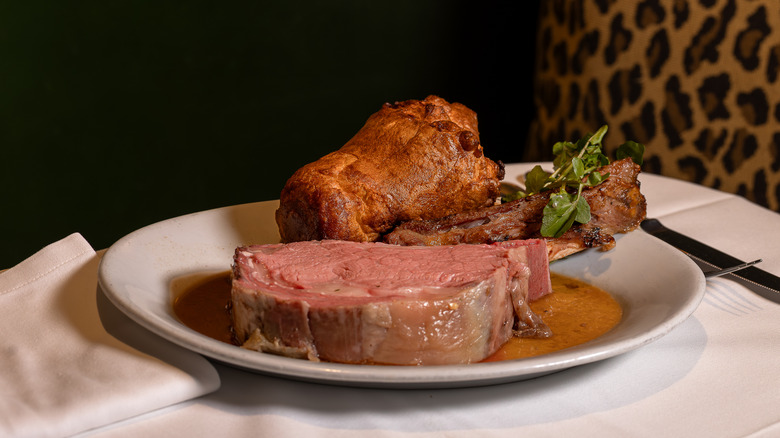
There's a reason why when you're describing something as the best of the best or top-tier, you may use the term "the prime rib of." Prime rib is a beautiful thing. It's the centerpiece that all other cuts of meat look up to and ultimately aspire to be. When you see it on a restaurant menu — especially if it's a tableside presentation — you know you're in for an absolute treat. So what if you're ready to tackle the ultimate red meat cooking challenge and make a prime rib at home? You need a guide. A navigator. A prime rib pilot, if you will. Well, buckle up friends, because we are about to provide you with the tips you need to make the absolute best prime rib every time.
We sat down with chef Brett Reichler, director of operations at Gallaghers Steakhouse in New York City, to get the inside scoop on making top-notch prime rib. Doing so isn't about being a culinary genius; it's simply about having all the information and tools you need to buy the right meat, season it, cook it correctly, and serve it at the right temperature every time. If you're ready to tackle the titan of beef dishes, having these tips at the ready may just help you become the prime rib of making prime rib.
Opt for Prime or Choice beef
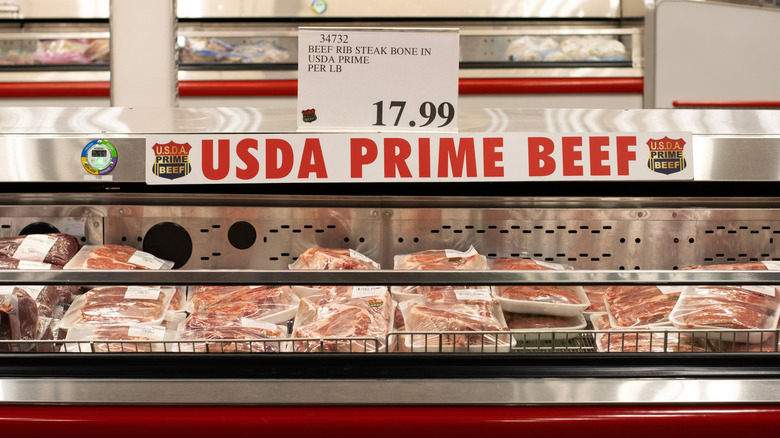
Whether you're getting your beef from your local grocery store or putting your trust in the hands of a local butcher (we'd recommend the latter if you're lucky enough to have one nearby), there are two key words to know when shopping for prime rib: Choice and Prime. These words refer to the USDA grades given to beef based on their marbling, tenderness, and flavor. Prime offers the most marbling, and Choice offers slightly less, but still visible, marbling. When looking for the best prime rib cut, use those keen eyes of yours — a quality cut will have a lot of visible marbling.
"The main reason anybody eats prime rib is for that fat content and that juicy unctuousness," says chef Brett Reichler. A meat with the Prime grade, unsurprisingly, will also cost more, since the higher fat content means more flavor. In this case, Reichler recommends not letting your budget sway you against a prime cut just because it has a higher price tag — the money you spend on the better cut of meat will be worth it.
As long as you're asking for Choice or higher, says Reichler, you're going to get a quality piece of meat. "Always buy the best [meat] you can," he says. "[If you] start with quality, you'll end with quality."
For more flavor and a better cook, opt for bone-in and cap-on
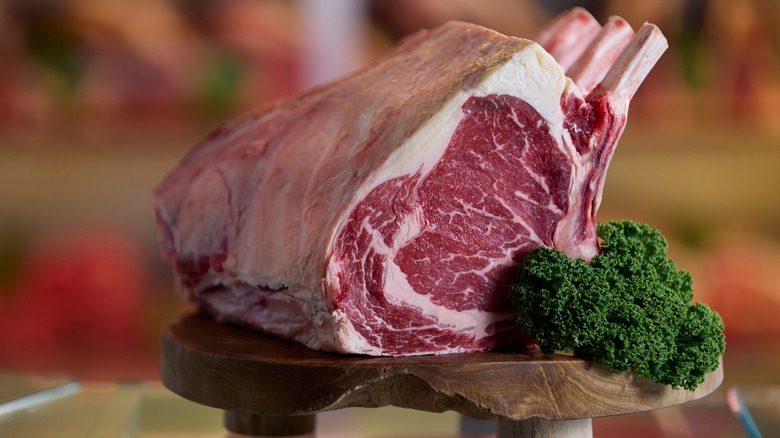
Buying a cut of meat to make prime rib at home may seem like a pretty simple task, but there's more to it than simply walking up to the butcher and saying, "Prime rib, please!" You've got to give them the right specifications to ensure the piece of meat you walk away with is the best one possible. For a piece of meat like this, you have two choices to make: bone-in or boneless, and rib cap on or off.
"One side may have more of the spinalis, the rib cap that comes under that fat cap. That's why you want bone-in, rib cap on. [You] get a lot of flavor in there," says Brett Reichler.
A boneless prime rib may seem like the best option, since you'll be slicing it straight down and don't want to hit any bone. However, the bone-in option offers more flavor and stability as the cut cooks. Don't leave the butcher shop without the spinalis, either. This outer muscle has that oh-so-important marbling, meaning as your prime rib cooks, the fat will melt and result in a more flavorful, tender bite.
Give the meat time to breathe
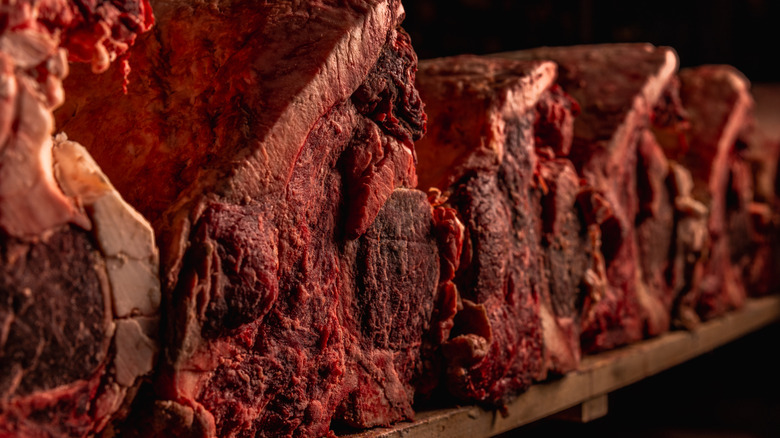
You've picked up the right cut of meat from your grocery store or butcher shop, and now you're back in your home kitchen. What happens next? Should it immediately go in the oven? In short — no. That honkin' piece of beef needs time to breathe, preferably in the refrigerator. Brett Reichler recommends leaving your prime rib unwrapped, in the fridge, for up to three days, allowing it time to breathe and get some air before it cooks.
"You're not dry-aging at this point," says Reichler, "just getting air on it. Especially if it's been in the supermarket in Cryovac, in its own blood. The butcher has taken it out of the Cryovac, so it's already had some air to it." This step, while it may seem insignificant, is a helpful part of the cooking process. Allowing the meat to dry out will result in a better, more even crust while it cooks.
Once you've given your prime rib time to breathe, it's in your best interest to let it sit at room temperature for at least a little while before starting to cook it; Reichler recommends about an hour. If it's still a little cold, that's okay — it's a big piece of meat that will have plenty of time to warm up as it cooks.
Don't skimp on the spice rub
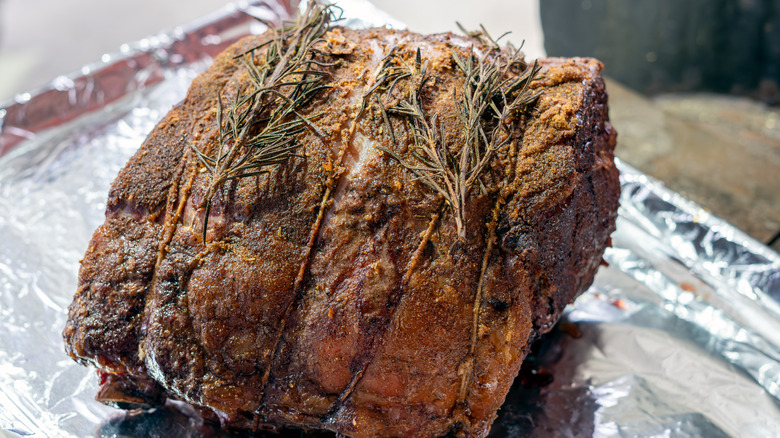
Seasoning, even when it's not much more than a sprinkle of salt, is key for cooking a flavorful piece of meat. In the case of the prime rib, the seasoning is absolutely crucial because it needs to penetrate as deep into the cut as possible. Brett Reichler keeps it simple with his prime rib seasoning; he uses a heavy dose of salt, pepper, garlic, and fresh thyme to guarantee a nice crust on the outside and a little bit of spice in every slice.
If you want to get creative, you could slather the meat in mustard, and then add your prime rib seasoning to it, giving it a little bit of an adhesive for the spices to hold onto. Barbecue or Asian-style sauces are great options too, says Reichler, but they may not appeal to a self-proclaimed purist.
He also cautions against doing a dry cure with salt. While salting two or three days ahead of time may seem like an asset for a piece of meat this big, it isn't; you'll end up drawing too much moisture out of the meat. Reichler recommends instead seasoning the meat an hour before cooking. However, if you're truly eager to get the seasoning on well beforehand, you could get away with seasoning 12 hours ahead of time.
Cook it low and slow
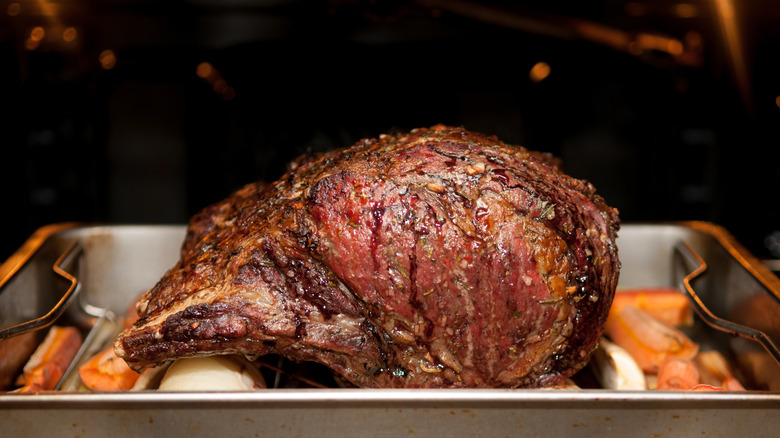
For a piece of meat with this much heft to it, there are actually many ways you could go about cooking it; the oven, grill, or smoker are all in play. No matter which avenue you choose to go down, the mantra is the same: low and slow.
"I'm a low and slow kind of guy when it comes to prime rib," says Brett Reichler. "It all depends on the amount of time you have and being able to keep an eye on it." Reichler recommends setting your oven between 250 and 300 F, cooking the prime rib to the center, and pulling it out at 115 F. Once it's out of the oven, give it time to rest.
Your prime rib has just spent the last several hours cooking, meaning all the blood has been pulled away. This resting period is a crucial step, says Reichler, as it allows the blood to settle back in and redistribute, giving the meat a nice color throughout. A half-hour to an hour on a roasting rack should do the trick, in what he refers to as "a little sauna for prime rib," which is our new favorite way of saying lightly tent it with tin foil.
If you're more keen to spend an afternoon smoking a prime rib in your backyard, go for it. Reichler recommends offsetting wood chips with the charcoal for a smokier flavor, and keeping the meat off the direct heat so it doesn't burn. Most importantly, keep an eye on the temperature, and don't rush the process.
Use a meat thermometer to make sure you reach the ideal temperature
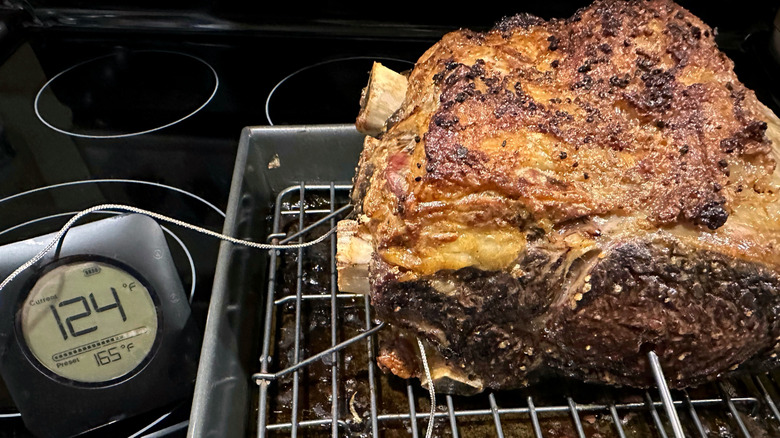
Unless you've got the power to tell the temperature of a piece of meat just by looking at it, you need a meat thermometer. It doesn't need to be an over-the-top-fancy one, and you shouldn't feel like you're "cheating" somehow by using one rather than using some mathematical equation of weight and oven time. An accurate meat thermometer is key to getting the perfect medium-rare cook.
"I'm not one of those guys who's going to tell you to give it 20 minutes per pound or something like that," he says. Instead, he recommends keeping a trusty kitchen thermometer nearby. That 115 to 125 F range? That's the sweet spot.
Why medium-rare, you may ask? For Reichler, it's the perfect temperature for a prime rib, and a temperature you'll be hard-pressed to achieve without that meat thermometer in tow. "Meat eats very differently at each temperature," he says. "I only use five temps: rare, medium-rare, medium, medium-well, well-done ... I think rare, it hasn't had time to tenderize enough. Medium-rare is right in there. And then at medium-well, you're getting into a much chewier piece of meat, it wasn't meant to be eaten that way."
When it's serving time, use a sharp, unserrated knife, and slice straight down. If you're serving for a dinner party, per Reichler's recommendation, ask the group who likes their meat at what temperature, and serve accordingly — the end cuts will be more cooked than the interior.
Ignore your condiment drawer and go for a simple au jus instead
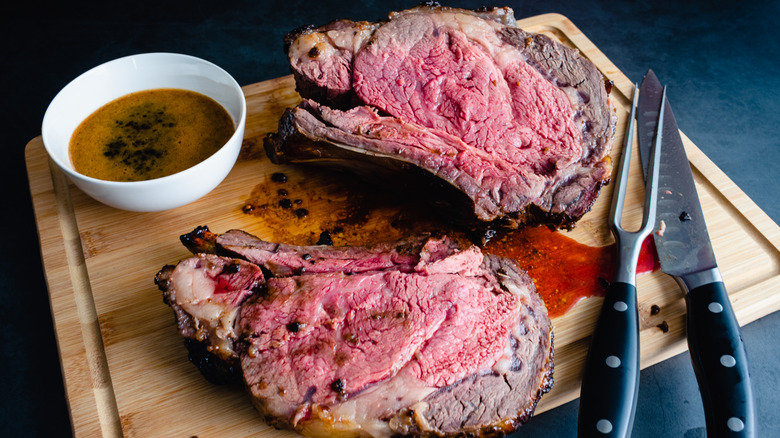
For a lot of steak eaters, a complementary dip or sauce on the side makes each bite a little more tantalizing. It could be a steak sauce, a barbecue sauce, a béarnaise, a green peppercorn sauce – you name it. It's a lovely thought, but for a prime rib, mostly unnecessary. For Brett Reichler, a self-proclaimed "meat-first guy," the flavor of the cut reigns supreme.
Rather than using a sweet or creamy sauce — or the dreaded "K-word" condiment — Reichler recommends opting for a simple au jus. At Gallaghers, the prime rib is served with an au jus sauce made from the pan drippings. The grease is strained, mixed with carrots, celery, and onion, and enriched with beef stock. The end result? A rich, meaty au jus that doesn't change the flavor of the prime rib itself. Instead, it gives it a more pronounced meat-forward profile. If you simply must have a little something for dunking or dipping on the side of your meat, Reichler recommends spicing things up with a horseradish cream sauce on the side.
A side of crispy potatoes is the perfect prime rib companion
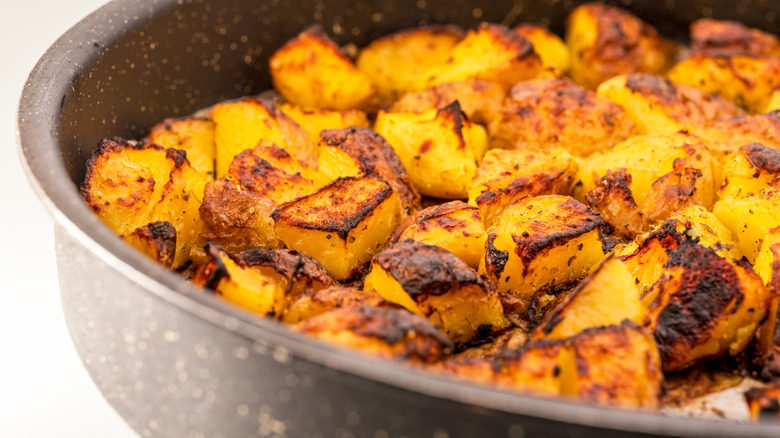
The meat? It's cooking low and slow. The wine? It's decanting on the kitchen counter. All you need now is to decide on a side dish to accompany your prime rib. A starch is always complementary to a rich piece of meat, and if it's a side dish that can use the flavor from the prime rib itself, even better. To reach true side dish supremacy here, Brett Reichler recommends a simple classic: fat-roasted potatoes.
Grab a few roasting potatoes (go for a potato with lower starch content and a waxy skin, like a Yukon Gold or Dutch cream), cut them into thick cubes, and throw them into the roasting pan with the prime rib when it's about halfway done. It may seem like a bit of a chore to add in the potatoes halfway through as opposed to at the beginning, but doing this will save your potatoes from turning into mush during that low and slow cooking. Remove your prime rib from the oven, and while it's resting, toss the potatoes in the fat, turn up the heat on your oven, and let the potatoes cook in all that fat and flavor. Once they reach a nice golden brown color and crisp texture, they're ready to go.