

The Original Themed Restaurants Were A Terrifying Journey Into The Afterlife
Though themed restaurants hit a heyday in the 1990s, such establishments can still be pretty fun (we're always in for a trip to the Hard Rock Cafe). After all, these restaurants are often built around concepts that can be easily translated into a great experience. For example, ESPN's sports-themed spot or Planet Hollywood's memorabilia-heavy celebration of entertainment. But if you've ever wondered what started this idea of themed restaurants, you're not alone — because we wondered, too.
After some digging, we found some information that's unsettling at best, and downright bizarre at worst. In fact, you can trace the idea for themed restaurants back to the late 19th century in Paris, which was a strange time all around. Back then, a trio of cabarets popped up in Montmartre. Here, the idea was that as you ordered your cocktails and enjoyed your evening out on the town, you were escorted through the afterlife.
Now, before we discuss the actual restaurants, we want to note that these concepts weren't totally out of left field. Since the 1870s, Paris had been the site of another gruesome spectacle: The bodies at the Paris morgue. In theory, bodies were publicly displayed in the hopes they would be identified, or their deaths solved. People being people, it turned into an ultra-macabre hotspot for sightseeing, and what better way to wrap up the evening than a cabaret experience of the afterlife? With that in mind, here's the terrifying truth behind the original themed restaurants.
Brussels was introduced to the Cafe de la Mort in 1892
While we often think of Victorians as a formal sort of people, that's not entirely true. Victorians were fairly odd in many ways, after all, and for these cabarets to make sense, we need a bit of history. By the 1860s, Victorians had become obsessed with death (sort of akin to what we'd call true crime today). Not only had Paris's public morgue become a major attraction, but similar public morgues had opened in other cities, as well. In other words, it doesn't take a leap in logic to draw a straight line from these public morgues — and a death-obsessed culture — to Café de la Mort.
First opened in Brussels, Belgium, in 1892, Café de la Mort was the brainchild of a magician and illusionist named Antonin Dorville. Now, information on the original location is sadly scarce (likely because it only operated for a few months). But we do know Dorville applied his skills as an illusionist to a restaurant setting, creating a place where diners could eat surrounded by apparently decaying corpses.
This involved a 16th-century theater trick called pepper's ghost. Perfected in the Victorian era, it's still used today (it's behind the ghosts in Disney's Haunted Mansion, for instance). It essentially uses glass, angles, reflections, light, and other materials to cast images onto a surface. Dorville used it to surround diners with images of the dead, and it was such a hit that he took his restaurant to Paris.
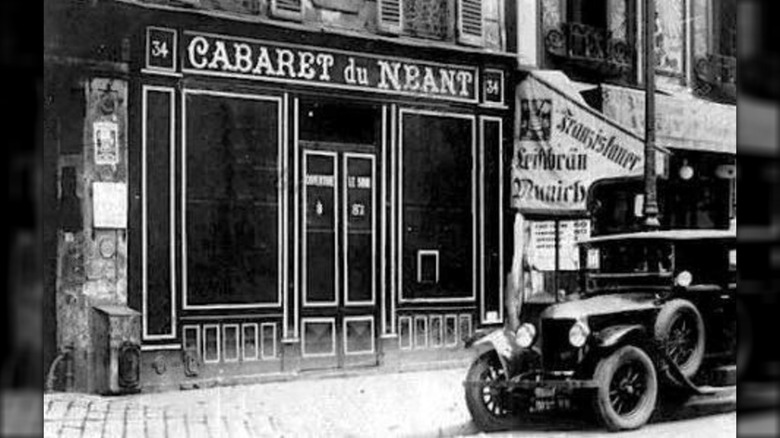
Cabaret du Néant celebrated death
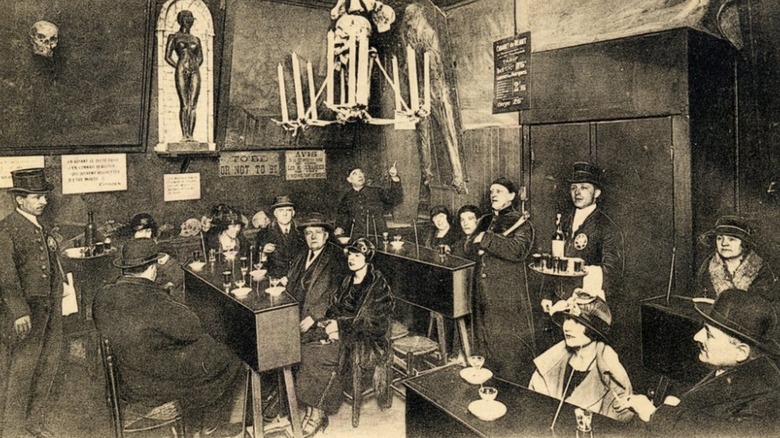
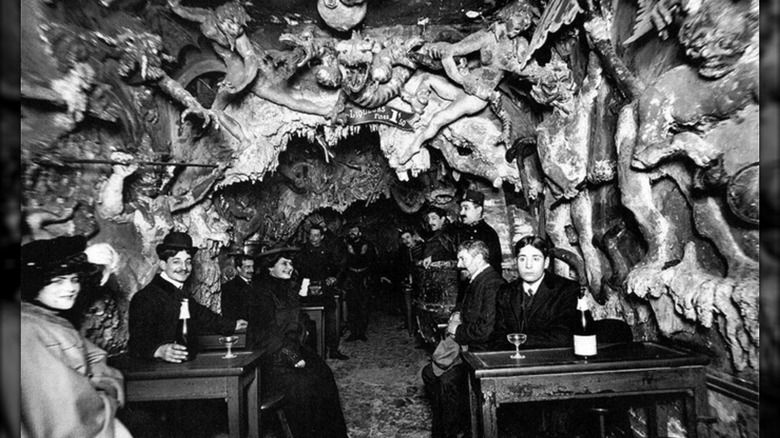
Antonin Dorville changed the name of his place to Cabaret du Néant when he set up in Paris, which translates to "Cabaret of Nothingness." Fortunately, there's an excellent first-hand description of what this place was like thanks to American writer William Chambers Morrow. In his "Bohemian Paris of To-day," he described the entrance to the cabaret as looking like a Parisian morgue.
Visitors were greeted by pallbearers, according to Morrow, who wrote: "A more dismal and forbidding place it would be difficult to imagine." It was so eerie that his companion had to be persuaded inside, where they found a dimly-lit space with coffins. The decorations were wax candles and bones, weapons, and more coffins. And the tables? Coffins, too.
After drinks, Morrow wrote they were treated to a performance by someone dressed as a cleric. This was followed by a series of illusions depicting battle scenes and warriors turning to skeletons, bloody executions, and a dance hall, where celebrants similarly turned to skeletons. Guests were escorted through other chambers, where "bodies" in coffins were cast with illusions of decay. The bravest participants could volunteer to get into the coffin and have the illusions cast over them, offering a startling contrast compared to the streets of Paris.
Those worthy of heaven were served by angels
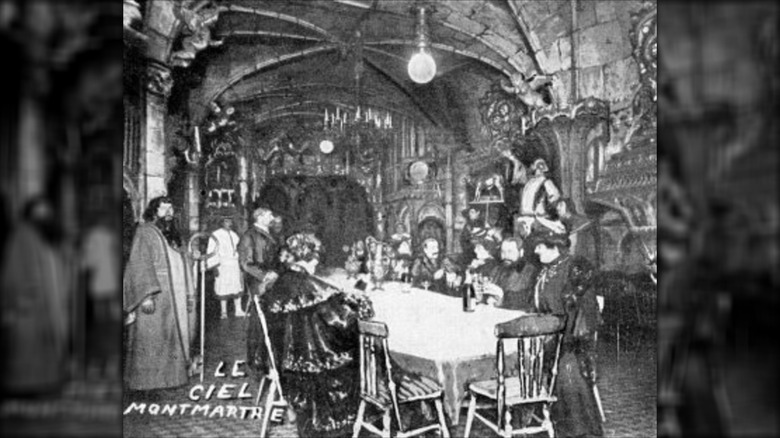
Many believe that there are two main options after death: Heaven, and Hell. Le Cabaret du Ciel was Montmartre's heavenly restaurant, and fortunately for us, William Chambers Morrow also visited and wrote about that location. Morrow wrote the entrance was meant to look like St. Peter's gates, while inside, employees were all dressed as angels, complete with wings, halos, and blond wigs.
Interestingly, the themed restaurant featured a hidden bar from which drink orders were served, as well as an organ hidden by clouds. But it wasn't as cheery as it might sound, with Morrow writing "an organ continually rumbled sacred music, which had a depressing rather than a solemn effect."
Drinks came with a show, as well, with St. Peter appearing. He would splash the crowd with what was supposed to be holy water, which was about the time Dante showed up. Attendees were treated to "a tedious discourse on heaven and all allied things," according to Morrow, and anyone who considered themselves worthy could head up to the so-called angel room. There, they'd join other angel performers suspected from the ceiling, flying around the room. For good measure, guests made sure to tip Father Time to ensure he kept his promise they had many living years ahead of them.
Those with sins to atone for could head for Cabaret de l'Enfer
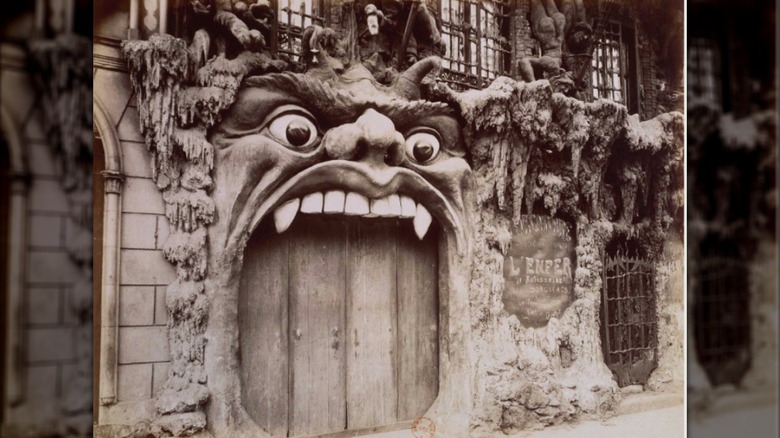
Sitting right next to the heavenly cabaret was one designed to look, feel, and sound like hell ... and it, too, made it clear from the outside that the afterlife charges for drinks. In his "Bohemian Paris of To-day," William Chambers Morrow wrote of the entryway being a massive mouth, adding, "A little red imp guarded the throat of the monster into whose mouth we had walked; he was cutting extraordinary capers, and made a great show of stirring the fires."
Morrow went on to describe musicians that played from inside a cauldron while being prodded by more "red imps," describing rooms lit only with fires, some of which would seemingly randomly burst from the walls. After they were seated and served their drinks (along with more than a few threats of tortures including being forced to drink molten iron), that's when Satan himself appeared to single some of the diners out from the crowd, berate them for their life choices, and promise an eternity of torment. Fun times!
Diners were then escorted through an iron door, into a chamber that was touted as one that would introduce them to the true temperature of hell. What was beyond the door was a stage, another illusionist show that involved some snakes and devils, and a surprisingly chilly atmosphere. Failure... or commentary on the conditions found in the depths of the afterlife? You decide!
What was on the menu?
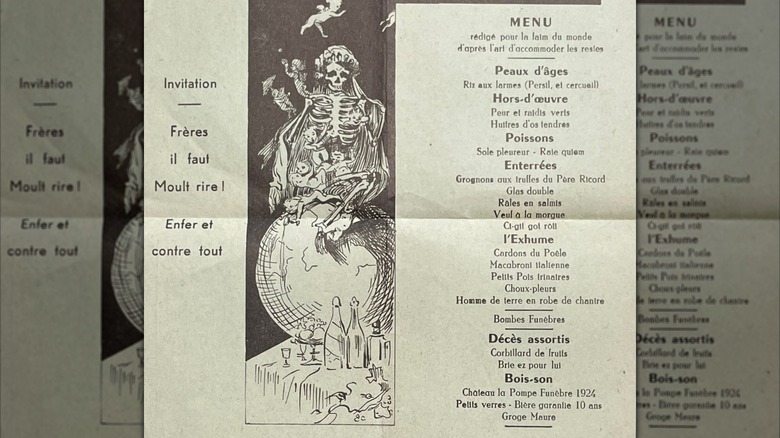
Thanks to both William Chambers Morrow and the survival of a few menus over time, we know what these themed restaurants offered to patrons. Morrow wrote in "Bohemian Paris of To-day" that, in Cabaret du Ciel, he ordered two boch beers and a verre de Chartreuse; these were described by employees as "two sparkling draughts of heaven's own brew and one star-dazzler."
Orders in Cabaret du Néant were a little more ... disturbing, so to speak. The party's orders of a bock beer, a cherry liquor, and a creme de menthe were — respectively — given names that suggested guests were being served doses of cholera, bone marrow taken from the corpse of a cancer victim, and the phlegm of a tuberculosis patient. Morrow wrote the presentation made it difficult to stomach the drinks, but there was good news. In the hellish restaurant, things actually improved a bit: Three black coffees with cognac were called "seething bumpers of molten sins, with a dash of brimstone intensifier."
Some copies of the menu from Cabaret du Néant have survived, and the death-themed menus were called "Diner des Squelettes," or Dinner of Skeletons. Dishes were given appropriately creepy names: Italian pasta was called "One word from cambronne" (which is a polite way of referring to excrement), ox tripe was "two death knell tolls," and sandwiches were "sighs of the dying." Other drinks included the juice of crushed maggots (absinthe), and a glass of strychnine (lager).
Another late 19th century cafe turned customers into prisoners
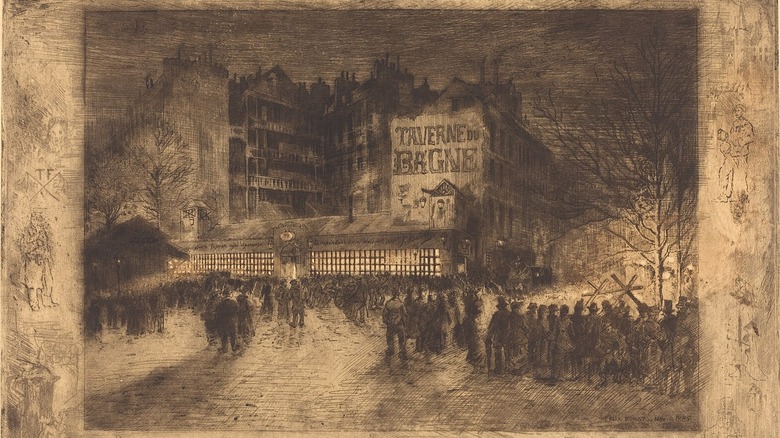
Somewhat surprisingly, Montmartre's afterlife-themed cabarets weren't the only themed restaurants in Paris in the late 19th century. In fact, the incredibly short-lived Taverne du Bagne was arguably just as disturbing. Opening in October of 1885 (and lasting just six months), this one had a prison theme. Wait staff carried around a ball and chain, and diners didn't leave — they were released.
The best depiction of this particular restaurant was in an etching done by Felix Buhot (pictured above). In addition to a quote from Dante's "Inferno," a bit of text on the piece showed just how dismal the place was: "While they are bound to eternal labors, by the impeccable grip of chains ... O convicts! ... Here the passer-by finds amusement in a shackle." Cynical? Absolutely.
The back story of this place was pretty dark, too. It was opened by Maxime Lisbonne, a career military man who was first sentenced to death then a life of forced labor for choosing the wrong side in a 1851 coup. Lisbonne opened Taverne du Bagne after returning to France from a period of exile, and the idea wasn't strictly a culinary endeavor. After all, he also wanted to raise awareness of what he and other exiles had suffered.
The idea spread to the US, where beefsteak dungeons were introduced
The earliest themed restaurants weren't just for shock value. In fact, they were also trying to make statements about socialism and capitalism, the conditions of prisoners, and religious beliefs. And, in the case of Le Chat Noir, the idea was to ridicule the notion of language purity (at least in part). But gradually, the novelty started to wear off. Themed restaurants and cafes became more of a commercial thing that targeted tourists, and the idea began to spread overseas.
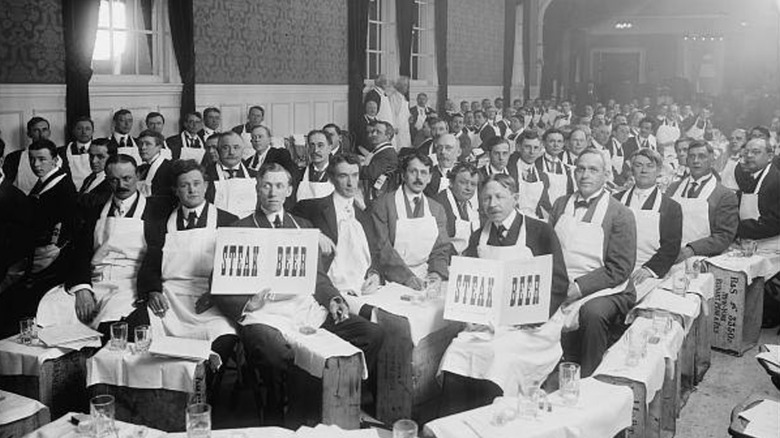
French-themed cafes were popular in the U.S. in the 19th century, but one of the direct descendants of Paris's macabre cafes were New York City's beefsteak dungeons. Started in the 1890s, the idea was pretty straightforward, and was popular among all-male clubs that thrived during the era. Popularly held in basements (although beer halls and bars were also common settings), beefsteak dinners involved dungeon-like settings where diners gorged themselves on beefsteak and bread. Additionally, the use of utensils was strictly forbidden.
Interestingly, there were two different types of beefsteak dinners that developed. While that standard description continued to thrive on the East Side, the city's West Side dinners came to embrace utensils for an appetizer course, while stressing the all-you-can-eat aspect. Now, there may be a handful of themed buffets in existence in the 2020s, but it's unclear whether any could hold a candle to the beefsteak dungeon. In some early 20th century records, it's estimated guests consumed, on average, three pounds of meat and 25 beers in a single dinner.
Themed restaurants were still pretty dodgy when debuting in Los Angeles
Themed restaurants in the 21st century are pretty inoffensive overall. There's a Washington restaurant where you can dine like it's the Middle Ages, for example, and also the 1990s-era Rainforest Cafe. Yet if you go back to the early 20th century, you'd find themed restaurants had more in common with Cabaret du l'Enfer than the Hard Rock.
One of the first, which opened in 1905, was the galleon-themed Baron Long's Ship Cafe. But ships and pirates evidently remained popular, as the 1940s-era Pirate's Den was a restaurant where dinner came with a side of kidnapping. Employees would often stage fights that ended with dragging female diners off to faux captivity, and they were only released when they started to scream (yikes). Jail-themed restaurants were popular in the past, too. Some featured tables set up in jail cells, and yes: Customers were locked in for their meal.
These restaurants have since been deemed problematic for glorifying experiences in jails across the country, and if that's not problematic enough for you, consider the Zulu Hut that opened on Ventura Boulevard in the 1920s. The brainchild of Iowa-born actor Raymond McKee, it served pigeon and fried chicken, forbid diners from using utensils, and employed both Black staff and white staff in blackface (before burning to the ground in 1931).
What happened to Montmartre's three cabarets?
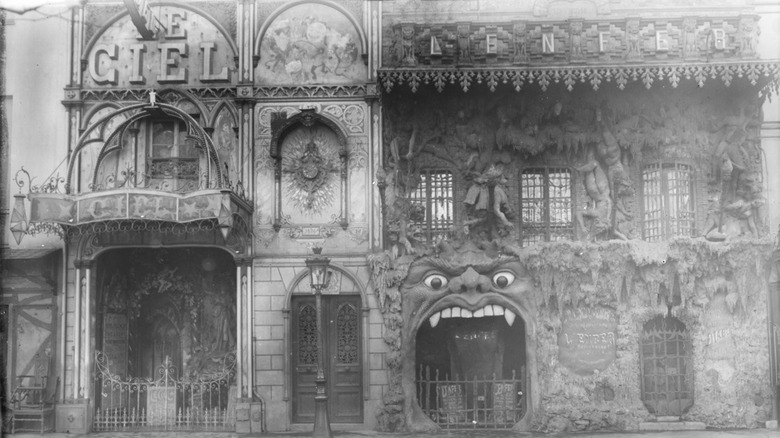
If you're curious about the three afterlife-themed cabarets of Paris, let's talk about what happened to them. Cabaret du Néant survived until 1956, outlasting both Cabaret du Ciel and Cabaret de l'Enfer, which were demolished in 1950. In a strangely interesting turn of events, the twin cabarets were replaced with a Monoprix supermarket after closing, which was in the news once more in 1998. That year, it was the site of the arrest of a French serial killer named Guy Georges, who was eventually given a life sentence for the murder of seven women.
Of course, while it's not 100% clear why these ghastly nightclubs fell out of favor, we can make an educated guess with help from the Grand Guginol. This Paris theatre existed around the same time, and was renowned for staging some seriously bloody spectacles and works about everything from serial killers to revenge killings. Its popularity waned after World War II, though, and historians say the theater's downfall came because people had had enough of real life horrors — and no longer wanted to see them reenacted on the stage.
On that note, the same was likely true of Paris's early themed cabarets. This could be why current incarnations of the idea tend to be much more family-friendly, from whimsical restaurants made entirely from ice to medieval-themed pizza places.