

The Absolute Best Time To Eat Lunch, According To Science

If you're regularly feeling an energy slump in the afternoon, rather than grab a bag of cookies, you may consider instead changing the time that you eat lunch. Eating a heart-healthy breakfast and a high-protein sandwich at lunch at particular times of day can have a positive effect on your metabolism and, if you're dieting, weight loss as well. We spoke with Courtney Pelitera, MS, RD, CNSC of Live It Up and a registered dietitian nutritionist, about scientific studies that link meal timing with maintaining a healthy weight.
"The conclusion has been that lunch should be between 11 a.m. and 1 p.m., and definitely before 3 p.m.," Pelitera tells us. She further explains that, according to some studies, eating after 3 p.m. can slow down digestion and decrease glucose, energy expenditure, and carbohydrate oxidation. She cites one 2019 study in particular in which overweight participants who ate a late lunch lost less weight than those who ate lunch earlier in the day (before 3 p.m.). We wondered, though, if there were times that might be considered too early for lunch.
"Everyone has a different circadian rhythm," Pelitera said, "so it would be hard to say if there was a period of time that is too early." For example, if you eat breakfast very early in the morning, say, around 6 a.m., then it's not inappropriate to eat lunch at 10 a.m. "For health in general, I recommend that clients eat something every three to four hours," Pelitera reveals. "Whether this is a meal or a snack."
Why the right timing of your meals is essential
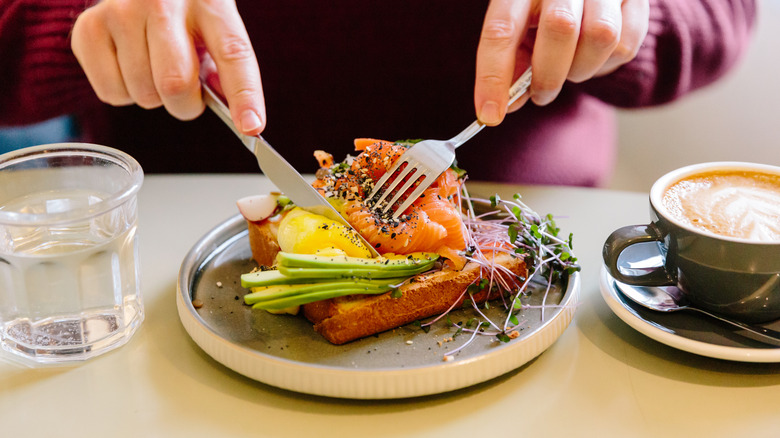
Some experts believe that it's healthier to eat a large lunch and a small dinner because our bodies are better able to absorb nutrients earlier in the day. According to Pelitera, the size of the meal doesn't matter as long as you eat lunch between that 11 a.m. and 1 p.m. timeframe. "Someone might have a preference to eat a larger meal at lunchtime," she adds, "which they may want to eat closer to 11 a.m. if breakfast was a very small meal, for instance, or closer to 1 p.m. if breakfast was larger." Understandably, it's not always possible to have lunch at that exact time. As Pelitera notes, "Some variability during the day is normal, but for hunger hormones like ghrelin, ideally the same meal times on a day-to-day basis is optimal."
Ghrelin — the so-called hunger hormone — sends signals to our brains that we're hungry and drives us to feed our appetite. Ghrelin levels increase when we're hungry and decrease when we're full. This can be a challenge for some who are dieting for weight loss because a low-calorie diet increases the ghrelin hormone and thus increases appetite. Because ghrelin is linked to circadian rhythms, timing meals accordingly will ease hunger pangs and help your body to better metabolize nutrients. A high-protein diet helps balance the effects of the hunger hormone, and there are high-protein foods you can eat at certain times of day, and surprisingly, green peas can also pack more protein into your diet.