

Granite Is Out — Here's The Countertop Everyone Wants Instead
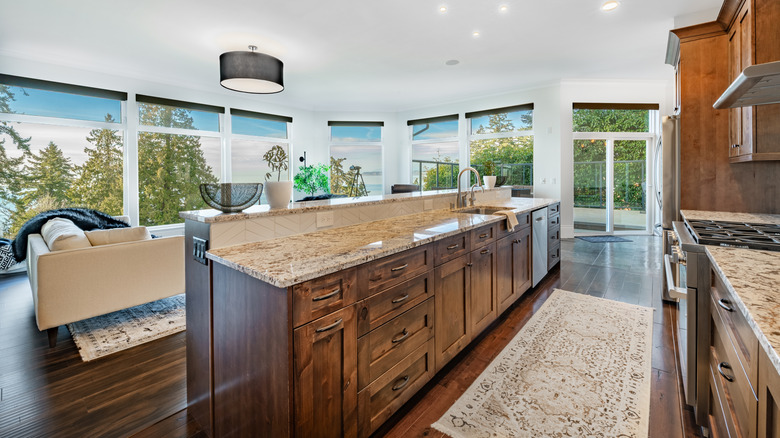
If you remodeled or bought a new house in the '90s, there was almost no question that the kitchen countertops would be granite. The combination of its beauty with its durability and functionality made it the ideal type of kitchen countertop material, with the only roadblock being its relatively steep price. But things started to shift in the late 2010s. According to a the 2026 forecast from the National Kitchen and Bathroom Association (NKBA), granite has now been completely overtaken in popularity by quartz and quartzite.
NKBA forecasts are based on polling responses from industry professionals, and 78% of designers, contractors, and manufacturers said they'd consider using quartz in their kitchen projects over other materials. This was far ahead of granite, which only 43% of respondents expected to use. Ranked based on the responses, granite fell all the way to third place behind quartz and quartz's cousin, quartzite. This is quite the change, because for years natural stone countertops, including granite and marble, were considered the supreme. Quartz, on the other hand, is an engineered material.
Although quartz is a naturally occurring mineral, quartz countertops are made by mixing quartz particles with resins, pigments, and other additions. It didn't even exist until 1963, when it was created by an Italian inventor. Quartzite, by contrast, is a natural stone. It's technically a kind of sandstone, mostly made of natural quartz grains, although it also includes other minerals. Both have unique properties that have propelled them past granite.
Quartz is a durable material with less maintenance
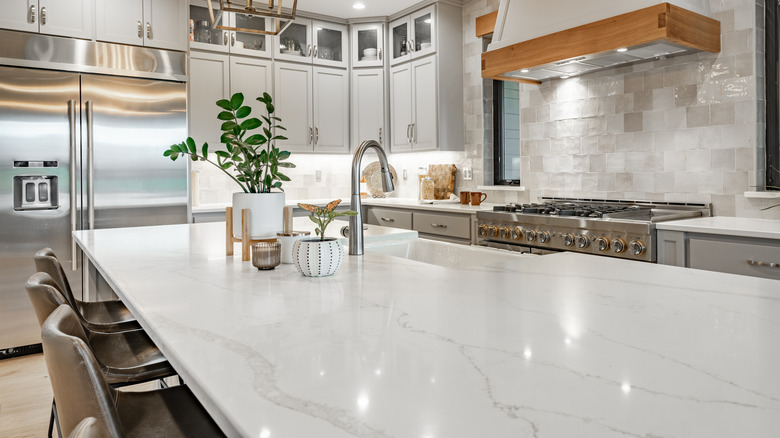
Quartz has always had some major advantages over granite as a kitchen countertop. But, when comparing granite vs quartz, granite was the more affordable option for years. That has changed recently, and with improvements in quartz production techniques they are not that different in price. While the highest end quartz is still more expensive, on the low and middle-end of the cost curve there is very little difference, and that means it's now purely a battle between the characteristics of the two materials.
Granite was prized for its durability, which is very important when you are making a long-term investment in your kitchen, but quartz is even more durable than granite. Its engineered nature makes it virtually indestructible. And while granite is also tough, quartz has another big advantage that granite doesn't: it's non-porous. Being a natural rock, granite is porous, which means it can be stained by spills and dirt, requiring regular sealing to protect it. The natural resistance of quartz doesn't just mean it looks better longer — it also requires less maintenance over time.
Granite does have one advantage compared to quartz: it is more heat resistant. While quartz is heat-resistant, it's not heat proof. You'll need to be careful with hot pans and make sure you don't put them down directly on the countertops.
Quartz and quartzite offer unique style advantages
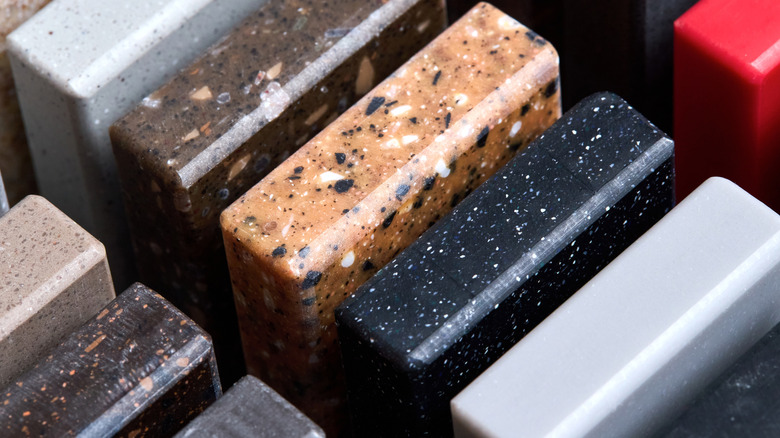
Quartz's use of pigments means it comes in a wider variety of colors and designs. That makes it easier to match with any kitchen style, which is especially good for popular "transitional" style kitchen designs. Additionally, quartz can be made shiny or matte, patterned or solid, and it can even be made to resemble other stones — giving you a similar aesthetic with quartz's superior durability. On the other hand, if you are interested in the natural quartzite as opposed to quartz, you will be getting something much closer in appearance to granite.
Unlike engineered quartz, quartzite is not resistant to staining, and needs more maintenance like granite. It's quartzite's appearance that makes a popular second place choice to quartz. Quartzite has a natural beauty compared to quartz's more manufactured appearance, and it comes in a variety of unique colors and patterns. Because quartzite is very similar to granite, it's this appearance that has driven its surge in popularity — as quartzite has a more neutral look, mimicking marble at a lower price point.
In the end, the perfect kitchen countertop material for you is still going to be a matter of preference, especially over the design. But quartz' declining cost and toughness has made it the top choice for some really practical reasons. Tastes will inevitably turn against it like they have with granite, but the 2020s are looking like they'll be the age of quartz countertops.