

How To Tell If Vintage Jars Are Real And Worth Money
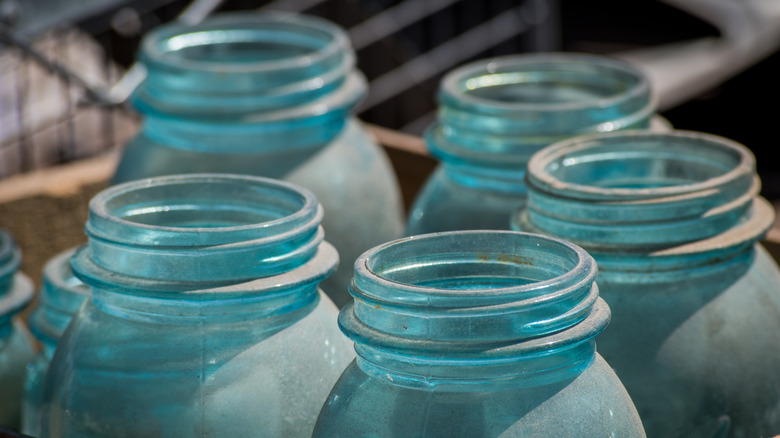
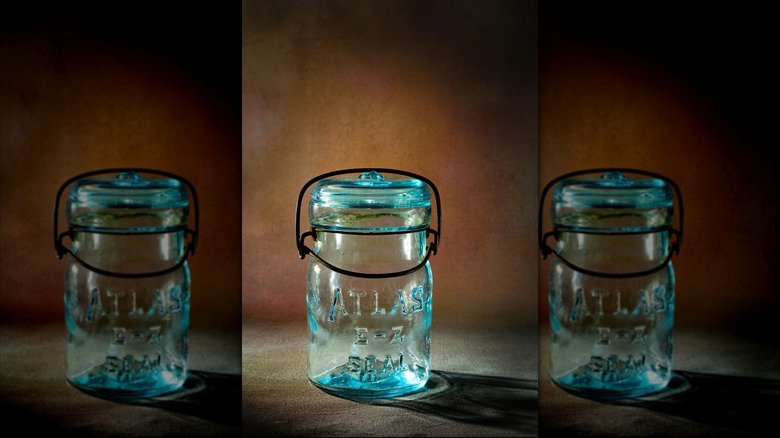
From Kerr and Ball mason jars to the valuable brand of Atlas jars – many vintage canning glasses are popular not just as kitchen decor items, but as true collectibles. A good rule of thumb is that the older the jar, the more valuable it is. Having said that, not every "vintage" jar you come across is the real deal, and fewer still are worth serious money. That $50 jar you're thinking of buying at the flea market could really only be worth $5, or it could be a hidden gem worth $500 — basically, you're never quite sure if you're getting a steal or getting fleeced. The good news is that, by paying attention to a few key details, you can quickly sort valuable originals from cheap reproductions.
The first step is to look for signs of age, such as scratches or worn out bases. Another reliable way to date a jar is by examining the logo. Manufacturers have updated their logos multiple times, and each version is a strong clue to the decade it was made. For instance, the Ball logo appeared in plain block letters from 1880 to 1890, before shifting to the now-famous cursive script — which has gone through several iterations itself, with subtle changes in loops and tails marking the passage of time. Along with the logo, also look out for embossed words like "improved," "special," "perfect," "sanitary," "ideal," "square," or "eclipse" — these are strong clues to the decade it was made.
Size, color, and other signs of a valuable vintage jar
Among authentic vintage jars, anything that sets one apart usually adds to its value. For example, most were made in standard quart, pint, or jelly sizes, so anything larger is often worth more. The same can be said of any telltale signs of hand-blown or primitive manufacturing methods. Bubbles in the glass or stretch marks near the base point to manual shaping, and slight asymmetry in the mouth or body reveals more rudimentary manufacturing techniques. Far from being defects, these quirks only authenticate a jar's age and craftsmanship.
Color is one of the biggest indicators of value. Jars that are purple, amber, citron green, or milky white, are much more sought after. The rarest of all are cobalt blue Ball jars, produced between 1890 and 1940 before being discontinued. These square "perfect" Ball mason jars consistently fetch top prices on the collector's market, so they're worth grabbing. The "strong shoulder" mason jars from Atlas are another example of a high-value mason jar variety you shouldn't hesitate to buy at the thrift store, along with the blue jars from Kerr and regional brands like Drew or Knox.
You may be more likely to come across vintage jars embossed with the number 13. According to an old legend, superstitious bootleggers during Prohibition smashed these jars, believing the number would bring bad luck to their trade. Whether the story is true is up for debate, but the jars have retained high value nevertheless.