

The 20 Most Iconic Food Scenes In Cinematic History
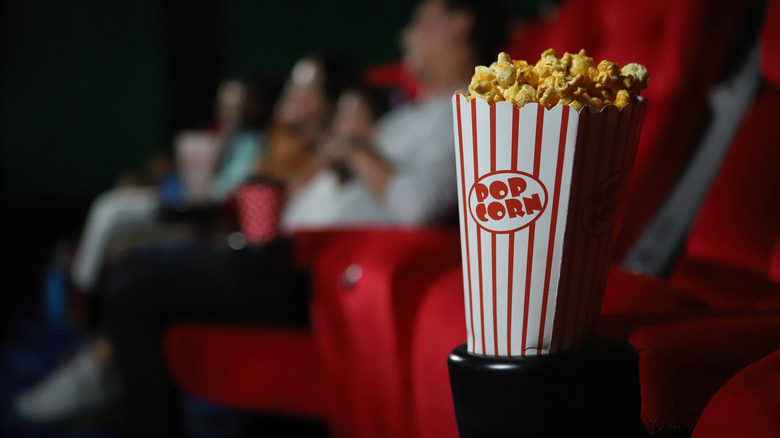
Being one of life's most essential things, humans have been depicting food within our art forms since we learned to draw. Sometimes that depiction is used to honor the gift of nourishment. Other times, we use food as a tool or medium to tell stories. Yet even when used to craft a narrative or detail our human connections, food will always be described and captured differently. It's as variable as the things we taste.
In a story-centric medium like cinema, food is regularly a storytelling tool. Sometimes it appears to introduce a motif that's central to the story. Other times, it creates exposition for characters, settings, or situations that we encounter within a movie. Always, though, the best food scenes in cinema have some things in common: Food is treated or displayed with a sense of respect, realism, and perhaps a bit of humor. There are a lot of movies that include references to food. Very few of them make it an essential part of their characters' lives.
1. Dinner in prison - Goodfellas

Anyone familiar with Martin Scorsese's 1990 mob piece knows that there are several scenes that are important to the film. Yet this crucial scene from "Goodfellas" is important to cinematic history, thanks to its iconic direction, exposition, and foreshadowing.
The scene is set when narrator Henry Hill (Ray Liotta) details a cooking process that sounds perfectly cozy, despite that it's happening behind bars. Prison is a minor inconvenience for these mafia members; Paulie (Paul Sorvino) literally slices garlic razor-thin, while Vinnie (Charles Scorsese) adds veal to the tomato sauce. As steak and lobster appear seemingly at will for the mafia members, the length of their influence is clear. The dinner symbolizes tradition and the rituals that bind these wise guys together, while also portraying violent men in a domestic scenario.
2. Opening scene - Reservoir Dogs

It's debatable whether or not the opening scene of Quentin Tarantino's first film, "Reservoir Dogs," actually qualifies as a food scene. It takes place in a breakfast joint, but no actual food is consumed, apart from some cups of coffee. Yet the debate over tipping etiquette, led by Steve Buscemi's character Mr. Pink, is one that resonates 30 years later, making it an essential piece of food-related cinema.
The conversation (and the setting that facilitates it) isn't just a piece of cultural commentary. Similar to "Goodfellas," this is a scene that operates as a story device as well, introducing us to the various personalities and complexities of a group of people who will go on to commit heinous acts, despite arguing about the right way to treat service workers.
3. Old 96er - The Great Outdoors

Long before television shows like "Man Versus Food" nurtured a greater cultural interest in eating challenges, Chet Ripley (played by John Candy), of 1988's "The Great Outdoors," took on an iconic challenge: Eating the Old '96er.
Faced with consuming a 96-ounce prime cut dubbed the "world famous Paul Bunyan Big Blue Ox steak," Ripley steps up to the plate, at the encouragement of his brother-in-law, played by Dan Aykroyd. The prize? A free meal for the family, if Ripley can finish. The server (Nancy Lenehan) tells the family that no one has ever finished the steak in her lifetime. What follows is a masterclass in physical and gag comedy that simultaneously lambasts American excess. As Ripley is faced with the ghoulish necessity of finishing the gristle, he's given an all-American reminder that there really are no free lunches.
4. Aunt Meg's steak and eggs - Twister

Between its sequences of devastated plains country and following the action-packed path of its storm chasers, "Twister" doesn't have many calm moments. But when Dr. Jo Harding (Helen Hunt) shows up at her Aunt Meg's for a post-game breakfast after chasing down an F2 tornado, one of the film's most homey food scenes is delivered with a heaping plate of steak, eggs, mashed potatoes, and brown gravy.
Harding and her team's arrival at Aunt Meg's is presented as a ritual. The gang has just chased down an F2 tornado, and they've come to replenish themselves. The scene shows warmth and camaraderie, grounding the characters in comfort food and conversation after the chaos of hunting twisters. It inevitably connects viewers to a location that will itself become food for the F5 tornado.
5. I Can Eat 50 Eggs - Cool Hand Luke

"I can eat 50 eggs." When Luke Jackson (Paul Newman) delivers this straightforward proclamation in 1967's "Cool Hand Luke," he adds fuel to a scene that goes on to become both an absurd spectacle and profound character study.
Few characters in cinematic history have been defined by sheer force of will as much as Luke has. His fellow prisoners at Road Prison 36 take bets against whether or not he can back up his claim to eat over four dozen eggs. As they cheer and jeer, the contest transforms the mundane act of eating into a test of identity and spirit. It stands as one of the great food scenes because few films use food with such symbolic, humorous, and tragic weight.
6. Campfire beans - Blazing Saddles

By the time "Blazing Saddles" hit the silver screen in 1974, Hollywood had been romanticising the lives of Old West cowboys for nearly 80 years. Mel Brooks' satirical film, which took aim at everything from racism to the fourth wall, uses food as a tool to parody the myth of the lonesome cowboy. Even the most rugged heroes are humans subjected to the same earthly truths as the rest of us.
The scene unfolds quickly. As they sit around the fire eating hearty plates of beans, one cowboy after another erupts into loud flatulence. Fart humor might be a little stale these days, but the scene's staying power exists because of its simplicity. A plate of beans isn't symbolic or ritualistic. It's a real bit of food, exaggerated to an obnoxious level purely to make fun.
7. Captain's Dinner - Triangle of Sadness

A more recent film (released in 2022), "Triangle of Sadness" is an Oscar-winning dark comedy that touches on topics like wealth and influence. One particular dining scene encapsulates the film's themes while also serving as an unforgettable plot device: The Captain's dinner.
Despite being on a luxury yacht, the scene at hand turns into chaos when wealthy guests gather for an opulent meal just as a storm hits. Constrained by the limitations of their situation, the evening devolves into mass seasickness, vomiting, and overflowing toilets. The physicality contrasts sharply with the elegant setting, satirizing privilege and the hubris of excess. For some cinephiles, the heart of the scene comes after guests have begun tossing their cookies, when the captain, played by Woody Harrelson, engages in a capitalism vs. communism debate with Russian oligarch Dimitry (Zlatko Burić).
8. Katz Deli - When Harry Met Sally

When Harry (Billy Crystal) met his friend Sally (Meg Ryan) down at Katz's Deli (also a favorite spot for Anthony Bourdain) in the 1989 film, their talk was more than just a little eye-opening for everyone involved. And, also those technically involved at all.
Over pastrami sandwiches and a few comments about sexual escapades, Sally demonstrates for Harry just how easily a woman can fake pleasure, leaving Harry flustered and the entire deli stunned. The punchline, however, is delivered by none other than director Rob Reiner's mother, who declares to her waiter, "I'll have what she's having." Set in the bustling and very real New York deli, the moment is grounded in authenticity as a bold and effective conversation about intimacy, honesty, and gender dynamics plays out.
9. Greedy feast - Spirited Away

Studio Ghibli's 2001 film, "Spirited Away," is a cautionary tale about excess and greed. As with any work that regards intemperance, there are more than a few scenes involving food in the film, but none are as iconic or commentate more than the turning point sequence in which our hero's parents gorge themselves on a magical feast.
Drawn to an unattended spread of food, Chihiro's parents eat greedily. As they scarf their food, they ignore nervous warnings from their daughter until all is lost, and they are transformed into pigs. Just a young girl, Chihiro is isolated and forced into the spirit world's dangerous labor system to save her parents. This lavish meal, full of roast duck and noodles, is one of cinema's most aesthetic food scenes, not to mention one of its most impactful: The fusion of cultural symbolism, emotional stakes, and use of food as rich temptation creates a powerful allegory that remains relevant over 20 years later.
10. Egg breakfast - The Big Night

The final scene of "The Big Night" is celebrated as one of cinema's great food scenes thanks to the way it distills passion, conflict, love, and forgiveness into the ordinary act of sharing food. The scene is painfully simple: After the failure of the banquet that was meant to save their restaurant, brothers Primo (Tony Shalhoub) and Secondo (Stanley Tucci) share a simple omelette in silence the next morning, along with Cristiano (Marc Antony).
For nearly four minutes, the near wordless take acts as an emotional resolution. It highlights the intimacy and weight of the current moment as well as all that came before. Across the same kitchen where these same men fought just hours ago, food is shared as a source of comfort and connection. A humble dish of eggs and bread becomes the physical manifestation of reconciliation and unspoken bonds. And although their elaborate Italian banquet ends up as a disaster, viewers are left with the feeling that this is a group who will survive.
11. Spaghetti scene - Lady and the Tramp

Far from being just one of cinema's most cherished food moments, the spaghetti-sharing scene from "Lady and the Tramp" is one of cinema's all-time most iconic moments. We've all seen it before: Two dogs enjoying a piece of pasta, until their little noses meet tenderly.
The dish is what makes this scene sing; Using an everyman's Italian-American classic, spaghetti and meatballs, as the medium, Disney's 1955 film possibly cued up a gesture of romance that would go on to be a cultural touchstone, while also highlighting the ability of simple foods to bridge class differences. The scene speaks to spontaneity and vulnerability. It's playful. It endures because the feeling of being in love is universal. Especially if that love involves pasta.
12. Strudel scene - Inglorious Basterds

Much less touching than an animated classic, the strudel scene in "Inglorious Basterds" teaches a lesson in building tension for a film that is already wrought with it. This scene of Tarantino's WWII story is set in the fictional Parisian Chez Maurice restaurant. Over dessert, S.S. officer Hans Landa (Christoph Waltz) begins applying pressure to his guest Shosanna Dreyfus (Mélanie Laurent) as she hides her identity from Landa, because he was responsible for hunting her family.
Using food as his weapon, Landa first exerts control by stopping Shosanna from eating her strudel until fresh cream is slowly doled out. The real test, however, is whether or not Shosanna will eat the pastry at all, traditionally made with pork lard, so refusing would reveal her as Jewish. The psychological warfare of the scene is taut and palpable, as is (nearly) the taste of the German pastry.
13. Big Kahuna Burger - Pulp Fiction

To speak of power and food, few directors wield it as well as Quentin Tarantino does, especially when directing one of the earliest sequences of the cult classic "Pulp Fiction." Fresh from discussing the difference between an American and European Quarter Pounder, Vincent Vega (John Travolta) and Jules Winnfield (Samuel L. Jackson) find themselves privy to some burgers while on the job for their infamous boss, Marsellus Wallace.
The Big Kahuna burgers become a tool of authority in the situation. Jules takes what he wants, and offers back the food only as a form of dominance. With unforgettable style, each bite of burger that Jules takes becomes a power play, coiling with friction right up until the sandwich is gone and the fountain soda is slurped empty.
14. My Dinner with Andre

If it feels a little cheap to include a movie that's essentially one long dining scene on this list, considering that in this day and age of poisoned dialogue, the philosophical dinner conversation that spans "My Dinner with Andre" reveals itself as being of a truly different era. It's already worth a watch as a time capsule of intelligent discourse, but the way the film treats food as a gateway into memory, experience, opinion, and meaning is why it lands on this list, specifically. It's what breaking bread is all about.
There are rounds of terrine de poisson (fish pâté), quail and raisins, green salad, and bread. Red wine is ordered, as is espresso and amaretto when the meal concludes. Throughout, Wally (Wallace Shawn) and Andre (Andre Gregory) find room to discuss and disagree, reminding moviegoers of the power a meal can have.
15. Imaginary feast - Hook

It could be dubbed the worst practical joke of all time, or a certifiable nightmare. Your friends bring trays of steaming food to the table, only to lift the serving lid and reveal there really isn't any grub at all. In 1991's "Hook," Peter Pan (Robin Williams) has this happen to him, but it's an easy thing to fix when you're with the Lost Boys. All you have to do is imagine.
Food, or lack of it, helps transform Peter. In the span of a few short minutes, he goes from an angry and cynical adult to a childlike figure believing in so much abundance that he can have an epic food fight. All he has to do is trust and believe. As he does, the table fills with pastries and poultry, and a potent metaphor for faith and fun is brought to life using food as a tool.
16. Ramen eating - Tampopo

"Tampopo," which in Japanese can mean dandelion or really good ramen, is a film about characters finding their way to the latter after learning the art and cultural significance of making the dish. Told in a nonlinear way and with a mix of humor and seriousness, a particular ramen-eating scene turns the consumption of noodles into a spiritual act, where every part of presentation and eating is especially considered.
To this day, the scene is one of cinema's most culinary forward. Each chopstick poke of the bowl becomes a gentle nudge toward the notion that anything done with awareness becomes an art form.
17. Anton Ego eats ratatouille - Ratatouille

It's ridiculous and also so fitting that meme culture has given rise to so much discourse (can we call it that?) around this Pixar movie. But "Ratatouille" is emotional! Being a plucky underdog fighting a system stacked against you is such a common experience that it helps make the (totally bonkers) premise work, culminating with the first time a rat has ever been welcome in the kitchen.
There are loads of fun cooking scenes throughout the film, yet it's really the peak, when feared and cynical restaurant critic Anton Ego takes his first bite of Remy's dish, that makes cinematic history. Here, the power of food to move us is fully displayed, as the flavor transports Ego back through time to a memory of his mother's kitchen. It's enduring because it captures food's ability to disarm, heal, and reconnect us to who we are.
18. Killing Sollozzo and McCluskey - The Godfather

The restaurant assassination of Sollozzo and McCluskey in "The Godfather" is one of cinema's most pivotal and masterfully constructed food scenes, even if there's only one character truly eating. In a quiet Italian-American restaurant called Louis, a gangster and a corrupt cop sit down with Michael Corleone (Al Pacino), considered at the time to be the "civilian" of his crime family. He's uninitiated, in a sense.
The quaint setting acts as an ideal backdrop to the transformative experience. McCluskey eats steadily, while a bit of Italian dialogue masks some of the immediate tension between Corleone and Sollozzo. Still, when Michael goes to find the hidden weapon he intends to use for the murder, the nervousness is clear on his face. In just a few moments, the ordinary, civil act of dining is interrupted by immediate brutality with no soundtrack. Through extreme violence, an otherwise mundane dining table has become a transformative place for Michael to emerge into his new life.
19. The cheeseburger - The Menu

One of food media's modern classics, the cheeseburger scene at the end of "The Menu" is a sheer yet profound moment that severs the movie's critique of haute cuisine and elitist dining. Desperate to escape the restaurant but pitching herself as tired of the obsessed-yet-unloving cooking of chef Slowik (Ralph Fiennes), Margot Mills (Anya-Taylor Joy) makes a simple and straightforward request: A cheeseburger.
The request gives Margot an escape ticket. For the rest of us, a sharp craving for a humble but really well-made burger always feels apparent, even if it takes an iron stomach to reach the end of the film. Margot's request breaks Slowik free of his corrupted ego and performance demands by reminding him that the true power of food is in pleasure, not spectacle.
20. Champagne and potato chips - The Seven Year Itch

"The Seven Year Itch" will always be most famous as the film from which Marilyn Monroe's emblematic grate scene comes. Within the film's run time, there's a brief food scene that makes it into the pantheon of cinematic history.
When Richard Sherman (played by Tom Ewell), ends up sharing a late-night bottle of champagne (and a bag of potato chips) with Monroe's character, known only as The Girl, he can hardly seem to believe his luck. Sure enough, the scene is dripping with flirtation, but refreshments keep things casual and laid-back. The juxtaposition highlights what was, back then, perceived as Monroe's carefree charm and allure, while validating an easy and sophisticated snacktime pairing for feature fans.