

10 Best Espresso Machines To Buy Secondhand
We may receive a commission on purchases made from links.
Purchasing an espresso machine is not unlike entering a different world. The gleaming, chrome giants at the counter are the standard, but when you look up the prices, it's enough to close the browser and settle for drip coffee doohickey. That's when the used market is a lifesaver. Buying used isn't just more generous on your wallet, it opens the door to equipment that was constructed with care and longevity that frequently surpasses what's available brand spanking new today.
Many of the vintage designs were constructed to endure years of everyday brewing, evident by the robust metal bodies and brass boilers that simply refuse to quit. When you do find one that is taken care of, it doesn't quite feel like a compromise; it feels more like a discovery. Instead of paying for bells and whistles, you're paying for substance.
There are, of course, a number of things that can make a good used machine stand out from a headache in the waiting. Build quality is the priority. Tough materials and strong insides will tell you a lot about how long the machine will last. Serviceability is a big one, too. A model with easily accessible gaskets, boilers, or pumps is worth dozens of times as much as one with components that you can't get anywhere. Lastly, does this machine have an active community of owners on the internet, since group wisdom seems to keep such classics running years after warranties expire? In the end, buying secondhand is really about getting that ideal combination of longevity, performance, and value while giving a well-built machine a second lease on life in your kitchen.
Rancilio Silvia

The Rancilio Silvia's popularity has grown into a kind of cult among home baristas — not unlike stick shift car models. It became the conduit between café-level hardware and home brewing set-ups after its debut in the late '90s early aughts. It looks modest at first glance, but beneath the brushed stainless steel exterior lies a brass brew group, a heavy-duty boiler, and a pump with pressure sufficient to draw professional shots. It's constructed with the same materials Rancilio uses in its commercial line, which accounts for the fact that so many Silvias from a decade or so ago remain as vigorous as ever.
What's appealing about the Silvia is not bells and whistles but the payoff of learning it. The control panel has been distilled to four rocker switches, the steam wand is the real deal, and the machine demands attention to grind size and temperature. Because it's a single-boiler machine, you'll need to get used to toggling between steaming and brewing, and without an internal PID (stands for Proportional-Integral-Derivative, a temperature regulating device), you'll likely learn the art of "temperature surfing." These aren't flaws so much as initiation rituals for anyone who wants to learn espresso in a more tactile way.
Owning a Silvia is like having a classic car. It will need tinkering with, the drip tray clogs quickly, and you'll probably want to include small mods in the future. But for those with the patience to see it through, the reward is great. This is where secondhand versions are so coveted: they have both history and potential, ready for the next owner to employ them not as an appliance, but as a partner in the everyday search for a great espresso shot.
Gaggia Classic

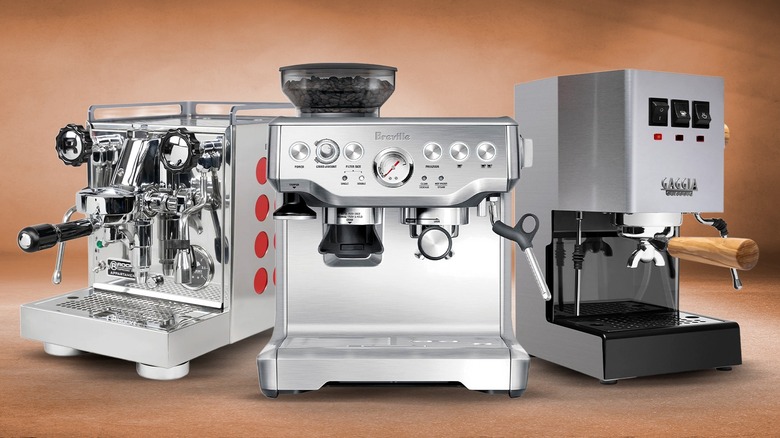
The Gaggia Classic is typically the gateway to those who want to escape pod machines and enter the world of "real" espresso. First released during the early '90s, it's remained largely unchanged in form as a heavy-duty little box of brushed stainless steel with a no-frills aesthetic. Inside, the Classic holds a commercial-quality 58 millimeter portafilter, an aluminum-walled boiler lined with stainless steel, and a pump that provides steady pressure. Not flashy to look at, but it built a reputation as a workhorse that keeps it in conversations decades later.
Why's the Classic so user-friendly? It gets the balance between simplicity and performance right. The controls are straightforward (three switches for power, brew, and steam), but that minimalist design lets beginners focus on achieving the grind and tamp. The steam wand, especially on newer models, is fairly flexible and produces microfoam perfect for latte art practice. Like most single-boiler machines, you have the pause when switching from brewing to steaming, but it teaches the rhythm of making espresso without drowning you in complexity.
Used Classics are generally a safe choice because parts are easily found, and the machine itself is easy enough to repair. Owners tinker with upgrades, ranging from fitting PID temperature controllers to upgrading the steam wand to more costly versions. It's not a machine that does it all for you, but one that improves with your skill. The Gaggia Classic is so adored precisely because it's dependably fixable and long-lasting enough to remain in the race long after flashier models have hit the dirt. Purchasing one secondhand feels more like becoming a part of a community of espresso enthusiasts who appreciate quality over newness.
La Pavoni lever

Few machines capture the romance of espresso like a La Pavoni lever. Originally made in Milan during the early 1960s, the La Pavoni Europiccola and Professional machines are almost as comfortable in a design museum as they are on a kitchen countertop. To own one is to embrace an engineering-and-artistry-imbued ritual.
As opposed to pump machines, a lever Pavoni completely depends on your timing and the strength of your arm, so it isn't the most accessible machine. You pull the lever downwards to generate pressure, then open it to pull the shot out. This puts you in full control of the flow, and consequently the flavor, but that also means that no two shots will ever be identical. It's a curve that can be frustrating to beginners, but for most the hands-on aspect is the entire concept. Mastering a Pavoni is as much about taking your time and savoring the journey as it is speed.
Buying one second-hand can be a treat, as these machines are known to be nearly immortal. They're built nearly all metal with hardly any plastic, and replacement seals and gaskets are easily found. Some of the seventies and eighties models continue daily service, sparkling from a clean. The quirks are part of the appeal: small boilers that must be coaxed, temperature fluctuations that require instincts, and the occasional necessity to cut short mid-session as pressure comes back up. But when it all comes together, the reward is a shot of personality, and occasionally a sense of satisfaction over flavor.
Breville Barista Express

The Breville Barista Express is simply nicknamed the gateway to true home espresso, especially for those who want convenience without losing control. It was an immediate hit in the 2010s for its one-box design: a built-in conical burr grinder and a solid espresso machine. It looks easy on the counter, with rounded edges and curves, and a tidy setup of buttons, dials, and a pressure gauge. More polished than the industrial machines.
What's unique about the Barista Express is its focus on convenience. The grinder built into the machine eliminates the need for you to purchase a separate device, and the dosing system automatically drops grounds into the portafilter. It features a thermocoil heat exchanger rather than a boiler, so heat-up is quick, and the controls enable you to mess around with grind size, dose, and extraction time without needing years of experience. The steam wand is humble compared to commercial machines, but capable enough to froth milk for cappuccinos or lattes with some competence.
The Barista Express can be a success as a used buy. Because it's in so many households, parts are readily available everywhere, and there's a huge owner base that puts up repair data. It does have more electronics than a typical single-boiler machine, and those machines do wear out with time. Grinder burrs, gaskets, and pump are all replaceable, and many owners just replace them. What you get with the Barista Express is not exactly a "forever machine" but more a learning environment to nail the fundamentals.
Rocket Appartamento

The Rocket Appartamento is likely the most stylish pro-espresso machine on the market, defined by its circular cutouts in the side panels and compact footprint. Released in 2016, it was designed to bring café performance to kitchen countertops without taking up an entire countertop. Underneath its mirror-finished stainless-steel exterior, the Appartamento houses a heat-exchanger boiler, E61 group head, and rotary pump system that's capable of delivering consistent, café-caliber shots. It's a work of art when untouched and a dignified tool when in use.
It's likely the heat-exchanger system that makes it such a desirable secondhand purchase. Unlike single-boiler machines, the Appartamento can steam milk and brew espresso at the same time, so consecutive drinks are a breeze. The E61 group head is a mainstay on high-end machines because it ensures temperature stability and solid pre-infusion. The steam wand is powerful for building thick microfoam quickly, and the overall design is built with longevity in mind with heavy metal components throughout. Although the control interface is a little analogue — just switches and a pressure gauge — the experience is decidedly professional.
As a pre-owned buy, the Rocket Appartamento is very serviceable. Parts are readily available, and the machine is built in such a way as to promote maintenance rather than replacement. Owners often speak of it as a long-term investment, something they expect to last for decades with constant upkeep. The only exceptions are its weight (which makes it less portable), and the need to familiarize oneself with routine maintenance like descaling and gasket replacement.
Quick Mill Silvano Evo

The Quick Mill Silvano Evo sits in an awkward place between entry-level machines and outright pro equipment. On the outside, it looks like a plain stainless box, which is a fair description of many competitors, but in truth it has a design that will appeal to tinkerers. The Silvano has a shared boiler for brewing and a separate thermoblock for steaming; you can pull a shot and steam milk simultaneously, which is pretty unusual for its size (needs 22" of room) and price ($600 and up is common for resale). This selection is an excellent compromise for those trying to steer clear of the conventional waiting game pulse of one-boiler machines.
Functionally, the Silvano Evo is simple to operate. Temperature is supplied by a factory installed PID. The steam pressure isn't as relentless as you'd get from a large boiler, but quite enough to produce silky foam once you're adjusted to its pace. The controls are easy to use, and the build is heavy enough to be reassuring, but lighter than some of the larger espresso machines.
One should consider buying the machine second-hand as a smart investment. The parts are plain and affordable, and Quick Mill is renown for long-lasting machines. The owners sing praises of how much the Silvano taught them without scaring them off. It's not so much a machine that can last forever, but a machine that teaches skills without exposing you to frustrations from early errors.
La Spaziale Mini Vivaldi II

The La Spaziale Mini Vivaldi II is not necessarily "mini" by countertop standards, but it's been a prosumer classic for over a decade. Its looks are utilitarian rather than glamorous, with a wide face, control buttons, and two spouts, but where it falls short in beauty, it shines in functionality. The dual boiler system gives you dedicated capacity for brewing and steaming, and its temperature control is fantastic with the added benefit of a built-in PID (a common thread in this list). Once you're pouring, the magic is clear.
The volumetric dosing system lets you designate shot sizes to your heart's content, and consistency is a breeze. For those who're used to manual timing, this is a luxury that removes the stress factor. The whole unit is closer to a mini commercial machine than a home brewing corner. Even the odd 53 millimeter portafilter, a deviation from the 58 millimeter norm, is deliberate and challenges what we're accustomed to.
Used, the Mini Vivaldi II remains ideal because it's robust, repairable, and backed by La Spaziale's decades-long reputation in cafes. The spares are easy to find, and the machine's tough build withstands years of use. It is not as attractive as some machines, but that actually seems part of its charm. Buying one doesn't so much feel like an investment in an appliance and more like recruiting a workhorse who shows up on the doorstep each morning. It won't try to bring attention to itself, but it will quietly deliver your home espresso to professional levels.
Profitec Pro 700

The Profitec Pro 700 is one of those machines that's as stunning as it is superb. Smooth stainless panels, geometric lines, and an E61 grouphead make it classically styled, yet the double boiler wands makes it capable of any household coffee load. A rotary pump keeps it silent, and the PID controller introduces accuracy. Profitec constructs their hardware with meticulous attention to detail, so each knob and switch feels purposeful rather than ornamental.
Using the Pro 700 is a matter of control. Separate brew and steam boilers enable you to dial the temperatures in, fine-tuning the espresso to the coffee you're using. The steam wand is commercial quality, more than sufficient to froth for your latte art. The user interface is gimmick-free, which serves to make the process less anxiety-inducing. Rather than attempting to distract you with screens, it invites you to refine your espresso-making skill, ease being the goal.
When purchased second-hand, the Pro 700 is typically praised for its durability to handle constant usage. It is built for long-term use, and overhauls or repairs are never huge inconveniences. Some consumers refer to it as a "trouble-free" machine, something you grow accustomed to and organize your coffee enjoyment around. It's not so much a matter of experimentation as it is a matter of refining your home brewing know-how.
La Marzocco Linea Mini

If you want to bring the chic of café sophistication directly into the house, consider the La Marzocco Linea Mini. Inspired by the cult favorite Linea Classic seen in coffee shops all over the world, the Mini shrinks the footprint but maintains the feel of commercial heft. Its double boiler configuration, massive steam reserve, and beautiful stainless steel build announce its arrival from the start. It's not a shy machine; it's made to be seen.
Drinking coffee from the Linea Mini is a joy rooted in familiarity. The saturated grouphead ensures thermal stability, and the paddle-type brew actuator a tactile feel. It can froth milk with near-theatrical ability. The controls are minimalist in design, but through the companion app you can also tweak temperature and programming. It is a mixture of analog presence and modern technology, with enough sensibility to set both in balance without becoming a hassle.
Buying a used Linea Mini is not so much getting a bargain as it is getting involved in a legacy or making a bit of a fashion statement. La Marzocco machines are known to be repairable, and spares are plentiful. They have been described by owners as heirlooms that will outlast trends but stay current. It turns into a statement of intention, a declaration that your espresso routine is not just a pastime but a lifestyle.