

10 Discontinued Cereals From The '90s We Want To Bring Back

Ah, cereal, the quintessential Saturday morning meal of the '90s. The TV is on, the house is quiet, and you're slurping down a bowl of sugary goodness that matches the show you're watching. The '90s was a decade of rapid technological and cultural change; the Internet became widely available, Cartoon Network was launched, and neon spandex was replaced by grungy plaid or over-sized street wear (depending on which end of the music spectrum your tastes landed). Meanwhile, the grub was about convenience and hyper-palatability. Remember those old-school frozen foods like Eggo Waf-Fulls, Banquet kids' dinners, and Jell-O Pudding Pops? And nothing was easier or tastier than a bowl of cereal for a quick breakfast.
Cereal screams '90s food nostalgia, probably because seemingly every show, movie, and pop-culture moment was marketed with a cereal launch, from "The Flintstones" and Steve Urkel to "Bill & Ted's Excellent Adventure." A branded cereal essentially solidified your place in the zeitgeist. While it's hard to comprehend today (imagine a cereal from "The Big Bang Theory" called Bazingas), this marketing strategy worked in the '90s. Millennials know this better than anyone: TV and cereal are a solid pairing.
At the time, cereal was also advertised as being part of a nutritious balanced breakfast. Although some of our favorite '90s cereals were typically loaded with sugar and closer to dessert, they were a staple in the decade's food culture and thought to be high in vitamins and minerals, making it most people's go-to way to start the day. Sadly, some of the best cereals were short-lived.
Urkel-Os
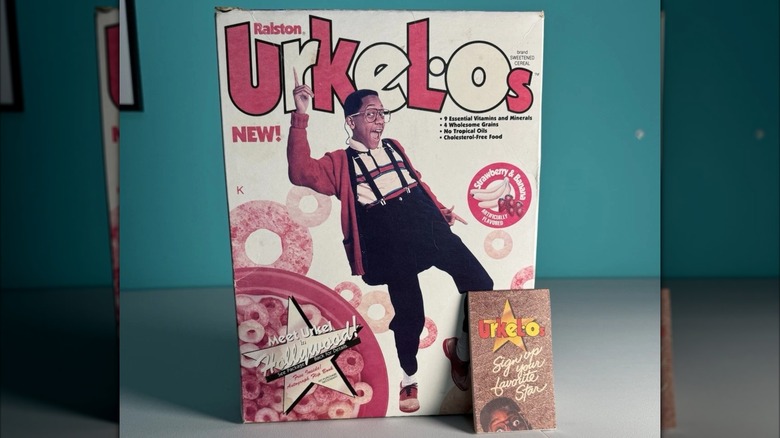
The Winslows were the beloved family of the popular sitcom "Family Matters," and the show's most popular character had his own brand of cereal. Steve Urkel wore suspenders, had glasses, and spoke in an exaggerated nasally drawl. He also had some trademark dance moves that were pretty uncool, even by '90s standards. Despite being the ultimate TV "geek," audiences loved him, and the actor who played him, Jaleel White, went from being cast for a one-time appearance to becoming a regular on every episode. Urkel was so popular, he even made appearances on other sitcoms, like fellow TGIF series "Full House." Steeped in the cultural zeitgeist, he had his own doll, board game, and became the mascot of his own brand of cereal.
Urkel-Os were an original fruity-flavored cereal made by Ralston that consisted of strawberry and banana circles. The cereal resembled Fruit Loops in taste and texture but only had red and yellow Os in the pack, probably due to Urkel's classic red-and-yellow outfits. Two versions of the cereal box were released: the first featured Urkel in his go-to costume mid-dance moves, and the second was a special pack made for the 1992 presidential election year. It featured Urkel in an Uncle Sam costume and offered campaign button prizes inside the pack. Both boxes featured games or contests and were labeled as being loaded with vitamins and minerals.
The cereal was released in 1991, but sadly, by the end of the decade, it was discontinued. Remarkably though, Urkel-Os outlasted "Family Matters" by two years.
Cinnamon Mini Buns
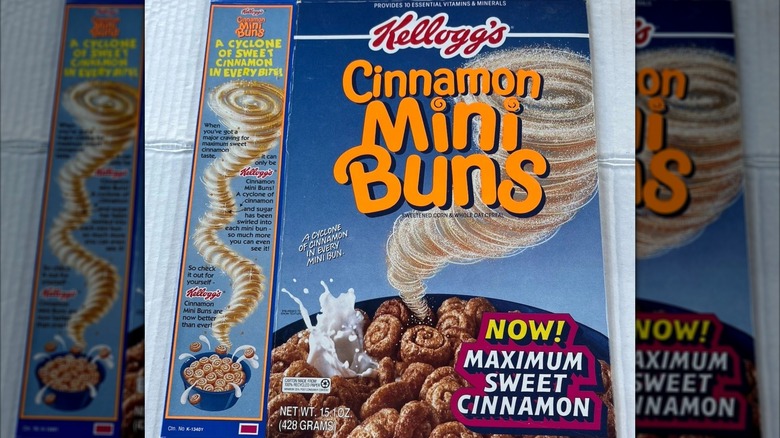
Kellogg's Cinnamon Mini Buns have seen several iterations, but nothing screams nostalgia more than the original '90s version. Cinnamon Mini Buns cereal was a sweet and crunchy treat consisting of tiny swirls. The pieces resembled miniature cinnamon rolls and were made from whole grain oats and corn, and of course, a dash of cinnamon. Introduced in 1991, the cereal was mostly aimed at kids, while advertised to parents as being a balanced and healthy breakfast. The commercials were fun and whimsical, featuring talking cartoon cinnamon buns or live-action, bite-sized characters. The boxes often contained prizes like mini comic books or cassette tapes, and some editions displayed board games on the back.
According to a Mashed survey, Cinnamon Mini Buns were the No. 1 cereal that consumers wanted back on the shelves. Considering its popularity, it's hard to believe the '90s classic only lasted two years, but by 1993, it was discontinued. In 2005, Mini Swirlz entered the market. Being not much more than Cinnamon Mini Buns with a new name and different packaging, the company also included two new flavors, Fudge Ripple and Peanut Butter Blast, to set it apart from its '90s version.
Finally, about five years later, Kellogg's introduced yet another rebrand, and Cinnamon Swirlz became Cinnabon. While we've got nothing against Cinnabon cereal, sometimes the nostalgia's too strong and a classic should just be left as is.
Rice Krispies Treats Cereal
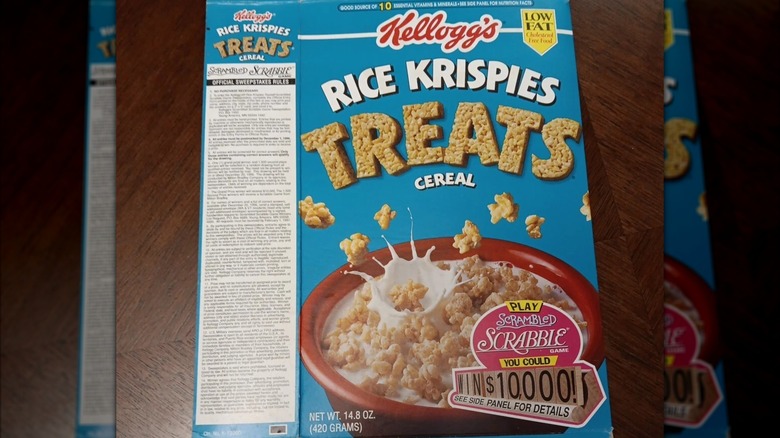
Rice Krispies treats are an easily customizable birthday party staple — in fact, they're arguably an every party staple. Made from Kellogg's Rice Krispies, marshmallow, and butter, there is almost nothing better — other than the deliciousness of Rice Krispies treats in the convenience of a cereal box, that is. Rice Krispies Treats Cereal entered the market in 1993, long after the treats had first gained enormous popularity in the decades prior.
This cereal aimed to capture the essence of the treats in bite-sized bits. While crunchy upon opening, the cereal gets gooey when mixed with milk, and the commercials suggested there would be no holding back after your first bite. The box was a bright teal with raised Rice Krispies treats printed onto it. It also featured maze games and images of an imaginary Willy Wonka-esque machine credited for making the cereal. Despite being inspired by an actual dessert, the cereal was advertised as being part of a balanced breakfast. Considering the triple whammy of marshmallow, sugar, and corn syrup, we're not convinced of that claim, but this '90s cereal is still certainly sorely missed.
Sadly, the original product was discontinued by the mid-2000s. Although a renewed, less popular formula — this time in a purple box — debuted the following decade, it too was discontinued in 2021 due to a lack of customer demand.
Dino Pebbles
Dino is Fred Flintstone's lovable pet dinosaur from the classic cartoon "The Flintstones." The show first graced our TV screens in the 1960s, and it's since been fully embedded in the global cultural canon. Set in prehistoric times, "The Flintstones" follows Fred, Wilma, their daughter Pebbles, their best friends, and Dino as they traverse the daily antics of ancient domestic life. Until "The Simpsons," "The Flintstones" was network TV's most financially successful cartoon ever created. It was also the first to develop characters with the intention of licensing them — meaning, "The Flintstones" and the world of branded cereals were a match made in '90s heaven.
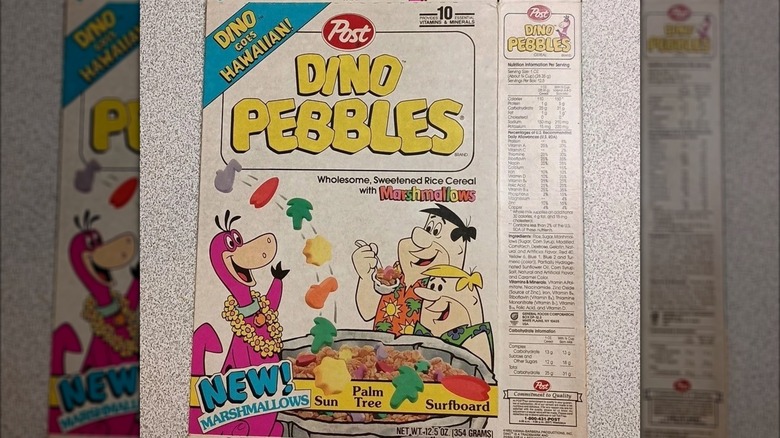
While Fruity Pebbles and Cocoa Pebbles have been around since the '70s and still endure today, Dino Pebbles entered the market in 1990. The third addition to the Post cereal Pebbles family was a vanilla rice cereal with colorful marshmallow bits shaped like dinosaurs. After some years, tropical-flavored and -shaped marshmallows were added to the original lineup of purple, orange, red, and green dinos. This version was advertised as the Hawaiian edition of the cereal, and it showcased Dino surfing in its commercial. The Dino Pebbles boxes had games on the back and some included prizes like stickers or color-changing dinosaur toys.
As with so many of the cereals in the '90s, Dino Pebbles was advertised as being a "wholesome" addition to a nutritious breakfast, despite being loaded with sugar and corn syrup — you've got to love the '90s. Sadly, this cereal only lasted a few years and was discontinued in 1993.
Reptar Crunch
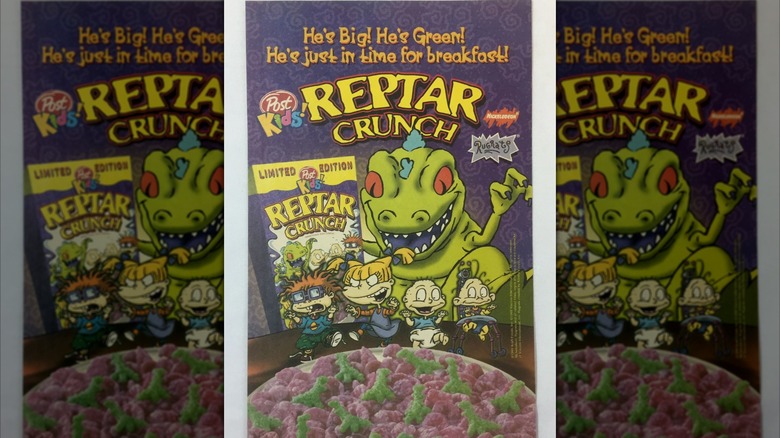
If you're a '90s kid, or even a '90s adult, then "Rugrats" is a part of your vocabulary. The Nickelodeon cartoon centers around a bunch of babies named Tommy, Chuckie, and twins Phil and Lil, plus Tommy's toddler cousin, Angelica, as they embark on misadventures heightened by their imaginations. It also features their parents and friends. After first gracing our screens in 1991, its popularity soared, and by 1994, the then-newly syndicated series had 26 million weekly viewers.
But let's back up a bit. The third episode of Season 1 features a story titled "At the Movies," in which the babies sneak into a scary movie called "Reptar!" The fictional monster movie was inspired by "Godzilla," and soon, Reptar became a fan favorite. Reptar featured in multiple episodes and movies, and then became a key player in "Rugrats" merchandise — including the monster's very own cereal. Reptar Crunch was a rice-based cereal released by Post, and it consisted of sweet purple flakes topped with green dinosaurs. The back of the box featured a "Rugrats" trivia board game with questions about the series and its characters.
Unfortunately, Reptar Crunch was a limited-edition release, used in the summer of 1999 to market the release of the "Rugrats: Runaway Reptar!" direct-to-video movie, with the VHS being advertised on the side of the cereal box via a mail-in rebate option. It would be gone from store shelves by that September.
Sprinkle Spangles
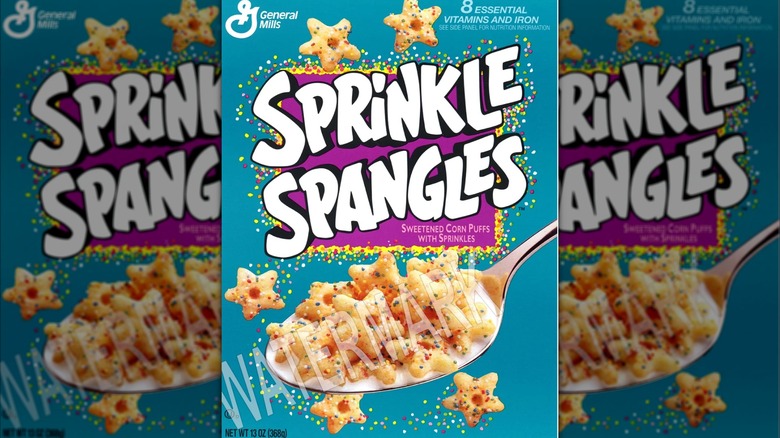
In 1993, General Mills gave our cereal aisles Sprinkle Spangles. Made from corn, Sprinkle Spangles were star-shaped sugary puffs inspired by sugar cookies. The sprinkles were sold as the key element to the cereal, with commercials noting that every inch of the cereal was covered in sprinkles.
The company later introduced a genie mascot to the cereal's branding, and on the newer boxes, the purple animated genie emerged from a spoonful of cereal. The character was voiced by American actor and comedian Dom DeLuise — '80s and '90s may have even recognized his voice, as he voiced multiple beloved cartoon characters, including Itchy in "All Dogs Go to Heaven" and Fagin in "Oliver & Company." The new Sprinkle Spangles mascot was no ordinary genie, but rather, a sprinkle genie who adorned this cereal with its trademark sprinkles, using the tagline, "You wish it, I dish it!" Many have since assumed that this mascot may have been introduced to capitalize on the popularity of the Robin Williams-voiced Genie in 1992's "Aladdin."
Despite the genie's — and General Mills' — best efforts, this cereal was short-lived. Due to a lack of sales, Sprinkle Spangles was discontinued in 1994, only one year after it was first introduced. Since then, it has amassed a cult-following in online '90s food nostalgia groups and forums, with consumers on the hunt for dupes of the beloved cereal. Some people have noted that cereals such as Twinkles, Mickey Mouse Club Confetti Cake Cereal, and Cap'n Crunch's Sprinkled Donut Crunch are a great way to satisfy a Sprinkle Spangles craving. But nothing is as good as the '90s original.
Pop-Tarts Crunch
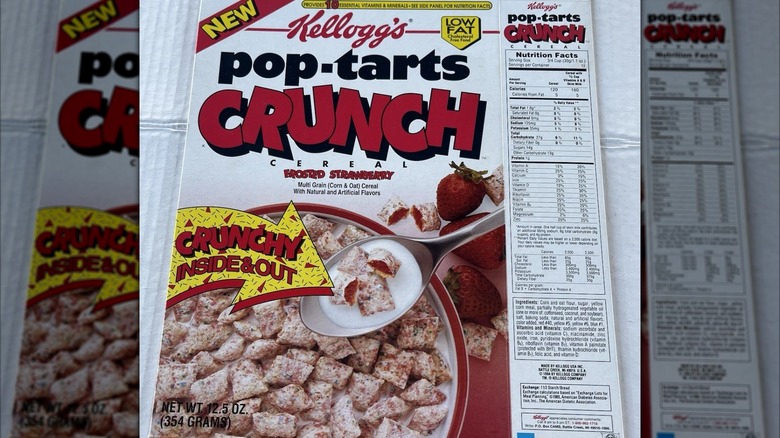
Pop-Tarts have a long and storied history in the world of snack food lore. Around the time of the Space Race, food manufacturers were embroiled in their own competition around convenience foods. Specifically, it was Kellogg's and Post at war over developing a long-lasting, foil-wrapped, fruit-filled pastry — what we now know as Pop-Tarts — with the former ultimately winning the battle in 1963. And by 1994, Kellogg's Pop-Tarts would enter the cereal market.
Kellogg's claims that consumers were breaking Pop-Tarts apart, throwing the pieces in milk, and essentially making homemade cereal. The company responded by developing Pop-Tarts Crunch. The cereal consisted of corn and oat pastry bits resembling tiny Pop-Tarts, with each heaped with a generous filling. It was available in two flavors: Frosted Strawberry and Frosted Brown Sugar Cinnamon. Commercials for Pop-Tarts Crunch featured pre-teens playing electric guitar or utilized celebrity backing by teen stars of the day like Marla Sokoloff from "Full House."
Despite the popularity of the toaster pastry, the cereal had low sales. In 1995, Pop-Tarts Crunch was discontinued after only one year. Thankfully, in 2019, Kellogg's released Pop-Tarts Cereal, a remake of the beloved '90s version with the same flavors, plus a Frosted Cookies & Creme version. However, these have also been pulled from store shelves. Alternatively, you could take a cue from the brand and just grab some Pop-Tarts, break it apart, and make your own homemade Pop-Tarts Crunch.
The Addams Family
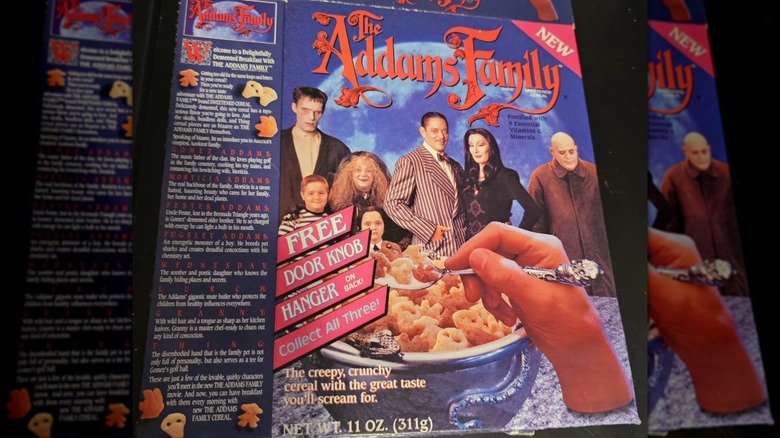
Long before Netflix's "Wednesday" hit our screens, "The Addams Family" first entered pop culture as a cartoon strip in the pages of The New Yorker in 1938. Decades later, cartoonist Charles Addams' famously macabre characters would appear in a major live-action blockbuster. In 1991, "The Addams Family" movie was released, featuring stars like Anjelica Huston, Christopher Lloyd, and a young Christina Ricci. The dark comedy was one of the year's highest-grossing films, and soon, a sequel was set in motion. Naturally, to accompany the hit movie, a cereal was launched.
Ralston released The Addams Family cereal in 1991. The front of the box featured a portrait of the family backlit by a full moon, with the disembodied human hand called Thing holding a spoonful of the cereal. The cereal pieces resembled skulls, headless dolls, and other creepy, kooky things. It's hard to know exactly what this wheat, corn, oat, and rice cereal tasted like, since the only descriptor on the box is simply "sweetened," but the apparent idea was to tap into the eeriness of it all, emphasizing that even the flavor was a mystery. That said, some '90s kids have since likened it to a bland combination of other sweetened cereals like Cheerios, Honeycomb, and Kix.
Some versions of the cereal box featured collectible cut-out door hangers on the back, including an eye peering through a door hole or Thing holding an invisible doorknob, while others featured collectible portraits of the family or character-based flashlights. Sadly, this mysterious and spooky cereal was discontinued in 1993.
Hidden Treasures
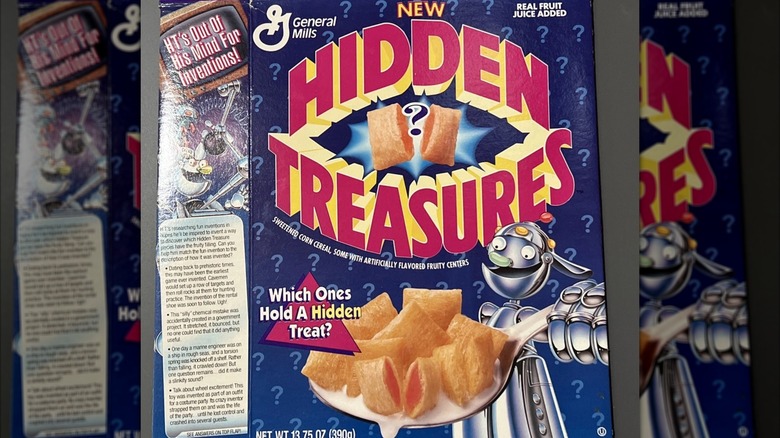
Launched in 1993, Hidden Treasures was manufactured by General Mills. Made from sweetened corn, each cereal piece resembled a small, puffed square or pillow, which were stuffed with a fruit-flavored filling of either orange, grape, or cherry — the catch being that not all of the puffs had filling inside. Rather, some of the pillows were made purely from sweetened corn, and you had to search for the delicious frosting-filled pieces ... hence the name Hidden Treasures.
The box featured the cereal's mascot, H.T., a silver robot that could decipher which pieces held the treasure and which were just squares. However, in the animated commercials for Hidden Treasures, kids suggested that all of the fun was in being surprised. The side of the cereal box illustrated H.T.'s love of inventions with trivia games about famous inventions, and the back displayed a comic strip reminiscent of the cartoon commercial.
Later editions dropped H.T. as the mascot, with the cereal box designed without the robot and the background being changed from blue to purple. The Hidden Treasures commercials were also reshot, and H.T. was booted for a live-action ad featuring a kid explaining the premise of the cereal. Despite the rebrand, the cereal was short-lived and discontinued by 1995. Still, Hidden Treasures made a huge impact in a short amount of time, with social media outcries demanding it come back.
Bill & Ted's Excellent Cereal
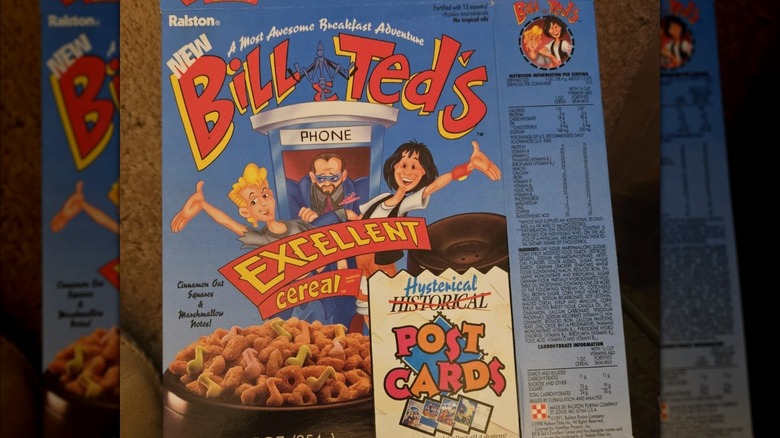
"Bill & Ted's Excellent Adventure" was released in 1989. The movie centers on a pair of high-school slackers played by Alex Winter and Keanu Reeves. After finding a magical phone booth time machine, the two friends adventure through multiple time periods to write the greatest history report their teacher has ever seen. The film grossed just over $6 million on its opening weekend, an impressive standing for what began as a small sci-fi comedy and has since risen to cult-classic status, with two sequels to boot. Given its success, just a year later, Hanna-Barbera created an animated series based on the movie's time-traveling duo. But it wasn't truly a '90s cartoon if it didn't have its own cereal, right? So, Ralston released Bill & Ted's Excellent Cereal in 1990.
This discontinued cereal consisted of sweet cinnamon oat pieces with marshmallow music notes. The box featured the animated Bill, Ted, and others in front of their time machine phone booth, and it labeled the cereal, "A Most Awesome Breakfast Adventure." It also offered various prizes like cassette tape holders that looked like phone booths, miniature characters from the show, and hysterical (not historical) postcards. The accompanying commercial featured the animated characters traveling through various historical time periods with the cereal, and it was advertised as being a healthy way to start the day (or night).
The TV show only lasted two seasons, and the cereal survived only a year in grocery store aisles. Still, we think it's most excellent!
Static Media owns and operates Tasting Table and Mashed.