

How Julia Child Used Her Love Of Dry Martinis To Make Salad Tastier

Julia Child knew how to work a room, and a salad bowl. Her favorite vinaigrette, a staple of both her cookbooks and TV episodes, doesn't necessarily require fancy ingredients or fussy technique, because it's based on an easy-to-deal-with-and-remember ratio borrowed from the cocktail hour. Where many dressing recipes demand exacting spoons and measuring cups, Julia said: "Think martini." Her version of vinaigrette, introduced in 1968 on "The French Chef," calls for one part vinegar to five parts oil, a dry, "upside down" martini mix that's gentler than the usual 1:3 standard, and far less likely to overpower your greens. She explained that the usual ratio was too harshly acidic, so her method lets the delicate vegetal flavors shine rather than picking a fight with the main course.
So you can go ahead and forget the measuring cup and reach for a shot glass to measure if you want to keep things on theme. Pour your vinegar from the shot glass into a bowl, add a spoonful of Dijon mustard, a generous pinch of salt, and then measure and slowly drizzle in the oil, whisking as you go. If you're feeling showy, you can even swirl a crushed garlic clove around the bowl first, bartender style, to perfume the mix. The result is a balanced dressing that works every time, without a trace of sourness or intimidation.
Pour decisions lead to vinaigrette victory
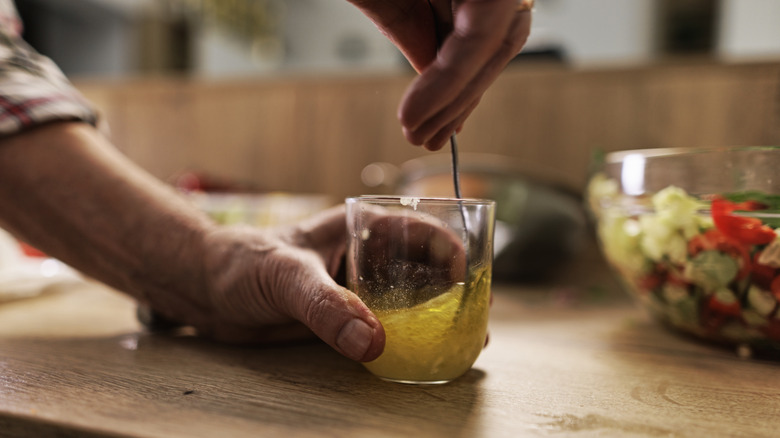
Vinaigrette is a classic emulsion, which means you're persuading oil and vinegar, immiscible liquids, to mingle and become a stable, if temporary, unified whole. Julia's technique, inherited from a bartender's confident pour, actually sets you up for emulsified success: The high proportion of oil in her "dry martini" formula creates a creamy, clinging texture that coats each leaf, and the vigorous whisking brings the two together, at least fleetingly, into a smooth, glossy dressing. If your vinaigrette separates (as all classic emulsions eventually do), she advises that another quick whisk brings it right back.
For cooks eager to play mixologist, Julia's blueprint leaves plenty of room to play. Experiment with the vinegar, trying sherry, Champagne, or a splash of lemon juice for a sharper, fresher finish. A bar spoon of pickle or olive brine brings a wink for the "dirty martini" crowd. You can even use a splash of vermouth if you want to get really cocktail-y. Use walnut, grape seed, or even pistachio oil if you want to match the flavor to the greens, add chopped shallots, or a pinch of fresh tarragon for more herbaceous complexity. For those who like a little ceremony, try shaking the dressing in a cocktail shaker over ice, then straining directly over the salad for dinner party drama.
Shaken, stirred, tossed: mixing up your salad routine
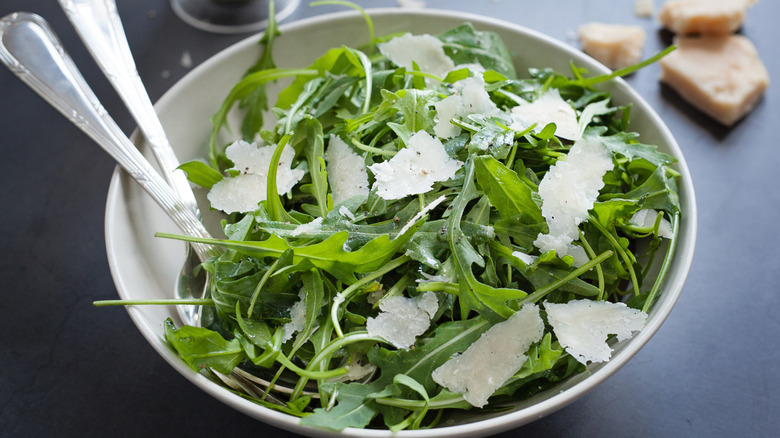
For a salad that practically toasts to cocktail hour, pair bitter greens like frisée or radicchio with slices of orange and a few Castelvetrano olives, then dress with a vermouth-spiked vinaigrette. Even the garnish can borrow from the bar; think citrus twists, thinly shaved fennel, or, for a playful nod, a single cocktail onion tucked beside the greens. Some chefs have built entire menus around this kind of "liquid inspiration," tossing together salads with gin-infused cucumber quick pickles, mustard seeds pickled in vermouth, or shallots macerated with a hint of juniper.
Julia's original insight remains evergreen: The lines between cocktail glass and salad bowl are easy, and deliciously fun, to cross. Both reward improvisation, both benefit from a moment of attention, and both have the power to turn any meal into an occasion. Above all, Julia's legacy is in making the "hard" part, which is getting the proportions, texture and taste into balance, feel as intuitive as fixing a drink. Taste as you go, toss just before serving, and trust your own sense of equilibrium. As always, the secret ingredient in Julia's recipe is precision, shot through with panache.