

Kerr Vs Ball Mason Jars: Is There A Difference?
We may receive a commission on purchases made from links.
Whether you're trying your hand at pickling vegetables or whipping up a flavorful batch of classic mint jelly, Mason jars are the tool for the job. Even if you don't can your own food, Mason jars are great for serving cocktails, overnight oats, salads, and other dishes. Regardless, the first step to elevating your culinary game with Mason jars is (surprise) actually buying Mason jars. The differences between the two major brands on the market — Kerr and Ball — are subtle, but it's important to understand how they benefit or hinder your desired use.
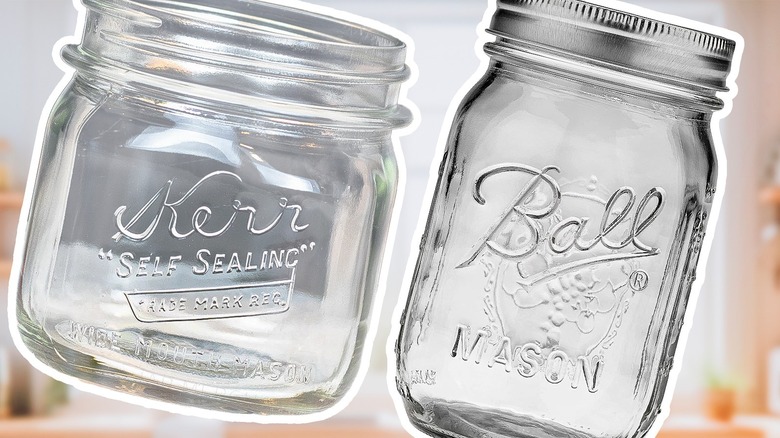
Both Kerr and Ball Mason jars are owned by the same company: Newell Corporation (known as Jarden from 2002 to 2016). Happily for home canners, this means that both options deliver on quality. Newell acquired Kerr in 1996 and began producing both Kerr and Ball jars in Indiana the same year. So, both brands are made in America and equipped with interchangeable bands and lids. The biggest difference between them is that Kerr jars are better for affixing with labels, while Ball jars are better for in-jar measuring. Notably, Ball jars have measurement markings, while the smooth Kerr jars do not.
Which brand you use might also depend on where you live. Newell primarily distributes Ball Mason jars in the eastern half of the U.S., while Kerr-brand models are typically sold on the west coast. Since 1998, Newell has also made Golden Harvest brand Mason jars, which are sold all across North America.
Ball Mason are imprinted with designs and raised measurements
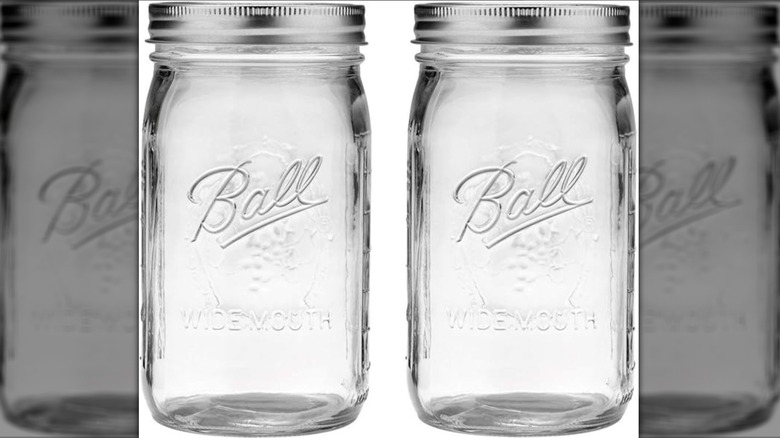
Since the 1970s, Ball Mason jars have been imprinted with a design of wheat and fruit inside a round circle, while their sides are stamped with raised measurements. One one side, increments display the jar's volume in metric units (250 milliliters, 500 milliliters, and 750 milliliters for a 1-quart jar). The other is imprinted with measurements for standard unit cups and ounces. This means that Ball jars boast a distinctively busy design, with some kind of stamp happening on every side of the jar. These raised edges can be helpful for in-jar measuring but can also prevent sticker labels from forming an adhering seal.
Ball jars tend to rock a slightly higher price tag compared to Kerr Mason jars due to the longstanding reputation of the brand name. Originally, the Ball Corporation was established by five brothers from Buffalo, New York during the 1880s. Since 1909, the company has put out the "Ball Blue Book," which is regarded as an encyclopedic, frequently updated authority on home canning and preservation practices. Currently, Ball is on its 38th edition of the book, which includes hundreds of recipes, step-by-step instructions, and troubleshooting guides.
Kerr models have smooth sides ideal for affixing labels
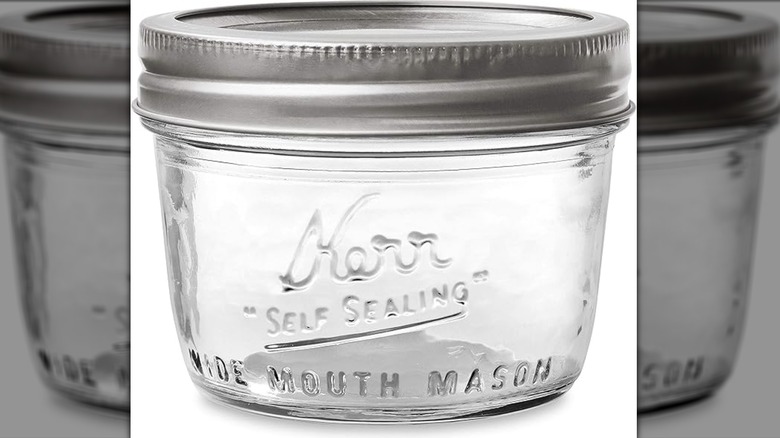
Unlike the busy, printed Ball jars, Kerr jars feature ultra-smooth sides. Some foodies prefer this, as it makes them a better choice for securely affixing with adhesive labels. With that said, Kerr's smaller jelly jars have a quilted texture along the sides. For these smaller jars, as with Ball, affixing a label to the top of the lid works better.
Even though Ball is revered by many modern foodies as the ultimate authority in home canning, it was the Kerr brand that first invented two seemingly universal aspects of the Mason jar's fundamental design: the wide-mouth jar openings and lid with the gasket affixed to its underside. All other Mason jar brands followed Kerr's innovative lead. The Kerr Glass Manufacturing Company was founded in 1904 by Alexander H. Kerr of Pennsylvania. In 1915, Kerr invented the self-sealing screw-on ring and metal plate lid that home canners use today. Regular-mouth Kerr jars are available in 4-ounce, ½-pint, ¾-pint, 1 pint, and 1 quart sizes. Wide-mouth Kerr jars are available in ½-pint, 1-pint, and 1-quart sizes.
Ball and Kerr jars are effectively the same product, but Ball models tend to be pricier
Despite Kerr's initial pioneering innovations (and both brands now being owned by the same company, Newell), Ball jars tend to be a bit pricier. For instance, a 12-pack of 8-ounce wide-mouth Kerr jars costs $37.28 on Amazon, while just two 32-ounce wide-mouth Ball Mason jars run for $15.88. Although, notably, the same jars can be found for significantly cheaper prices at Target and Walmart.
Garage sales and thrift stores can also be fantastic places to score high-quality canning jars on a budget. Just be sure to thoroughly sterilize or pasteurize those jars before using. Also, especially when purchasing jars secondhand, be sure to inspect each one for any cracks (failing to do this is one of the biggest mistakes people make when canning their own food). Accidental air leakage can compromise the jar's seal and pose a spoilage or botulism risk.
As one Reddit thread in r/Canning puts it, "[A]re all jar brands essentially the same or are some better than others? I'm needing more quart jars for this upcoming canning season and I'm finding that the ball brand ones I normally buy are hard to find or the prices are inflated. I am able to find kerr brand quarts locally and golden harvest pints. They look pretty much exactly the same." Indeed, with the exception of imprinted measurement units, all three Newell brands are delivering basically the same thing — any differences are nuanced.