

Why Are Quartz Countertops Being Banned?
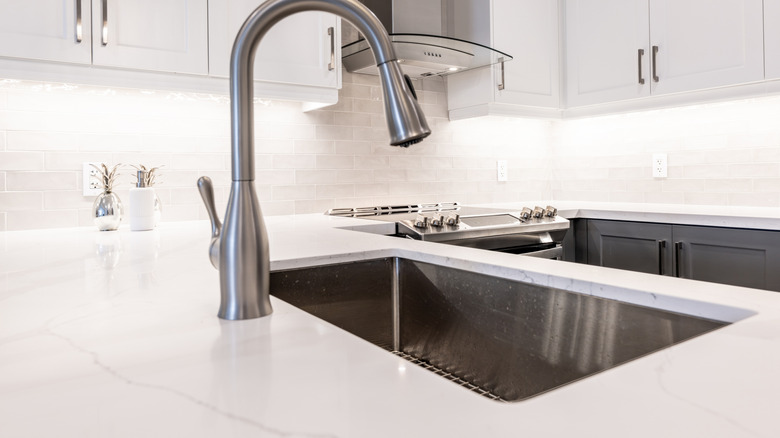
Choosing countertops can be a big responsibility. You probably want a material that matches your aesthetic vision, but it's also important to consider price, longevity, durability, functionality, and safety. And it turns out that the safety of quartz countertops is in question. While quartz countertops tick many boxes, this glitzy material is slowly being banned in parts of the U.S. due to major health concerns for the people who manufacture it.
"California is considering restrictions on the fabrication and installation of certain engineered stone products because of serious occupational health concerns associated with respirable crystalline silica dust," explains Kerrie Kelly, CEO and creative director of Kerrie Kelly Studio. This dust can have serious effects if inhaled, which makes it dangerous for the tradespeople who work with the material on a daily basis. "When silica-containing materials are cut, ground, or polished, they can release extremely fine particles that pose significant risks to workers without adequate exposure controls," Kelly says, which includes quartz countertops.
So even if it's Consumer Reports' highest-rated countertop material, it's probably time to think of an alternative safer-to-produce material if you're in the market for a countertop. However, if you already own a quartz countertop, you're safe. Kelly says, "The proposed restrictions focus on protecting the people who manufacture and fabricate these surfaces, rather than suggesting that professionally installed countertops are inherently unsafe for homeowners." Quartz countertops won't pose a danger if the material is already in your home, but the potential ban may affect quartz's future availability.
Defining silicosis and exploring alternatives
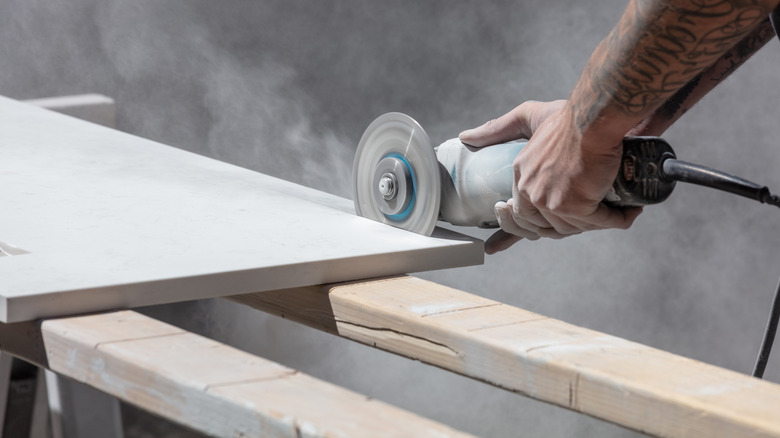
Similar to how prolonged coal-related inhalation can lead to black lung disease, prolonged silica-related inhalation can lead to a disease known as silicosis. "Silicosis is a serious, irreversible lung disease caused by inhaling respirable crystalline silica dust, which can be generated during countertop fabrication," Kelly says.
The potential ban has become a particular point of contention in California, home to more than a few quartz countertop manufacturers. The disease's incurable effects make it a major concern for people in the industry. And quartz isn't the only material that can lead to silicosis either — several of these other kitchen countertop materials can also cause serious lung problems for manufactuers.
If a ban does go into effect, there are, of course, alternatives to quartz countertops. "For homeowners considering alternatives, porcelain, ceramic, and verified low-silica or silica-free surface products, such as ECLOS, are worth exploring, although every material has its own manufacturing considerations," Kelly explains. "Natural stones such as granite and quartzite also contain crystalline silica and require appropriate fabrication safeguards," Kelly adds, even if the long lifespan of granite countertops seems tempting. The key when exploring other options is to avoid crystalline silica, which is found in materials ranging from natural sand and stone to artificial stone. "I encourage consumers to look beyond the finished product," Kelly advises, "and ask how their surfaces are fabricated and installed."