

The Backsplash Material That's Bound To Crack, And What To Replace It With
There are so many choices when it comes to decorating your kitchen that you're probably tempted to just choose a backsplash and move on, but the wrong material can be a headache. Every kitchen backsplash material has its pros and cons, as that natural stone you love will need sealing, and the marble may be too expensive to replace if damaged. That's why we spoke with Kerrie Kelly, the CEO and creative director of Kerrie Kelly Studio, who revealed that glass backsplashes are prone to crack.
While Kelly admits that glass can create a seamless look, she notes that it's not as forgiving as other materials. "Temperature fluctuations, improper installation, uneven wall surfaces, and pressure around outlets or cutouts can create stress points that eventually lead to cracking," she explains. However, the biggest consideration may be the heat that the glass is exposed to. Kelly adds: "Not all glass is designed to withstand the temperatures or thermal changes associated with a cooktop or range."
If considering glass, it's important to know the exact type and its characteristics, including how it will be installed and how much clearance your appliance manufacturer says it requires. Options like tempered glass backsplashes are more heat resistant and tougher overall, but that may not be enough peace of mind for something you want to last. In that case, Kelly suggests another material worth exploring: glazed porcelain tile.
Porcelain tile offers many of the advantages of glass without some of the downsides
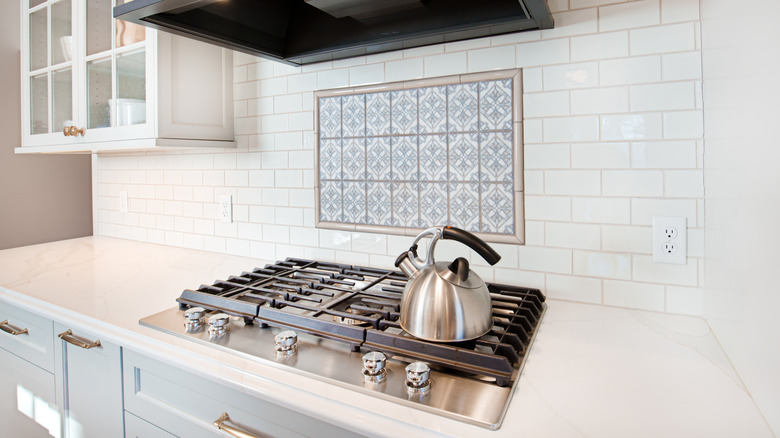
If you like the clean look of glass but have concerns about cracking, Kelly believes glazed porcelain tile will work for you. "It offers a similar luminous finish with excellent durability, a wide range of colors, and relatively easy maintenance," Kerrie Kelly explains. A big advantage to glass backsplashes is that they are nonporous and stain resistant, and porcelain offers a similar upside.
Porcelain is crafted at higher temperatures than ceramic, producing a dense material with very few pores. This makes it water and stain resistant, not to mention low maintenance. It is also highly resistant to heat, doesn't warp over time, and is tough enough that it doesn't scratch or dent easily. These are many of the same qualities that make porcelain a great countertop alternative to granite and marble.
The aesthetics are another plus. "Large-format porcelain is particularly appealing because it minimizes grout lines and creates that uninterrupted, contemporary look," Kelly adds. "It's a beautiful way to achieve the visual simplicity of glass with a material that's generally more forgiving in a hardworking kitchen." Even better, porcelain can also be quite flexible in appearance.
Modern crafting techniques allow porcelain to come in many colors, shapes, and textures, and even mimic other materials. So, it can work for modern looks or a kitchen that's more timeless and elevated. And, since it's an easy material to cut, it will fit all corners and edges.
Glass kitchen backsplashes require extra care
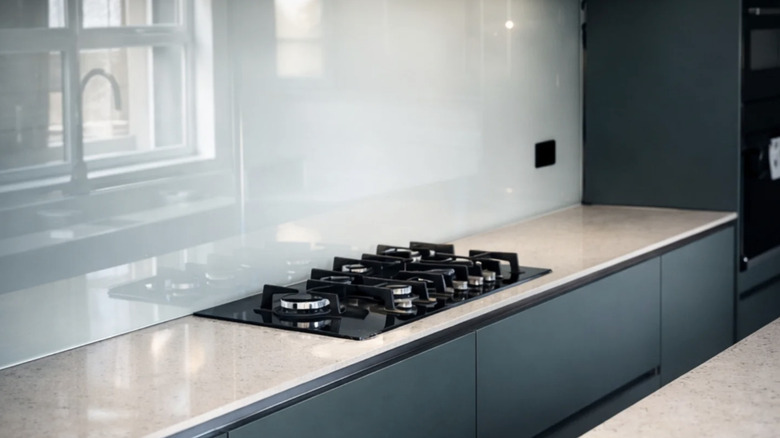
Despite cracking concerns, glass backsplashes offer a stylish, modern look. The reflective nature can brighten your kitchen, and their natural stain-resistance (and ease of cleaning) is a nice upside. So, if you stick with glass, Kerrie Kelly offers some recommendations for how to best care for it.
First, she reiterates that you should check the requirements of any heat source in the kitchen. Information on clearance and compatibility with different wall materials can often be found in the appliance manual. "If you're unsure whether the glass is heat-rated, have a qualified professional evaluate it rather than assuming it's safe behind a range," Kelly adds.
You also want to be sensitive to how glass backsplashes are installed. "Glass needs to be installed with appropriate allowances for expansion and movement," she notes. "If you're noticing separation around edges or corners, an experienced glass installer can assess whether the installation needs attention." Avoid putting too much weight or pressure on glass as well, which can risk cracking. "Be mindful of overtightened outlet covers, hardware, or accessories mounted through the glass," Kelly notes.
Lastly, the expert recommends hiring a professional to address any cracks quickly rather than covering them up or trying to fix them yourself. In the end, Kelly reminds us that a kitchen backsplash design should not just be beautiful, but practical. She concludes, "A backsplash should complement the design without becoming something homeowners have to worry about every time they cook."