

Burger King Vs McDonald's: Which Serves Healthier Breakfast Sandwiches?
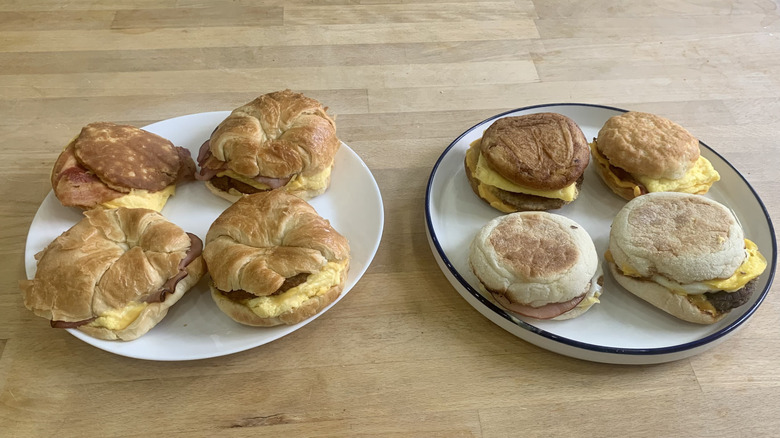
McDonald's and Burger King built their empires on burgers, but they are also breakfast powerhouses. Even compared to breakfast-forward chains like Dunkin' and Starbucks, these brands are among the top selling fast food breakfast sandwich purveyors. With tens of thousands of locations nationwide between them, they fill a big need for hungry Americans on the go. But convenience and taste aren't the only criteria folks care about. If you want a healthier breakfast, you are probably a little better off with McDonald's than Burger King.
To compare the two chains, we looked at a few key nutritional areas. Firstly, we compared the saturated fat, trans fat, added sugar, and sodium counts, as the U.S. Food & Drug Administration (FDA) considers these "nutrients to get less of." We also took protein and fiber into account. While breakfast sandwiches from both chains can be part of a healthy diet, those with certain dietary needs will want to keep these aspects in mind.
Of course, the respective breakfast menus are not perfect for comparison. Thus, we picked four categories that were the most similar, best representing each chain. The first are the signature breakfast sandwiches — the Egg McMuffin at McDonald's and the Croissan'wich at Burger King. Since McDonald's also offers the McGriddle, we also looked at that compared to another Croissan'wich. Both chains also offer bacon, egg, and cheese biscuit sandwiches and one larger, high-protein choice. Due to varying sizes, we looked for comparisons with as close calorie counts as possible.
Nutrition of Burger King's breakfast sandwich menu
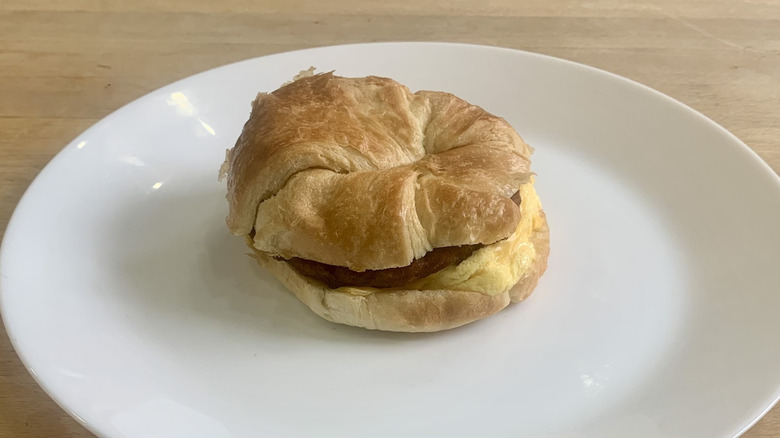
There are only two breakfast sandwich categories to choose from on the Burger King breakfast menu: Croissan'wich or biscuit. As far as breakfast sandwiches and eating healthy go, the biggest issue with the Croissan'wich is trans fat, as each contains a single gram. That doesn't sound like much, but, according to the World Health Organization (WHO), the maximum recommended daily intake is less than 2.2 grams.
Beyond that, the Bacon, Egg, and Cheese Croissan'wich is one of BK's lower sodium options, with only 810 milligrams, though it has a high-ish saturated fat count at 10 grams. Sugar was a small downside, as those croissant sandwiches contain 4 to 5 grams of added sugar. The biscuits are a mixed bag as well. Most only offer 0.5 grams of trans fat and on average contain half as much sugar, but the Bacon, Egg, and Cheese Biscuit, for instance, boasts a slightly higher saturated fat count at 12 grams.
The protein and fiber counts are similar as well. The Croissan'wich offers 15 grams of protein and 3 grams of fiber, while the biscuit contains 16 grams of protein and 2 grams of fiber. However, the biscuits are very high in sodium. The Bacon, Egg, & Cheese Biscuit boasted 1,340 milligrams, which is nearly 60% of the recommended daily intake from just one sandwich. That's over 500 milligrams more than its Croissan'wich counterpart, and more than 20% of the FDA-recommended daily value.
Nutrition of McDonald's breakfast sandwich menu
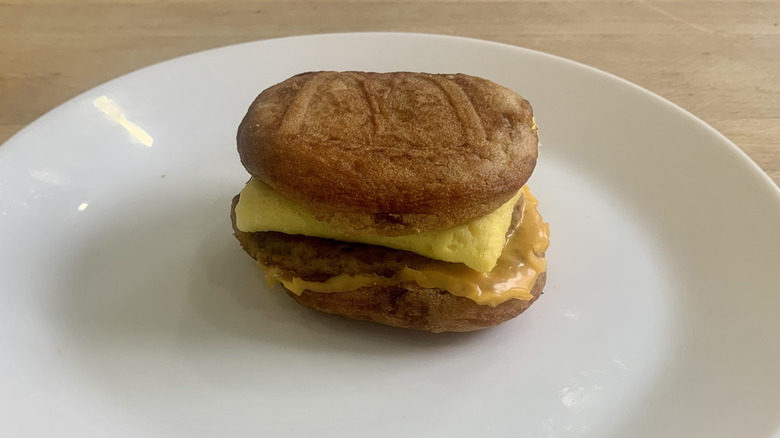
McDonald's breakfast sandwiches come in four varieties: McMuffin, McGriddle, biscuit, and bagel. To best compare, we chose those containing bacon, egg, and cheese, with the McMuffin being the Canadian bacon outlier. That said, McDonald's historic Egg McMuffin came out ahead on most fronts. The sandwich offered the least sodium by far at 770 milligrams, tied for lowest added sugar at 1 gram (total 3 grams), and had the least saturated fat at 6 grams.
By contrast the biscuit contains 1,330 milligrams of sodium, 13 grams of saturated fat, and 1 gram of added sugar (also 3 grams of total sugar), while the McGriddle boasts 1,230 milligrams of sodium, 9 grams of saturated fat, and much more added sugar at 13 grams (15 total), which is not surprising considering those sweet syrup pockets. The bagel sandwiches do boost the protein count, but they are also just larger overall — and contain more calories, at 590 calories compared to the McMuffin's 310, the McGriddles' 430, and the biscuit's 460.
However, that higher number may be worth it to you for the extra nutrition. The bagel offers 25 grams of protein, while the other three only have 17 grams. Interestingly, all four contain the same amount of fiber: 2 grams. In short: the biscuit is highest in sodium, the McGriddle highest in sugar, the bagel is more protein-rich but heavier, and the McMuffin is the lightest — your choice of McDonald's breakfast will depend on your individual concerns.
McDonald's narrowly beats out Burger King in comparisons of breakfast sandwich nutrition
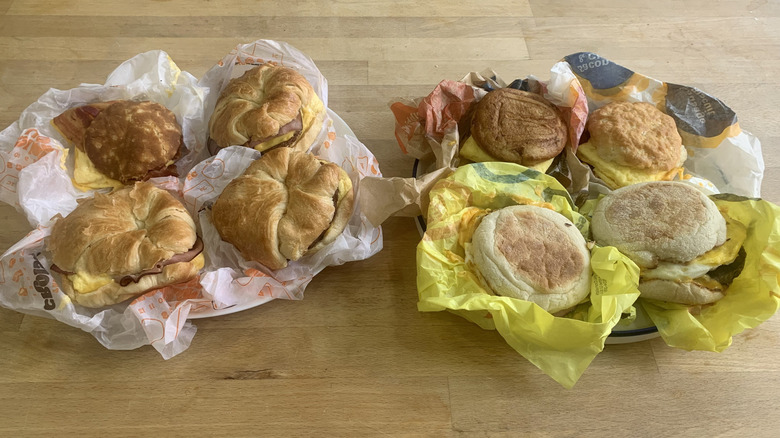
The most comparable options at both chains were pretty similar, with both being totally reasonable to enjoy as part of a balanced diet. Yet, broken down head-to-head, McDonald's narrowly came out on top. The biggest advantage for McDonald's is that most of its breakfast sandwiches don't contain any trans fat, with the bagel being the exception at 0.5 to 1.5 grams, depending on the meat. Conversely, all of Burger King's do. That nutritional red flag is a point in McDonald's favor.
For the most similar products — the bacon, egg, and cheese biscuit at both chains — it was the only meaningful difference. For signature sandwiches, the Canadian Bacon McMuffin's 6 grams saturated fat, 770 milligrams sodium, and 3 grams total sugar are lower than the Bacon, Egg, and Cheese Croissan'wich's 10 grams, 810 milligrams, and 4 grams, respectively. Another narrow advantage for McDonalds.
Comparing more positive nutrients, both McD's and Burger King were similar, offering solid protein but minimal fiber. The BK Croissan'wich offers 15 grams of protein and 3 grams of fiber to the 17 grams of protein and 2 grams of fiber in McDonald's Egg McMuffin. The numbers for the McGriddle were the same as the McMuffin. Both biscuits sported 2 grams of fiber, but McDonald's came out ahead with 17 grams of protein to BK's 16 grams.
Finally, the high-protein breakfast options. The McD's steak bagel contains 34 grams of protein against BK's Fully Loaded Biscuit at 31 grams. The latter also boasts a heavy 2,290 milligrams of sodium and 20 grams of saturated fat compared to the latter's 1,510 milligrams and 15 grams, respectively. So, if you are watching fat and sodium, McDonald's once again comes out on top.