

One Unique (But Pricey) Vintage Mason Jar Is A Collector's Thrift Store Dream

We may receive a commission on purchases made from links.
There are a few reasons people collect vintage Mason jars: To use them for food storage, to decorate with them, like turning old Mason jars into beautiful centerpieces, or to make money from them on the secondhand market, similar to how these vintage plates are worth a fortune today. One unique vintage jar collectors are thrilled to come across because it's quite valuable is the lightning jar. The jar gets its name from its glass lid fitted with a wire bail-and-clamp closure that was said to be lightning fast. It also replaced metal screw-on lids of the era, which could reportedly leave a metallic taste in food.
Lightning jars came on the scene in the 1880s after Henry William Putnam patented a design for a wire hinge that connected the glass base to the glass lid. They were produced by at least 11 U.S. glass companies, so they don't necessarily have brand logos on them, like Mason or Ball. Some versions are fitted with a rubber ring on the underside of the lid to seal the jar for food storage. By the late 1960s, lightning jars fell out of fashion in favor of easier-to-use jars with longer-lasting seals. Though replicas have cropped up through the years, the original late 19th- and early 20th-century jars are the ones to get excited about if you're an avid thrifter.
Signs a lightning jar may be worth something
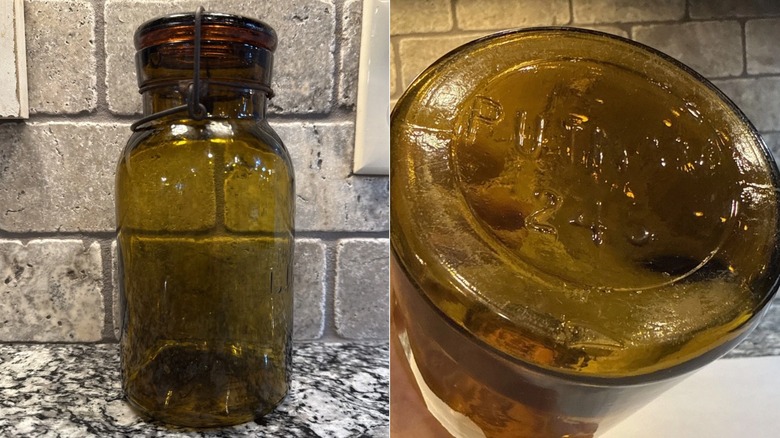
While some vintage kitchen items have suddenly become trendy again, old jars always seem to be in the periphery of the decor people are drawn to. Vintage glass Mason-style lightning jars, with their trademark wire closure and glass lid, appear to be particularly buzzy right now. Options on eBay are listed for as little as $14, and go up to the low hundreds of dollars. Others have reportedly sold one jar for $450. So what should you look for to tell if the lightning jar you spot while thrifting is an authentic antique?
Real Or Repro has an extensive guide on what to look for, but it's helpful to at least have the basics down. For example, wires on authentic half-pint jars tightly twist four or five times around the lid, not just once, as is often done on replicas. Authentic quart jars have a metal collar with a hole punched on either side that the wire loops through. Lightning jars of any size should be embossed on the base with the brand name, such as Putnam, and the mold number, indicating the style of jar being made. Some knock-offs have this embossing, so you should also look at the lip of the jar. Is it perfectly smooth? Probably a replica then. Even so, knock-offs are attractive and can be used as decor. But if you find the real deal at a thrift shop? Grab it.