

4 Disadvantages Of Tile Countertops
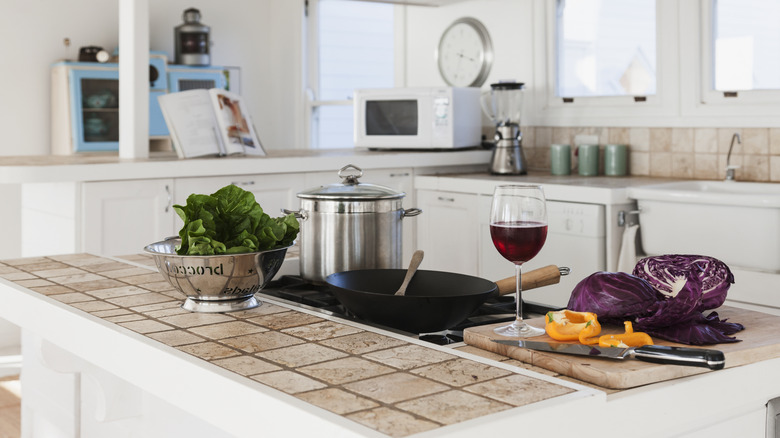
Countertops that look good on a Pinterest board don't automatically translate into a functional choice for your real-life kitchen. Tile countertops are the prime example of that. Although they do have an appealing retro look, which can make the kitchen feel unique, ceramic-tiled countertops can cause headaches in the long run.
We spoke to Kerrie Kelly, the CEO and creative director of Kerrie Kelly Studio, about the main disadvantages of tiled countertops that you should know before making a long-term decision. This is not a case against tile itself, mind you. "I love tile," Kelly told us, going on to clarify, "just usually not as the primary kitchen work surface."
Tiles can be a great pick for the backsplash, so you don't have to entirely give up on having a partially tiled kitchen. "Tile can be fantastic vertically, where its pattern, texture and craftsmanship become an asset without asking it to perform like a countertop," Kelly explained. After all, the main reason for choosing tile countertops is usually the aesthetic, and you can easily achieve that with a different surface. But the last thing you want is a kitchen that looks nice and is a hassle to cook in. So, here are four major disadvantages of tile countertops, as explained by the expert.
Tile grout introduces unnecessary maintenance
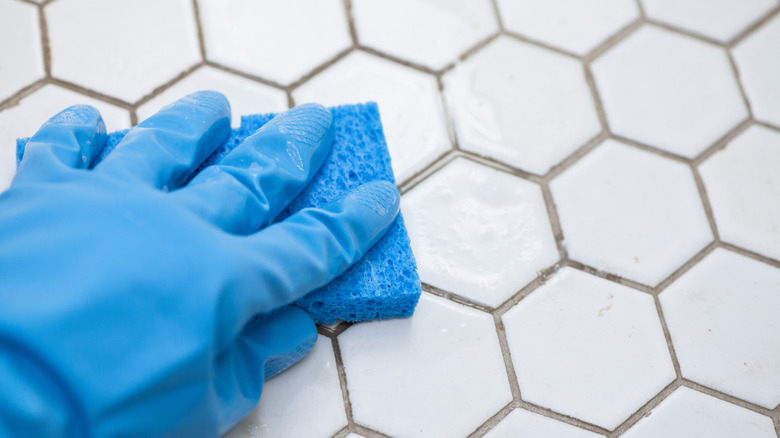
"The biggest disadvantage is the grout," Kelly told us — and you can't have tile without the grout. "The kitchen countertop is one of the hardest-working surfaces in the home, and grout introduces unnecessary maintenance exactly where you want the easiest cleanup," she pointed out. Cooking often gets messy, which is why having a countertop material that's easy to clean is one of the key components of a functional kitchen. "Crumbs, spills, oils, and discoloration can collect along grout lines, and the segmented surface is simply less effortless to live with than a continuous slab," she explained.
For those who already have existing tiled countertops, Kelly recommends regularly cleaning and resealing the grout, as well as repairing it as soon as you notice that it's damaged. For easier cleaning, hydrogen peroxide can help keep your kitchen spotless — grout included. As for the alternative countertop options, Kelly's pick would be a large-format, low-porosity surface. "Silestone or, depending on the application, Dekton are engineered/advanced surfaces that combine the visual impact with the performance clients expect from a modern kitchen," she noted.
Tile countertops present an uneven work surface
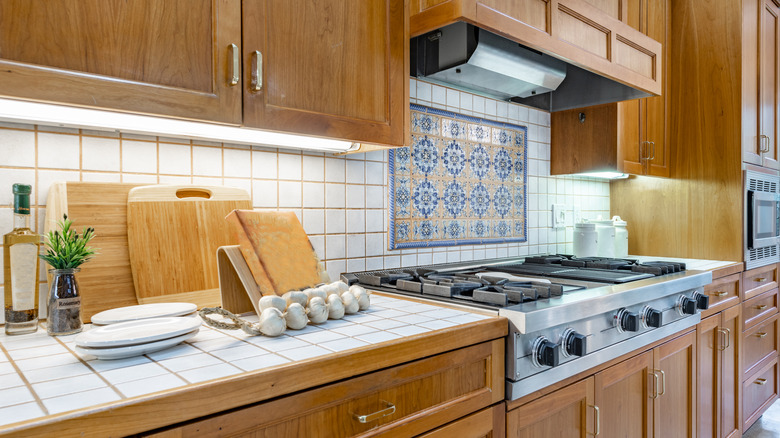
It's safe to say that countertops are a high-traffic area, and most of the actions we need them to perform require the surface to be even. You won't be getting that from tiles. "Grout joints interrupt the countertop, which can be frustrating for baking, rolling dough, wiping down, or simply setting smaller objects on the surface," Kelly told us. That's probably the reason why tiled countertops are among the 10 countertop styles disappearing in favor of other, more work-friendly materials. "A slab surface eliminates those interruptions," the expert pointed out.
For those who already own tiled countertops, Kelly recommends evening out the surface with the help of cutting boards and trivets. You could settle for a compromise, where a smaller part of your countertops (for example, just around the kitchen sink) is tiled, while the rest have a more functional single-slab material. You can also purchase a standalone kitchen island and use that as the main workstation if you have the space.
Tiles can chip or crack
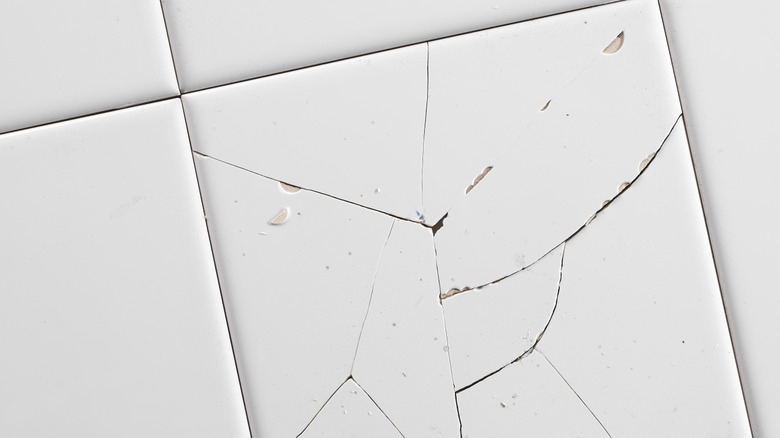
Tiles are not the best choice for high-traffic areas where pots and pans are constantly moving about. They're very sensitive to impact damage, and dropped items tend to leave large, starburst-like cracks that are very hard to hide or overlook. They can even pose safety risks if the material is flaking off from a large crack in the tile.
Per Kelly, "Individual tiles, and particularly exposed edges, can chip or crack. If someone already has tile, keeping a few matching replacement tiles is smart; otherwise, repairs can become difficult once a tile is discontinued." While thin cracks could temporarily be patched up with epoxy, larger cracks call for a replacement, which is not cheap — as of 2026, the cost is averaging around $400. Simply living with the crack is not an option either. When water or dirt ultimately gets inside, it can start to loosen the adhesive underneath the other tiles, slowly damaging your whole countertop.
Tile countertops can be visually busy
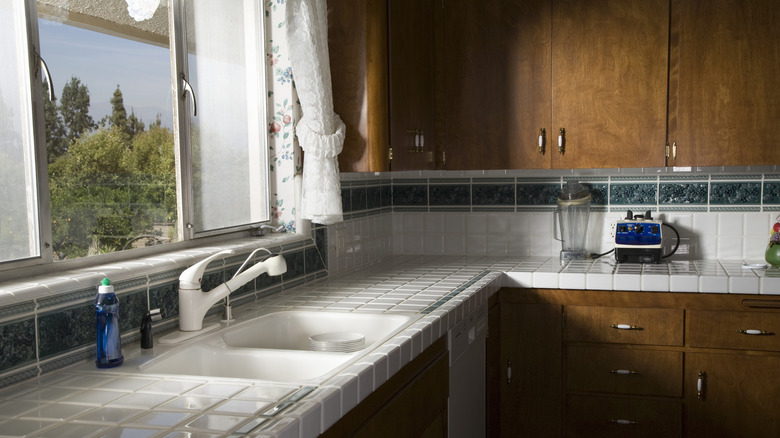
The biggest appeal of tiled countertops, and why some people are ready to overlook the downsides, is the unique, old-fashioned aesthetic. However, there's no guarantee that the result will match your expectations — you have to consider how the tiles will look alongside the other kitchen elements and what style you're going for overall. "Tile creates a grid across a large horizontal plane. In a kitchen already layered with cabinetry, hardware, appliances, and backsplash material, I prefer allowing the countertop to be one strong, continuous visual gesture. Large-format surfaces accomplish that beautifully," argued Kelly.
In other words, tiled countertops can make the kitchen look a tad cluttered and overly busy. This is especially a deal-breaker if you're going for a minimalistic and serene look. But even if you're in favor of designing a maximalist kitchen, there are better options. For example, terrazzo countertops are a great pick for a retro-styled kitchen that wants to lean into the more-is-more philosophy, while still keeping its functionality with an easy-to-clean, even surface. It's also very customizable, allowing you to play around with various colors and patterns.