

Forgotten Classic Milk Mixes From The '70s And '80s
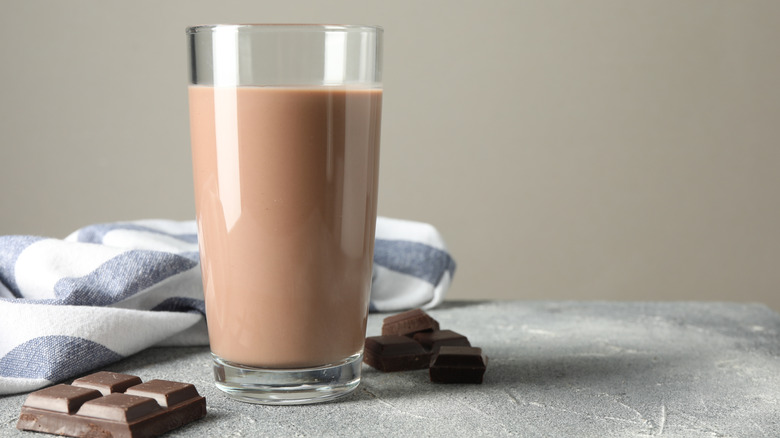
In the latter half of the 20th century, milk consumption began to sharply decline, according to a report from the U.S. Department of Agriculture. In 1945, Americans drank four times as much milk as soda. The trends converged in the early 1970s, when per capita consumption of both soda and milk was around 30 gallon. But, by 1997, we drank more soda than twice the rate we consumed milk; consumption of milk had further declined to just over 20 gallons per American, while soda had climbed to around 50 gallons per American, per year.
Although the history of chocolate milk goes back centuries, the dairy industry's attempts to combat milk decline was the introduction of sweet milk syrups and powders starting in the 1950s and 1960s, and really peaking in the 1970s and 1980s. If you're losing ground to soda, it makes perfect sense: mix in this liquid and turn your boring old milk into a creamy, sweet soda-like beverage. But as consumer tastes changed, many of these products disappeared into the mists of time. Here are some of the most fondly-remembered products from the heyday of milk mix-ins.
Milk Mate
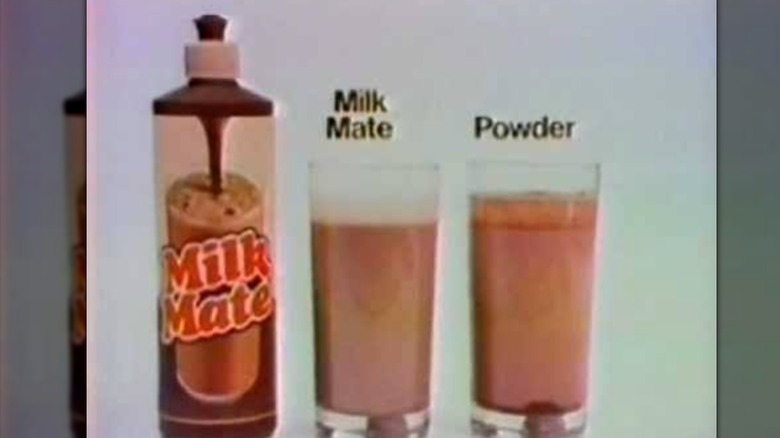
This chocolate syrup is still fondly recalled in retro-oriented corners of the internet, where Gen Xers have fond memories of putting Milk Mate on ice cream or making bubbly chocolate milk. Reportedly, it was less thick than the contemporaneous market leader Bosco, and a step above the milk powders of the time. Released in the mid-1970s, Milk Mate came in a squeeze bottle, which was a new innovation for the time. Old Milk Mate commercials position Milk Mate as a chocolate syrup that dissolves rapidly into milk, as opposed to competitors that leave traces of chocolate in the bottom of the glass.
This was arguably one of the oldest and serious concerns of chocolate syrup manufacturers. A U.S. patent from 1932, for "the process of making chocolate sirup [sic]," notes that, at that time, while freshly made chocolate syrup was easily poured, it quickly became thicker, and eventually fully set, making it impossible to pour. The patent also states that the only methods at that time to produce an "aqueous chocolate beverage" required the manufacturer to take out the "valuable cocoa fats," which presumably impacted the taste.
The patent holder's solution was to introduce an enzyme solution and heat the syrup; this process produced a shelf-stable chocolate syrup that would stay fluid. While the specifics of the process have evolved in subsequent years, the basic steps are pretty similar.
Bosco
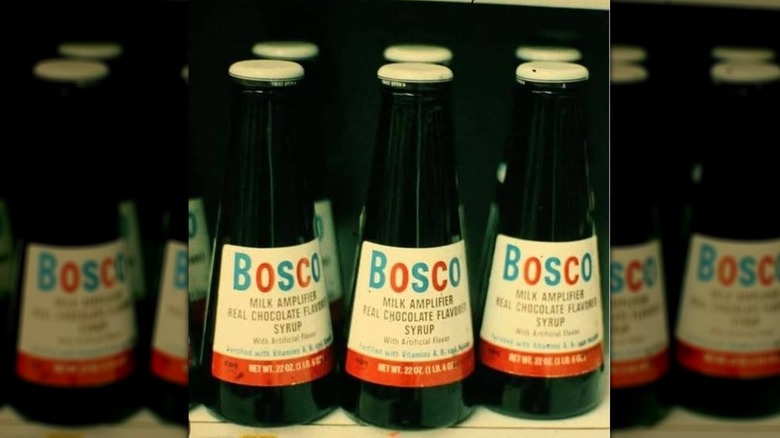
This once-popular brand of chocolate syrup was founded in 1928, and had achieved mainstream ubiquity by the '70s. You can get a partial sense of its popularity by looking back on its prominence in popular culture. For example, it was frequently mentioned on the popular 1970s sitcom "Laverne and Shirley," as one of the preferred foods of two of the main supporting characters. Seinfeld fans may also recall that George Costanza used the brand name as his ATM password. And movie historians note that Bosco was used as blood in the classic movies "Psycho" (1960) and "Night of the Living Dead" (1968). (In black-and-white, the dark, viscous chocolate syrup reads as blood-like.)
But nothing lasts forever, and Bosco's popularity eventually declined. According to reporting in the Chicago Tribune, the Bosco brand of chocolate syrup was only bringing in a measly $1 million a year by the mid-1990s. What happened? In the Wall Street Journal, a journalist who looked into the decline of the once-dominant syrup quoted the present owner as attributing the brand's fade from the popular consciousness to simply being outspent on marketing by Hershey's.
While it might seem unlikely that bad marketing can sink a great product, the WSJ gave an inadvertent glimpse into some of the thinking inside the company; when one Bosco employee noted it has a plush "Bosco Bear" costume the company uses at special events, a higher-up replied that the mascot would be paid $5 per hour. In a marketing battle between a billion-dollar corporation and a costumed mascot making less than minimum wage, maybe this result was inevitable.
The indignities didn't stop there. Allegedly, the Bosco syrup recipe has changed in recent years, and fans lament the omission of longtime ingredients malt and vanilla. Some say they wouldn't even bother buying the new product.
Carnation Instant Breakfast
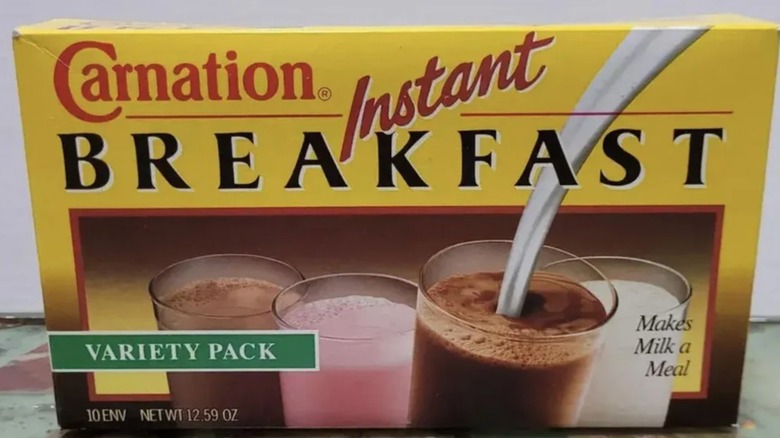
This product was once wildly popular in the 1960s through the 1980s; an ad from its heyday claims one packet provides "as much protein as two eggs, the minerals of two strips of bacon, and as much energy as two slices of toast." If that claim seems nutritionally dubious to you, you're not alone. According to 1970s reporting in The New York Times, the Federal Trade Commission singled out that specific line as an "unwarranted nutrition claim in advertising," and Carnation agreed to stop making it.
Regardless of the actual nutritional profile of Carnation Instant Breakfast, the product is still fondly remembered by generations who grew up drinking it in the morning. A HuffPost reported fondly recalled the "powder pebbles ... that would crunch and explode (in a good way)" and "that pocket of sugary powder that awaited you at the end of your glass." Interesting that the "product remaining in the bottom of the glass" problem that brands like Milk Mate sought to solve is remembered as a benefit by some consumers.
As many consumers remember, the powders were sugary, and in the mid-1970s, Carnation moved towards popular granola bars as well. Some observers attribute part of Instant Breakfast's decline to the overall decline of the Carnation parent company, a once-massive dairy company that was eventually purchased by Nestle. The Instant Breakfast brand was renamed "Breakfast Essentials" but that didn't help much; the product even retreated from the entire Canadian market due to low sales.
P.D.Q.
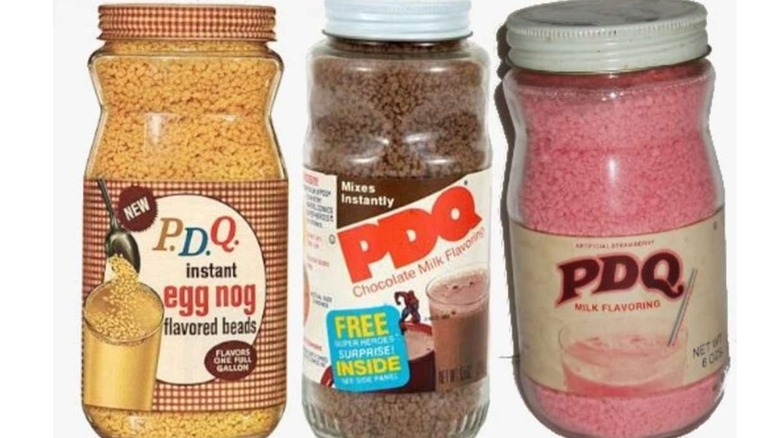
This offbeat product, whose name stood for "Pretty Darn Quick," consisted of small, hard flavor pellets that quickly dissolved in milk. Manufactured by Krim-Ko (which was bought by Ovaltine in 1970), PDQ came in strawberry, chocolate, and eggnog flavors. PDQ pellets were manufactured with a process called "agglomeration" that resembles the process behind making instant coffee. Essentially, it involves liquefying the ingredients and then drying them in a way that ensures they'll dissolve instantly in liquid, rather than clumping together.
PDQ debuted in the late 1960s and was discontinued in the early 1990s. According to photos posted online by one fan, PDQ offered collectible lids featuring characters from Marvel Comics for a while. Online, many fans of the discontinued product remember it affectionately, and a quick survey of the comments reveals that a large number of them loved the eggnog flavor. One fan even said they used to put the eggnogg PDQ on their Frosted Flakes for a "wonderful sugar rush."
Cocoa Marsh
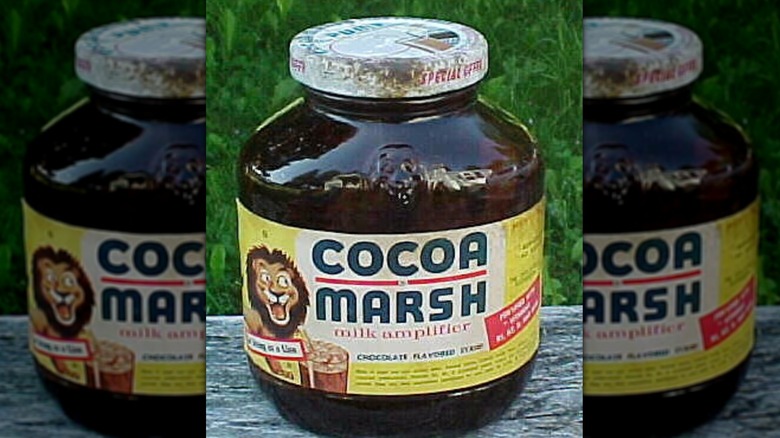
Marketed as a "milk amplifier" or "milk booster," this unique chocolate syrup had its origins in World War 2. Taylor-Reed, the company that put out Cocoa Marsh, produced sugar and chocolate rations for the U.S. military during wartime, and pivoted to a similar civilian product in the post-war years. Cocoa Marsh was heavily advertised in the New York City children's television market, starting in the 1950s and 1960s. Cocoa Marsh was still popular come the 1970s. Business would become competitive for it, and by 1980, the product was discontinued.
Cocoa Marsh used a cartoon lion as a mascot on its label, next to its tagline of "Be Strong as a Lion." Later, Cocoa Marsh came in a bottle with a pump spout on top that was meant to mimic a soda fountain. (The same company also made "Yum Berry," a short lived fruit-flavored milk syrup.)
While the syrup's unusual smoothness, along with its name, made many consumers assume that Cocoa Marsh contained marshmallow, a preserved label posted on Flickr shows that the product didn't contain any marshmallow at all; the listed ingredients are cane sugar syrup, corn syrup, blended cocoas, and imitation vanilla flavor.
Milk Magic
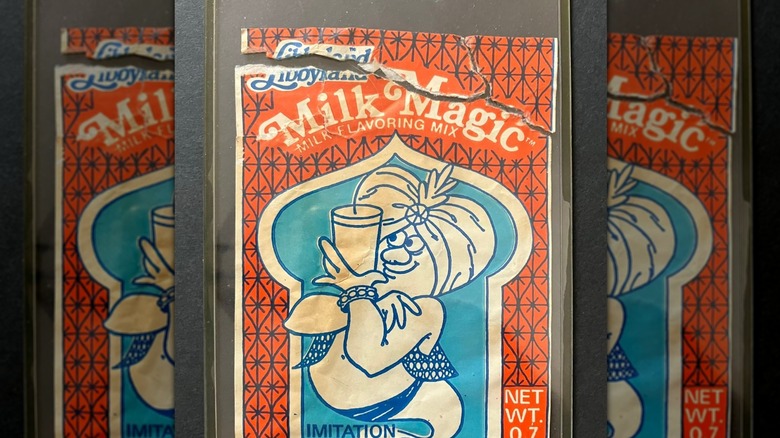
Milk Magic was a powdered milk additive that was Included with the Libbyland series of frozen TV dinners marketed to children during the '70s and '80s. This product line included the "Pirate Picnic," "Sea Divers Dinner," and "Sundown Supper." Preserved magazine advertisements from this era reveals that the Pirate Picnic isn't especially pirate-y; it contains a hot dog, french fries, macaroni and cheese with meatballs, corn, and chocolate pudding, along with the packet of Milk Magic.
On Youtube, an old commercial for these Libbyland frozen dinners aimed at kids reveals that the frozen dinner tray has a pop-up art panel for the kids to look at while they eat their food; it's not exactly Youtube on an iPad, but it's better than nothing. The quality of the food may have left something to be desired. "They weren't great, but the 'Magic Milk' and the cartoons and games made it worth choking it down," said one Redditor. "Magic Milk lit my brain up," said another. "Good stuff."
Thanks to a consumer who saved their torn-open packet of Milk Magic for decades, and then posted photos of it on Facebook, we can see exactly what Milk Magic looked like, as well as what was in it. The ingredients list is fairly straightforward, and not especially nutritious: "sugar, dextrose, artificial flavoring, artificial colors." In our era of health and wellness, it's not hard to figure out why this type of product has disappeared from the market. The directions are equally straightforward: tear the packet open, pour in the Milk Magic, and "stir until crystals are completely dissolved."
Moo Juice
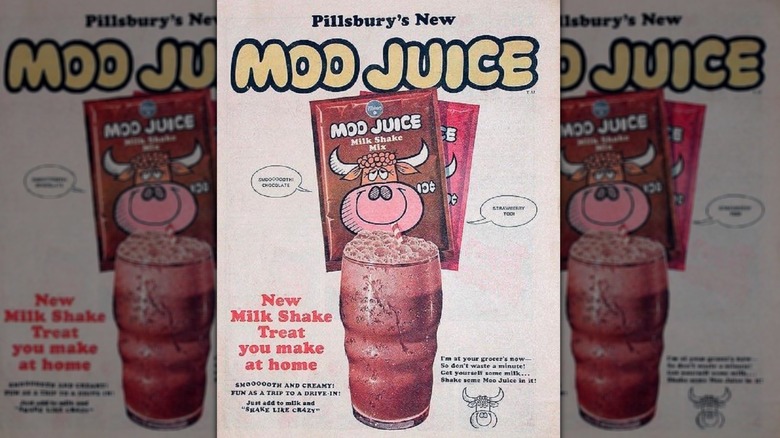
This powdered chocolate product from Pillsbury came in a paper packet similar to Kool-Aid. When added to milk and shaken, it claimed to produce a creamy milkshake. One surviving TV commercial for Moo Juice (voiced by an actor from "The Jackie Gleason Show") instructs consumers to add it to milk and "shake like crazy" for a treat that's "more fun than a trip to the drive-in." Some sources claim the Moo Juice milkshake was "thin," and the product was eclipsed by thicker concoctions like Borden's Frosted and Birds Eye's Thick and Frosty.
A surviving packet of Moo Juice for sale on an auction site reveals an interesting ingredient list: Sugar, cocoa processed with alkali, carageenan, salt, lecithin, mono and diglycerides, and artificial flavoring. The most interesting ingredient on this list is carageenan, which is a thickener and emulsifier derived from a cold-water seaweed originally found in Ireland. It became a popular additive in the 1960s and 1970s for its remarkable ability to give products a creamy, smooth feel, and is used in everything from diet soda to shampoo. Coincidentally, one of its first appearances in U.S. manufacturing was actually in a patent filed by PDQ's parent company, Krim-Ko, in 1941, when it was simply called "Irish moss extract."
It seems like Pillsbury didn't add enough carageenan to Moo Juice, since people seem to have complained that about the chocolate milk's texture. Maybe that was why the company added a suggestion to the Moo Juice packet to "add a scoop of ice cream" for an "extra-creamy" shake.