

Laminate Or Real Wood: Which Is Better For Your Kitchen Cabinets?
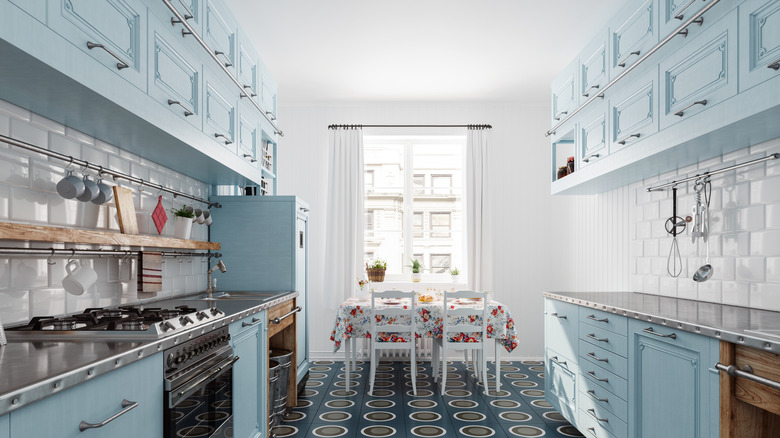
Cabinets are often the single most expensive part of a kitchen renovation, according to experts. There's a lot at stake, not just financially but aesthetically– do you want to go traditional or modern? Bright colors or muted wood grain? Most importantly, do you want cabinets made of laminate or wood?
For a long time, the conventional wisdom was that laminate was a cheap, nearly disposable option for cabinets, and that wood was a more upscale, durable option. But recent technological advances have scrambled a lot of those assumptions. While wood is still a solid option, a high-end laminate can look as good as the most expensive wood cabinets, at only a fraction of the price. And many homeowners don't realize how much maintenance wood cabinets require, from initial careful staining, to refinishing and repainting every few years. Your local climate can also have a massive impact on the durability of your cabinets.
Tasting Table talked to Jan Rutgers, director of sales and design at Cabinet IQ about the debate over wood vs laminate cabinets. Rutgers said what he'd recommend for different looks and situations, and what can make or break a set of kitchen cabinets, regardless of material.
It doesn't have to be all or nothing
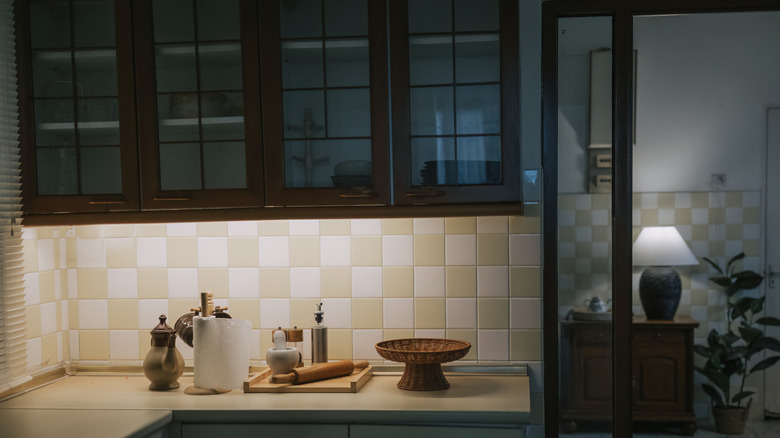
While many consumers see the "wood or laminate" question as an either/or, the reality is that it's rarely a black-or-white choice. Many kitchens feature cabinets that are part wood, and part laminate. "A cabinet consists of two parts: the cabinet box and the cabinet face," said Jan Rutgers, director of sales & design at Cabinet IQ. "Both parts can be produced using wood or laminate. There are many subcategories within each, [and] it is often mixed with every combination available."
There are many good reasons for mixing the materials, often, it comes down function. "The cabinet face includes doors, drawer fronts and end panels, and of course the cabinet box is the structure of the cabinet including sides, backs, shelves and, in some cases, face frame," said Rutger.
For example, laminate doesn't absorb smoke, grease, or dirt like wood does, but grime won't settle into laminate. It makes a lot of sense to use laminate for cabinet doors that might be exposed to heavy kitchen use, even if the cabinet itself is made of wood, since those laminate doors can be wiped down easily. (You can also wrap your kitchen cabinets if they start to look grimy.) On the other hand, some consumers might want to buy inexpensive laminate cabinets, and make them look more sophisticated by installing wood cabinet doors, or wood veneers. There are no hard and fast rules here; it's truly a mix-and-match situation.
Quality construction is at least as important as quality materials
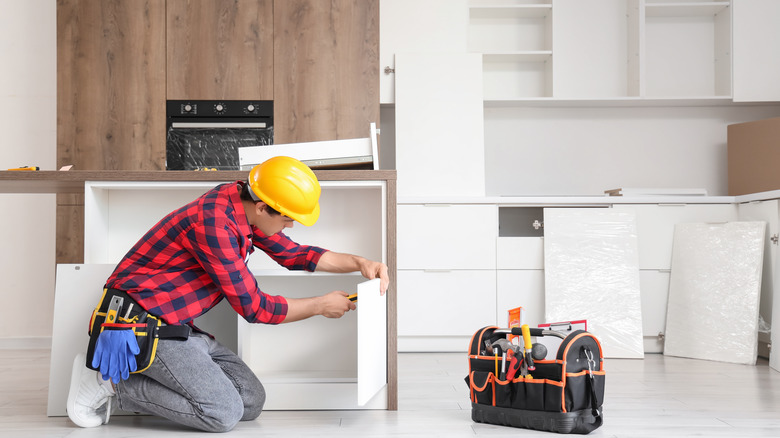
Whether you pick laminate, wood, or some combination of both, craftsmanship should be a very high priority. "Both are great materials for cabinet boxes assuming the correct construction methods are used," per Jan Rutgers of Cabinet IQ. "If the wrong construction is used to construct the box it doesn't matter what the material is, it will eventually fail."
Even the best materials will lead to a low quality cabinet if they're assembled and finished by an inexperienced or unskilled craftsman. And the phrase "low quality" doesn't just refer to how the finished cabinets look; a poorly constructed or poorly mounted set of kitchen cabinets can catastrophically fail and become separated from the wall.
Experts suggest taking a look inside a cabinet to see if it's well-constructed. Poorly constructed cabinets can be built with wood glue, staples, or other flimsy joinery, and the drawer slides (the rail-like piece that drawers slide on when you pull them out) might be cheap, weak, or perhaps not even added. Another sign of poor construction is a cabinet door or drawer that isn't well-aligned with the cabinet itself. Always seek out a seasoned, knowledgeable contractor for your cabinet work.
What's underneath is just as important -- if not moreso
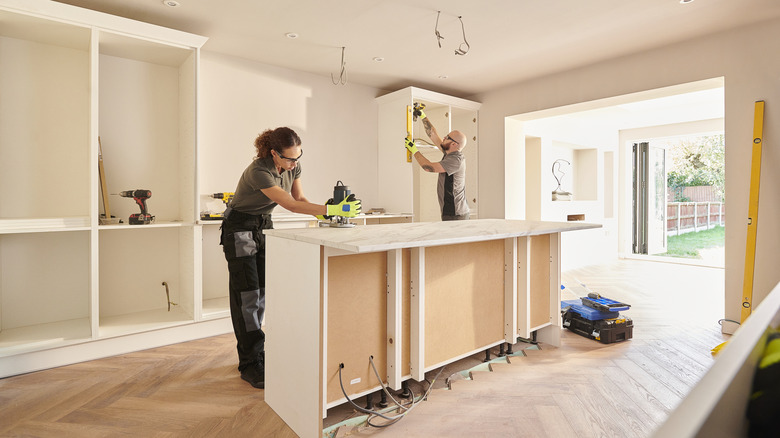
Unless you're building 100% solid wood cabinets, the laminate or wood veneer are only what you'll see on the surface of a cabinet; generally, they're applied to another material, or "substrate." Usually, this substrate is a plywood or particleboard. And just because you don't see it, doesn't mean it's not important. Notes Jan Rutgers of Cabinet IQ, "The quality of this substrate will affect the durability and aesthetics of the door. A lower quality substrate can telegraph through the smooth surface of a laminate and a veneer."
This is a very important point for homeowners who might be tempted to save money by putting a beautiful veneer on a cheap substrate. A low quality substrate can't be concealed by quality veneers, especially when the cabinets are opened.
Experts say plywood is a durable, high quality substrate, since it holds screws well and is actually more moisture resistant than natural wood. Manufactured wood products like particleboard and medium density fiberboard (MDF), which is made of wood fibers embedded in resin, are also solid choices. All of these are less prone to warping from moisture absorption than solid wood.
If you live in a humid, hot climate, laminate might be your best bet
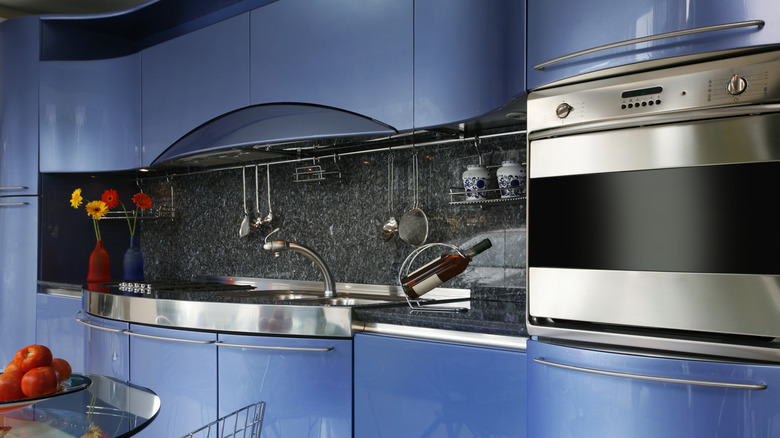
While wood is a solid and versatile choice for kitchen cabinets, it does come with some drawbacks. For example, in very humid conditions, wood will absorb moisture from the air and can swell and warp, resulting in doors that stick, warped cabinet boxes, or cracked paint. To avoid this, cabinet owners in humid climates may have to run dehumidifiers or air-conditioners just to keep their wood cabinets from being negatively impacted by conditions. And overly humid conditions aren't the only hazard.
"Humid climates do not mix well with wood inset cabinetry," according to Jan Rutgers. "When a wood door is fit into a wood frame, as is the case with inset cabinetry, any expansion of the wood due to humidity can cause binding and sticking. Also moisture can permeate wood cabinetry and cause cracking in very humid environments — as well as overly dry climates."
Laminate is non-porous, so there's no risk for warping or swelling from humidity. "Laminate cabinet doors are finished on all sides and edges preventing moisture from getting in so they do better in humid climates than wood cabinetry," said Rutgers. Bottom line: if you live in an area with very humid summers, it might save you a lot of time and money to opt for laminate cabinets over wood ones.
If you have a high-traffic kitchen, wood might be a better option
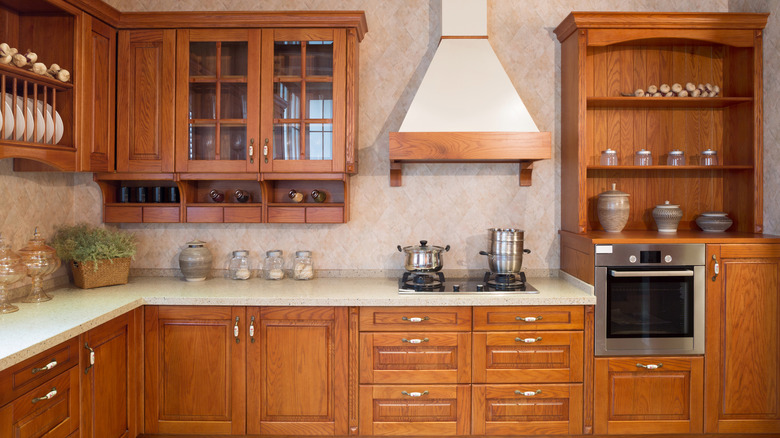
Jan Rutgers of Cabinet IQ notes that wood is much more susceptible to little nicks and dings, but is very straightforward to fix. "A wood cabinet door [is] easier to repair since it can be sanded and re-stained or, if painted, touched up," he said.
That leads to a bit of a counterintuitive conclusion. If you have a very busy kitchen where heavy items like pots and pans, or sharp items like knives and utensils, are going to be frequently thrown or shoved into cabinets, it makes more sense to use wood, even though it's more prone to take damage. That's because you can sand down your wood cabinets, and then repaint them, which will restore them to their original condition. Think carefully about how much activity your cabinets might see, as well as how long you might stay in that home, before you choose a material for your cabinets.
If you have a low-use kitchen, laminate is likely your best option
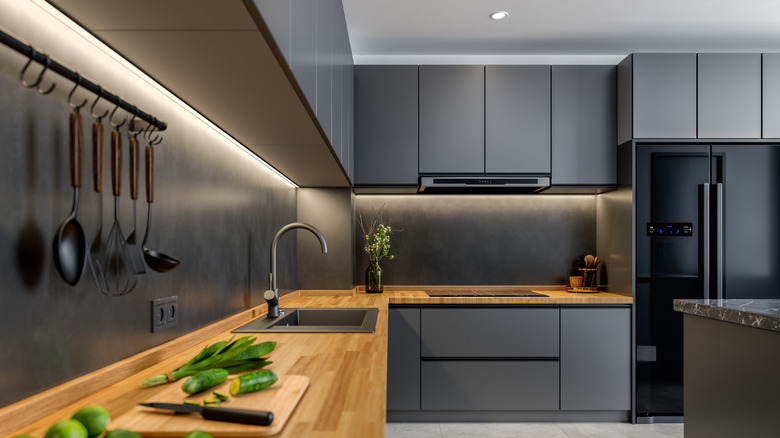
While laminate cabinets offer a lot of advantages, they generally don't have a second act. "Once the laminate surface has been chipped or scratched it is difficult to repair," said Jan Rutgers. It might make sense to think of laminate cabinets, or laminate surfaces (if they're placed onto a wood substrate), as "all or nothing" materials. It will look great, until it takes damage, and then it must be fully replaced.
The most durable laminate is high pressure laminate (HPL), which has been fused under extreme pressure, and is very resistant to damage. Predictably less durable is low pressure laminate (LPL), though it's also more affordable than HPL. Melamine, a type of laminate made from resin-soaked paper mounted onto a wood product, is widely customizable but the most susceptible to damage. If you have laminate cabinets and want to prolong their lifespan, your best bet is to use them with care.
If you're someone who orders takeout the majority of nights, and mostly uses your kitchen as snack storage and a place to make instant coffee, laminate can be the perfect cabinet material for you, since it probably won't take much damage, and can retain that new (or almost new) appearance for a long time.
If you prefer install and forget cabinets, look to laminate
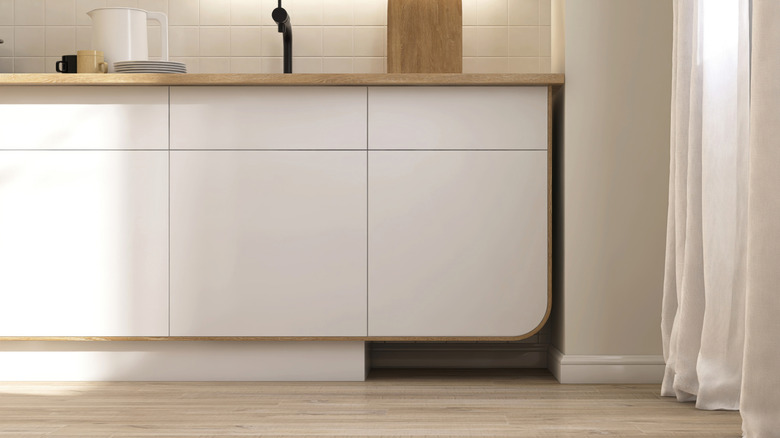
Compared to laminate, wood requires more finishing and regular maintenance. Wood needs to be stained to lock out moisture, or painted (and repainted every few years). And your choice of finish can have a huge impact on the cabinet's durability.
"For cabinet doors [that are] solid wood or wood veneer ... durability can vary widely especially once you get into the finish applied to the wood," Jan Rutgers of Cabinet IQ said. "Stain tends to be more durable because it permeates into the wood, while paint sits on the surface and is more susceptible to chipping."
Skipping or even skimping on those finishing touches can make your wooden cabinets susceptible to warping, swelling, cracking, or even mold. Finishes like paint also need to be retouched when and if it cracks or chips, to continue protecting the wood. If you're not willing to perform this kind of regular maintenance, laminate might be an easier, better choice.
Wood cabinets need a high level of craftsmanship to look good, while laminates are lower maintenance
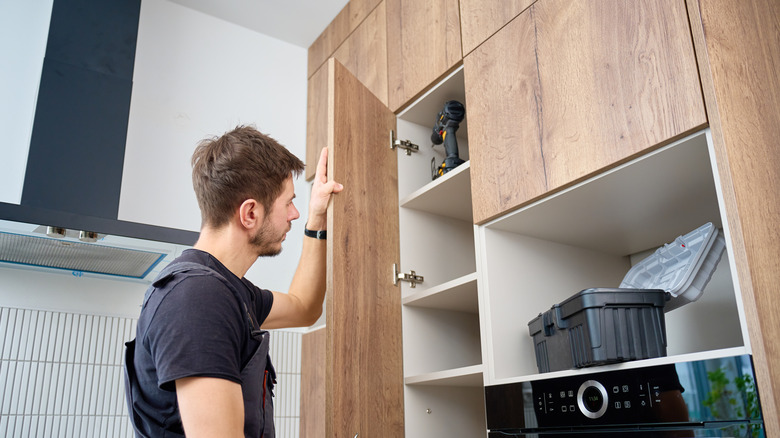
Craftsmanship of wood cabinets makes a big difference in how long they last and how good (or bad) they look, so steer clear of the cheapest wood cabinets. And it's not just about the wood itself; the finishes and other small details have a huge impact on how a cabinet looks and ages.
"With wood cabinet doors, veneer doors need to have the edges "banded" to cover the substrate," said Jan Rutgers of Cabinet IQ. "There are different thicknesses of this banding available which can affect aesthetics and durability. Even how it is applied and cut makes a difference. It can be lasered cut at the high end and scraped off with a file at the lower end. Two very different looks!"
This means that wood cabinets require multiple steps, and careful, specialized finishing. Laminate, on the other hand, is much simpler; most laminate cabinets and veneers come fully finished and ready to install.
If you have a limited budget, new laminates offer some high-end options on par with fine wood
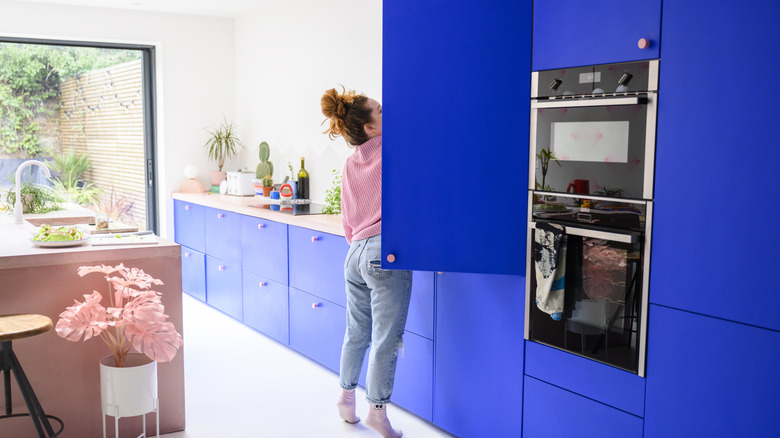
If you love the look of high-end woods, but don't want to spend five figures on your cabinets, recent advances in laminate technology has led to some very sophisticated and impressive laminates. Experts say these new laminates are visually on par with, or maybe even nicer than, some of the high-end woods on the market.
"The textured melamine products have come a long way in recent years," said Jan Rutgers of Cabinet IQ. "The grain on a textured melamine is more consistent than the same styled door in a wood veneer. Textured melamine is available in "exotic" wood looks that can be extremely expensive in real wood."
Custom teak cabinets can cost as much as $2,500 per square foot, while a teak laminate costs a tenth or less of that. If you love how walnut, mahogany, or teak looks, but don't have the budget to install it in your kitchen, a laminate lookalike can get you most of the look at a fraction of the price.
If you're on a very tight budget, opt for laminate cabinets
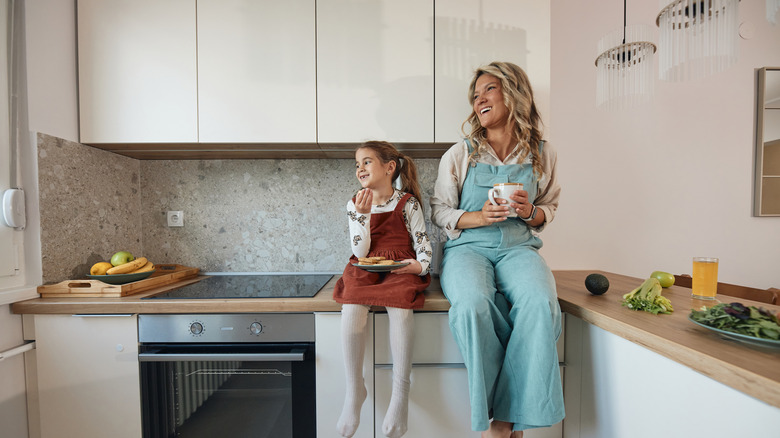
If you're trying to spend as little as possible, low-end laminates offer the most bang for your buck. Wood — even the cheapest plywood — generally costs more than its laminate equivalent.
"If comparing apples to apples, typically plywood interiors are a bit more," according to Jan Rutgers. "The same holds true for cabinet doors but, on average, a laminate or textured melamine cabinet door will be less expensive than a stained wood door."
The price difference is significant. Laminate cabinets cost around $50-$300 per linear foot, while on average wood cabinets cost around $150-$500 per linear foot. At the low end, that means wood cabinets are triple the cost of laminate ones. Laminate can be a nice-looking, inexpensive option if you're doing a quick home flip, renovating an investment rental, or building out a second kitchen at home on the cheap. Although they aren't as durable as wood, you can pull them out and replace them with another inexpensive laminate set if they take too much damage.
If you're going for a modern kitchen aesthetic, laminate is probably your best choice
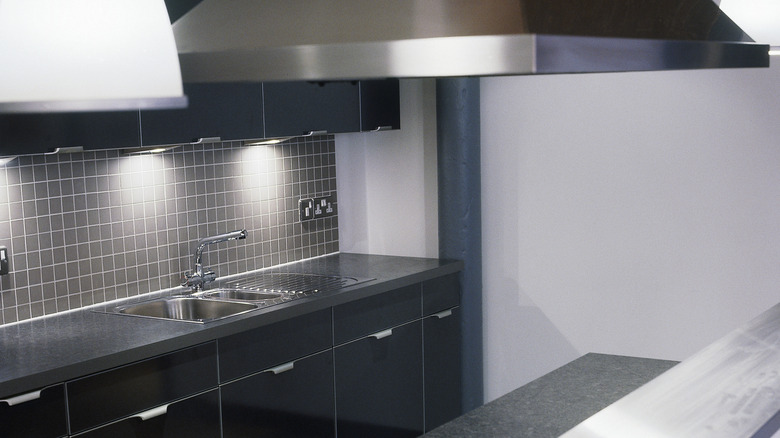
Smooth, uniform laminates that come in a variety of colors or neutral hues will fit better into a modern kitchen aesthetic, which values bright, bold colors, and curved shapes.
"A melamine or laminate interior is often in a bright white or light color which coordinates well with a modern kitchen design," said Jan Rutgers of Cabinet IQ. "For cabinet doors, the same holds true with laminate being used a lot for modern kitchens."
While this look can be accomplished in wood, it takes a lot of expensive and time-consuming work, while laminate can easily be custom-made to your visual specifications. If you want vivid or glossy cabinets, or cabinets that come in unconventional colors or shapes, a laminate is the superior choice. It's also worth remembering that bolder styles are quicker to go out of fashion, so it makes sense to build very aesthetically cutting-edge cabinets in laminate, since they'll essentially have a hard expiration date attached to them. With laminates, updating your kitchen cabinets is as easy as updating your kitchen counters.
If you're going for a traditional kitchen aesthetic, opt for wood
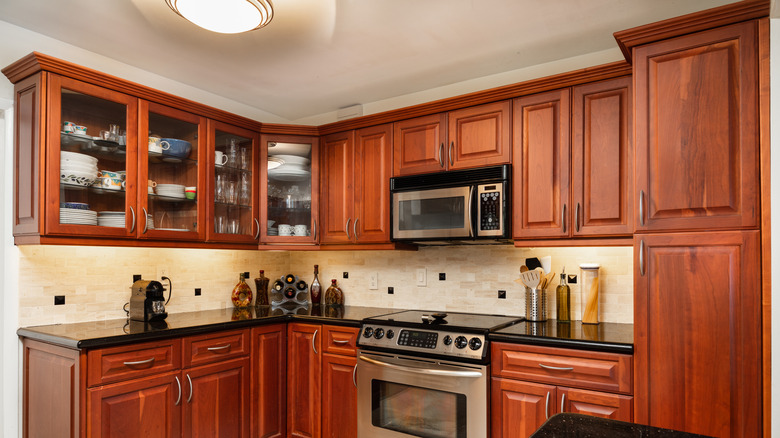
If you're building a sleek, ultra-modern kitchen with stainless steel appliances, dark, glossy colors, and lots of glass, concrete, or stone, wood cabinets will likely look out of place. But in a traditional kitchen that might feature softer, warmer natural tones and materials, wood cabinets can set the tone perfectly.
"Plywood interiors [and doors] have a wood grain which coordinates with a more traditional kitchen styles," Jan Rutgers of Cabinet IQ said. According to experts, traditional kitchens are coming back into style in the U.S., now that the era of the ultra-modern, minimalist kitchen aesthetic is tapering off. That means that an increasing number of people prefer traditional features like small, handmade architectural details instead of the "clean lines" associated with the modern aesthetic. They're also gravitating towards more natural materials like wood, and cozy colors.
To accentuate the natural look of the wood, consider staining it instead of painting over it. This will showcase the wood's natural grain and texture.
If you love wood, but the inconsistency bugs you, look into laminates
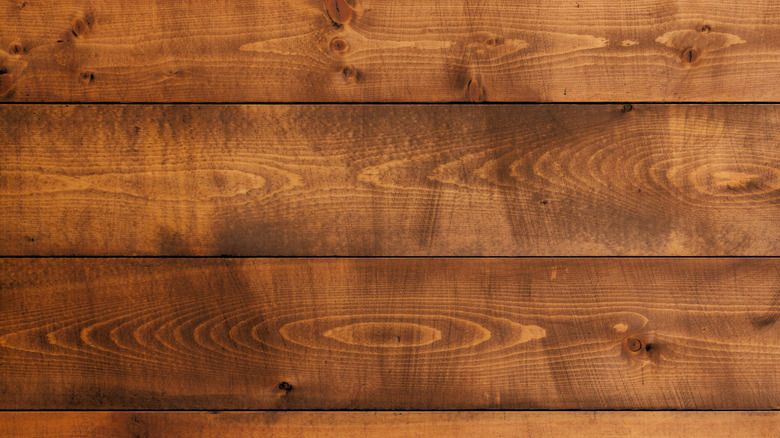
Because wood is a natural material, it's not perfectly consistent. Different sections from the same tree can look significantly different. Some consumers can be surprised by how different sections of wood can have different grains or have different tones, and if you're a stickler for detail, this inconsistency can be a dealbreaker. However, if you love the way wood looks, but yearn for a more visually consistent wood, some modern laminates can offer the best of both worlds.
"For example, on a long wall covered in tall cabinetry, a stained wood can have a lot of variances since every piece of wood is different," per Jan Rutgers of Cabinet IQ. "Not all consumers appreciate each piece looking different." On the flipside custom-made laminates in a wood-grain pattern can be manufactured to have exactly the same grain and tone across multiple pieces, offering the beauty of wood with a consistency that doesn't exist in the natural world.
For wood cabinets, look for a lighter, harder wood
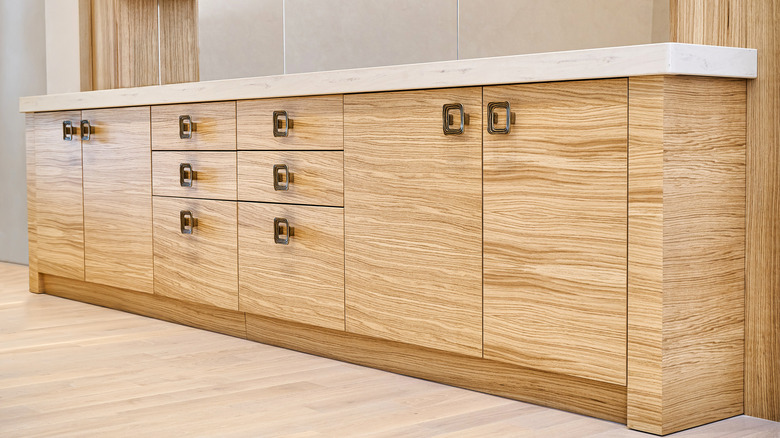
Not all wood is suitable for use in kitchen cabinets. Soft woods can be dented and scuffed, and these lower quality woods require constant maintenance and refinishing. Experts suggest harder woods that can stand up to heavy use.
"The best bet for wood cabinetry is to stay with a mid to hard wood," said Jan Rutgers of Cabinet IQ. "For North America-produced cabinetry, this usually means maple or red oak. With imported cabinetry it is usually a local 'white' wood from the origin country." Experts note that the hardest woods for cabinets are sweet birch, hard maple, and white oak, with the softest being pine, cherry, and walnut.
Rutgers notes that there are some very fine wood options for homeowners with a significant budget. (A significant budget for kitchen cabinets is in the mid to high five figures, while a low-end budget is around $2,000.) "We are seeing rift cut white oak in the high-end category, along with American walnut," Rutgers said. (Rift cut is a technique of cutting a log into lumber that produces wood with a distinctive grain and depth.) "But there are many specialty wood species available, such as hickory, cherry and wenge." It's important to mention that woods that are more affordable aren't necessarily less expensive because they're lower quality; often, these woods are simply more abundant. For example, maple is a very affordable wood that's also high quality, and is only inexpensive because maple trees are numerous in North America.