

Here's When An Expert Actually Washes Berries
We may receive a commission on purchases made from links.
Few things are more tragic than berries going bad in the fridge, especially after you've meticulously washed them after picking them up at the market. But what if washing the berries at the wrong time is actually what's leading to their early demise? We spoke with Lisa Steele, the master gardener known as the host of "Welcome to my Farm" and as the author of "In Season," who offers her advice on the best time to wash berries.
As a rule of thumb, Steele tells us that all berries need a good washing before being eaten, unless you've grown them yourself and know for a fact that they're free of chemicals and pesticides. While she eats raspberries straight from her own raspberry bush without fear, Steele adds that "all store-bought berries, or even berries you pick yourself from a local farm [should be washed]." But it's knowing when exactly to wash the berries that's the real challenge, as the timing is dependent on the type of berry itself.
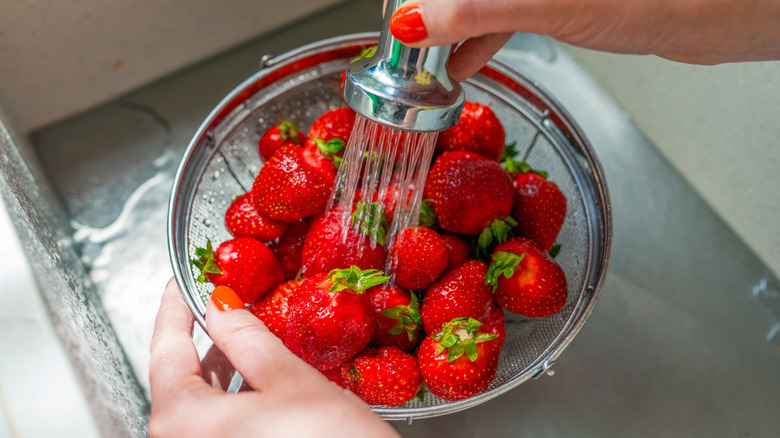
"Strawberries and blackberries are fairly sturdy," Steele reveals, "and can handle being washed as soon as you buy or pick them." Blueberries, on the other hand, are a little more complicated. "[They] have a whitish film on the surface called the bloom that helps to protect the berry from losing moisture and drying out," explains Steele, adding that they also protect from mold and bacteria. Just like farm fresh eggs, blueberries' protective outer film shouldn't be washed off until just before eating.
Timing, proper drying, and storage are all key factors
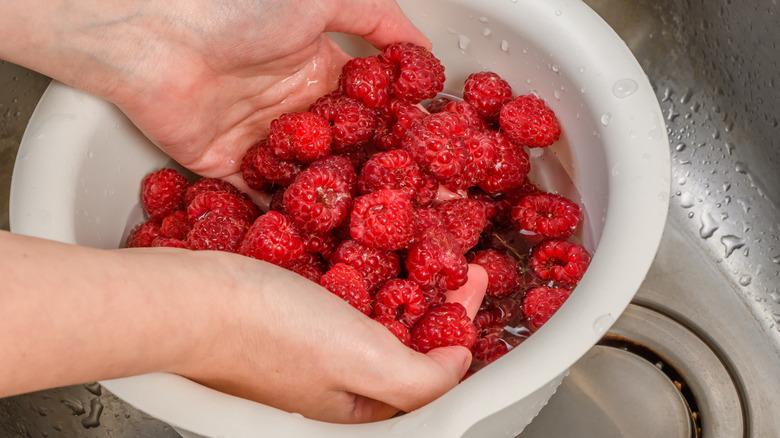
Even more fragile than bloom-covered blueberries, raspberries are the most delicate. "[These] can get mushy if you wash them, so they should be rinsed off just before eating them as well," notes Steele. The expert also cautions that raspberries "don't last as long as other types of berries in the refrigerator, so plan on eating them within a few days." In terms of washing, Steels advises you "rinse them under running cool water before eating them."
In terms of the actual logistics of washing, Steele's instructions are simple: "You can simply soak the berries in a bowl of cool water for two or three minutes, stirring to help loosen anything on the skins, then rinse the berries in cool water, and spread them out on paper towels to dry." After they've dried completely, which is arguably the most important step, Steele recommends storing them in a paper towel-lined container, covered loosely.
Of course, she also knows that some would rather wash berries in a distilled white vinegar solution — and there's nothing wrong with that. "Mix 1 part vinegar to 3 parts water in a bowl," she explains, "then submerge the berries for up to 10 minutes." This process must be followed up with a good rinsing with water to ensure there's no residual vinegar taste lingering on the berries. After rinsing, follow the same drying and storing process.