

Why Catering Services Have A 'No Leftovers' Rule — And What It Means For Weddings And Parties
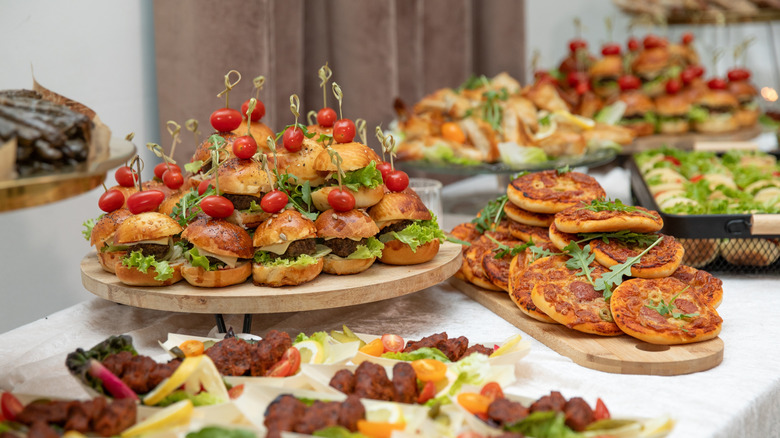
If you've ever planned a large event like a wedding or some other catered affair, it's likely that the catering manager or event planner informed you that you can't take home any food from the event. This is not a slight against you personally, nor is it meant to make you feel like you're squandering your hard-earned money. Some buffets don't allow to-go boxes for your leftover food either, but it's not because they think you're trying to turn an all-you-can-eat lunch into a second meal at home. Although it may perturb you to see leftovers that you're unable to take home yourself at a catered event, those rules are really in place for your own safety.
Food has a "danger zone" that needs to be avoided. According to the United States Department of Agriculture (USDA), the danger zone is a range of temperatures between 40 and 140 degrees Fahrenheit. Keeping food in this temperature range allows harmful bacteria to grow and multiply. Cold foods should be displayed on a buffet at under 40 degrees Fahrenheit, while cooked foods, especially meats and poultry, should be kept at at least 140 degrees Fahrenheit. Additionally, refrigerated foods cannot be left unrefrigerated for more than two hours, and that window shrinks as the ambient temperature increases. Given this short window of temperature-sensitive time, it's likely that once the foods sitting out on the buffet are taken away, they're either already in the danger zone or are close to it, making leftovers dangerous for you to bring home.
Reducing the risk of foodborne illnesses
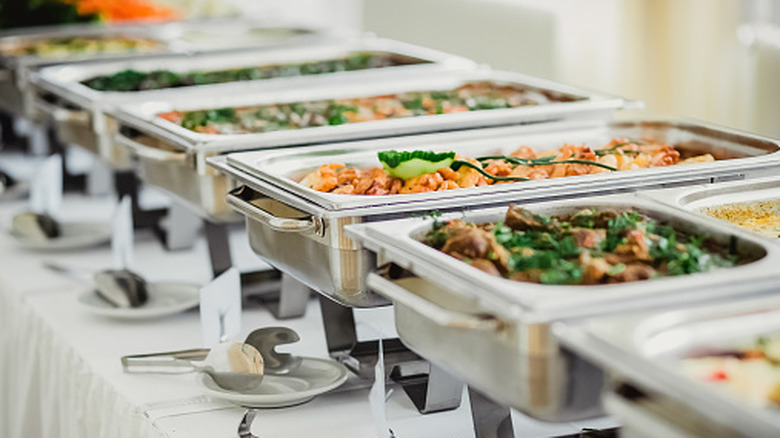
Although it's perfectly fine to ask for leftovers to go at an upscale restaurant, buffets and catered events are another story. Catered dishes and buffet food can sit out long after cooking, increasing the amount of time in the danger zone, while restaurant food comes directly to your table. While it may feel like you're being punished somehow by not being allowed to bring home food from an event, the truth is that the general public doesn't know enough about food safety to be trusted with temperature-sensitive leftovers. In the same way that large pans of food can be a red flag at a buffet, perishable food doesn't have an infinite shelf life after being cooked.
Additionally, the no-leftovers rule helps to protect the caterers or event services from liability, lest they be blamed for a guest getting sick from eating contaminated leftovers. I worked for years at a fancy catering company in Los Angeles, and I've seen my fair share of food waste at events, but much of that waste comes back on diners' unfinished plates. At the end of the night, staff are usually encouraged to take home any leftovers; however that's because we had demonstrated knowledge of food safety, knowing that certain foods like meat need to be properly reheated in order to be safe to consume. The risk of a guest contracting a foodborne illness from a plate of improperly stored leftovers is too great for most venues to chance.