

Why Some Buffets Don't Allow To-Go Boxes For Your Leftover Food
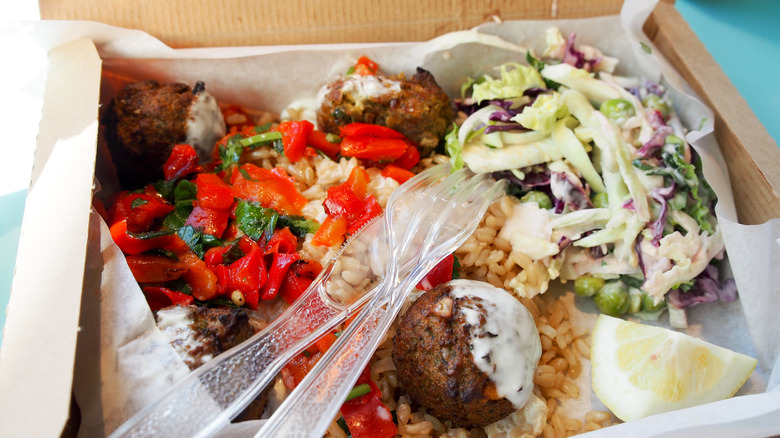
The big buffet decision: Do you go for another plate? Because there's a strong chance the restaurant won't allow you to take what you don't finish home with you. Aside from the obvious assumption that people might take excessive amounts of leftovers if given the chance at an all-you-can-eat establishment, there are actually legitimate food safety reasons to prevent customers from taking buffet food home.
Some foods should stay hot, while others have to be kept chilled. Contamination must be controlled, and food should be turned over or replaced regularly. Allowing customers to serve themselves before taking food home can blur the lines between the establishment's adherence to food safety practices and the customer's food handling. If someone were to take food home before getting sick, it could expose the restaurant to bad publicity, inspections, legal liability issues, and even lawsuits.
In a standard restaurant, kitchen and floor staff are the only people to handle your food until you receive it. This makes liability straightforward. At a buffet, you don't know if another customer cross-contaminated the tongs, touched food with their hands, or sneezed on the salad. Packing that food up for later gives potential pathogens more chances to multiply and jeopardize the safety of your food. Consuming food only at the establishment means that responsibility for food safety remains on the premises, where staff can control it.
All-you-can-eat doesn't mean over two days
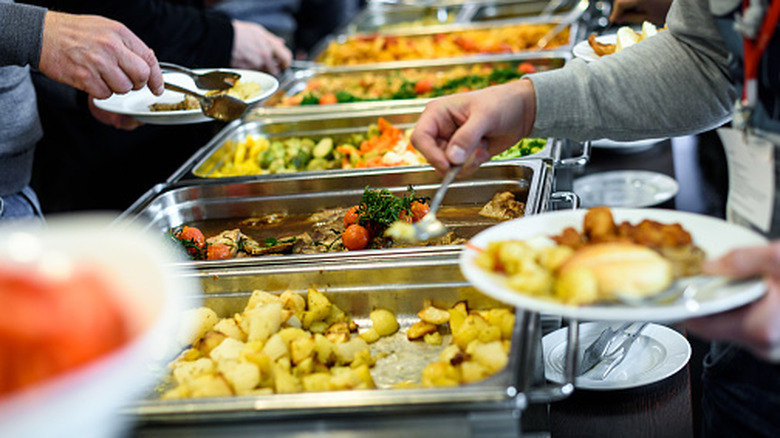
Liability around buffet food safety varies from state to state, but FDA recommendations direct safe food management in commercial and home kitchens alike. For commercial kitchens, as per the current FDA Food Code, it's recommended that any perishable food left at room temperature in commercial establishments be replaced every four hours to prevent pathogen growth. It also recommends that cold food should be kept below 40 degrees Fahrenheit and hot food over 140 degrees Fahrenheit.
Buffets are well equipped for this, with chafing dishes and warmers to keep food hot and cold pans to keep food safe for consumption. But if you combine your leftover raw sushi, still-hot chicken fillet, and wilting lettuce in a single container and put it in the fridge when you get home — after a five-hour car ride with no A/C — the restaurant may still be liable if you were to get sick. In most cases, it's simply easier to prevent customers from taking buffet leftovers with them in the first place.
This policy also encourages you to portion what you take to match your appetite, rather than taking too much at once. It also helps prevent frustrating behavior for buffet staff where one customer loads up on a particular food they want to take home, potentially stopping other customers from getting any. When restaurants say "all you can eat," what they really mean is here and now.