

How To Know If Your Cookware Is Really Oven-Safe
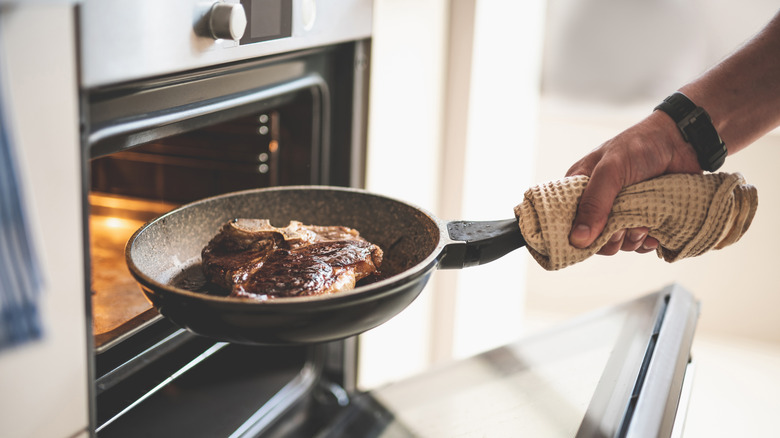
With all the cookware options available, there's a lot to remember when it comes to caring for your pots and pans, but not being oven-safe is perhaps the most nerve-wracking. It's one thing if you don't clean a pan properly once, but exposing cookware that isn't oven-safe to high temperatures can warp, melt, or even cause it to catch fire. Unfortunately, if you don't still have the original packaging, it's not always clear what pans are oven-safe. So, we asked Brian Theis, a recipe developer and cookbook author behind "The Infinite Feast," about the best ways to tell if your cookware is oven-safe.
According to Theis, "There is no surefire way (pardon the pun) to know what cooking-ware will survive in the oven at any particular high level of heat." Still, the expert adds that the best way to tell is to know your cookware materials and learn what they can handle. "If your piece is cast iron, your chances of 'Towering Inferno 2' are next to zero," he explains. One fact you should know about cast iron is that it's considered safe up to 600 degrees Fahrenheit, which most home ovens don't reach.
"If it is entirely stainless steel or carbon steel with no coatings, and no handles, knobs, or lids that are of a flammable, or melty," he adds, "you are also probably safe." On the other hand, Theis notes that, despite its durability, his Danish-coated copper cookware doesn't sit well with high heat in the oven.
The only way to ensure that your cookware is oven-safe is to know the materials
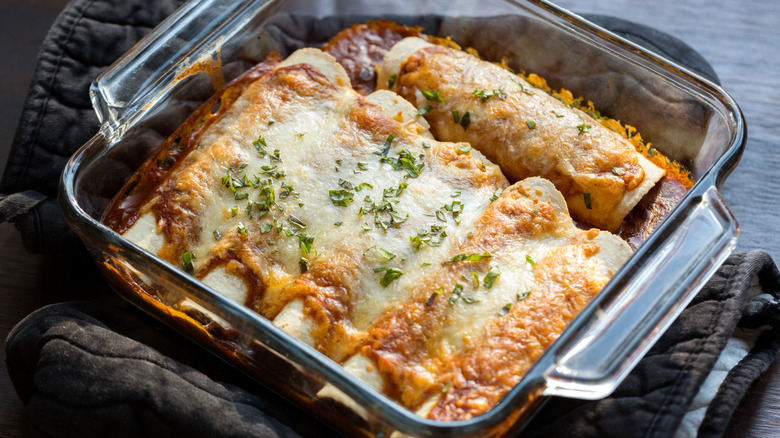
Unfortunately, even that knowledge is not perfect. Symbols indicating oven-safe capabilities are not always common, especially in older vintage cookware sets, which can make things complicated. "When I look at the many pieces of cookware in my kitchen here in New Orleans," he notes, "I see plenty of markings indicating capacity and make, but not many oven-safe marking indicators."
Even markings that do indicate that cookware is oven-safe often come with proverbial asterisks. Theis says, "There's Pyrex, which usually has reliable markings: a regular oven bake is okay, but don't put their dishes directly on the stovetop, or under the broiler!" He recalls that once he left a Pyrex on a hot burner that ended up exploding on camera. In the end, his recommendation is simple: "When in doubt, look yours up online. Don't try it unless you're confident."
Even when you think you know a material, you are better off checking online for the manufacturer's recommendation, as different brands of the same material can sometimes vary in temperature ranges. Some stainless steel pans are safe up to 800 degrees, but others (especially those made for normal home use) can be as low as 500 degrees. That little work is a small price to pay for preserving your cookware, and this way you won't need to rely on confusing and untrustworthy symbols.