

How Drive-Thru Breakfast Became An American Habit
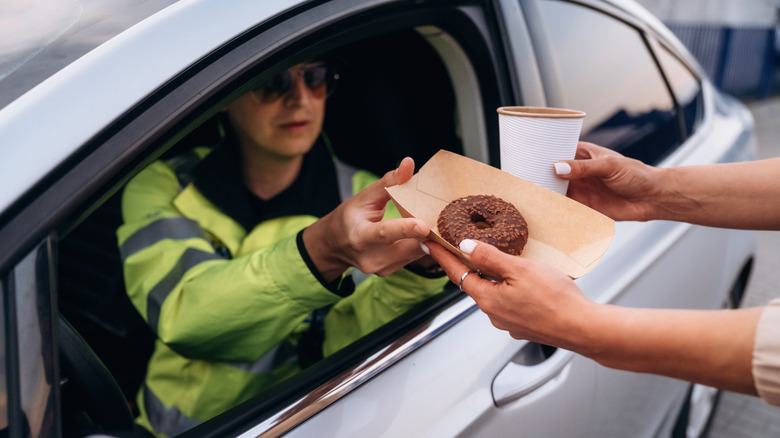
Grabbing a hot Egg McMuffin and an iced McCafé coffee without ever stepping out of the car feels like a God-given American right, but it's a relatively recent phenomenon. We seem to have two separate trends converging in history to thank: our dependence on automobiles, and fast food chains realizing breakfast was an untapped market. Drive-thrus, understandably, came first. In-N-Out is credited for inventing the modern drive-thru in 1948, which was a necessity back then because the building was too small to house both kitchen staff and diners.
Car-focused restaurants proliferated during the postwar decades as American suburban sprawl took hold, and more people spent more time behind the wheel. By the 1970s, most fast food chains were installing drive-thru windows nationwide as American habits switched to longer commutes, single-parent households, and changing family schedules. Wendy's actually introduced their drive-thru in 1970, called the "Pick-Up Window," five years before McDonald's opened its own in Sierra Vista, Arizona.
And wouldn't you know it, just around the same time, Mickey D's was working on breakfast as fast food. Santa Barbara franchisee Herb Peterson invented the Egg McMuffin in 1971 as a sort of portable Eggs Benedict, with a national rollout by 1975. In 1977, McDonald's formally launched its national breakfast menu, which included hot cakes, scrambled eggs, sausage, and hash browns. While traditional restaurant breakfasts required customers to park, sit down, and use utensils, a breakfast sandwich transformed all those ingredients into a one-handed commuter food. Competitors obviously wanted a piece of the morning action.
McDonald's continues to dominate drive-thru breakfast
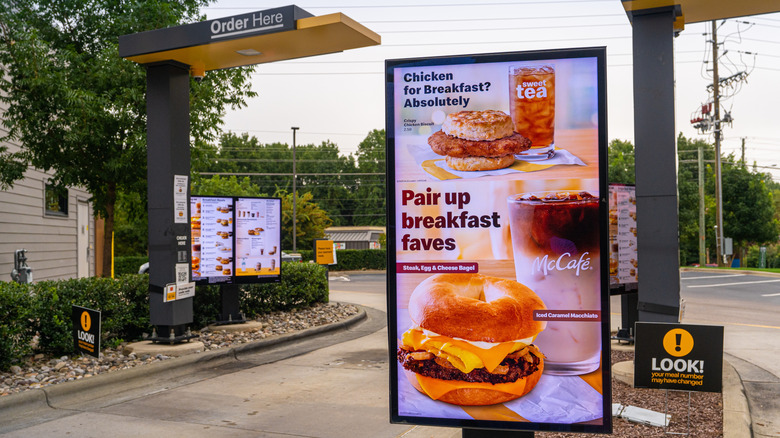
Burger King (BK) began experimenting with breakfast in the late 1970s, but it struggled at first because of its unique flame broilers. Unlike other fast food grills, which were easily adapted to breakfast entrees, BK didn't have success until the Croissan'wich in 1983, followed by the French Toast sticks in '85. Wendy's, on the other hand, has a history of frequent fails over the past four decades. Its attempt to make cook-to-order omelets went against the whole point of drive-thru breakfast: fool-proof techniques, speed, and portability. And although it still can't compete with McDonald's, Wendy's has a few highly ranked breakfast menu items.
Fast food chains also aren't afraid to mix up their breakfast menus as consumers' relationships to the so-called "most important meal of the day" evolves. Burritos, fried chicken biscuits, and McGriddles all compete in the growing sector of sandwiches that travel easily. Considering breakfast ingredients are relatively cheaper than burgers, brands are competing more than ever to offer value meals that entice hungry, time-strapped morning commuters.
These days, it seems like almost everyone is serving breakfast on wheels. While the O.G., McDonald's, is at the top of our fast food breakfast menus, Chick-fil-A is hot on its heels. Coffee, too, has grown in importance to customers, as places like Starbucks and Dunkin' have begun competing in the savory breakfast sandwich sector. While we can't quite predict what the next big breakfast trend will be, it's a sure thing all the fast food giants will watching closely.