

The Ideal Grilling Time For BBQ Ribs That Fall Right Off The Bone
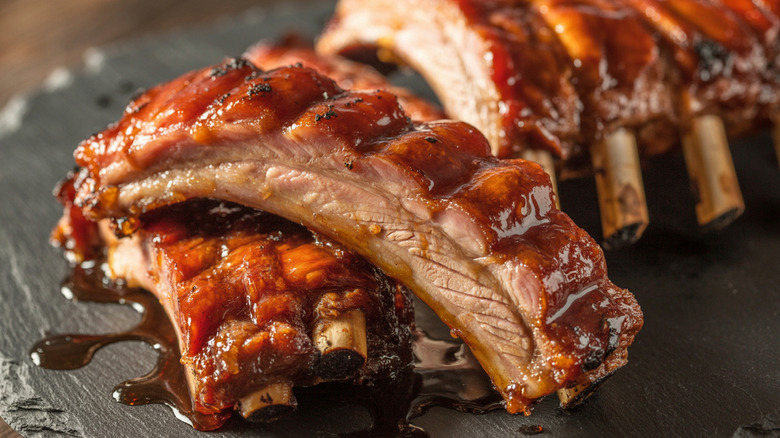
Ribs might be the perfect backyard barbecue food, if you can nail the ideal grilling time, that is. They occupy a balance between barbecue recipes that are doable for amateurs but still challenging enough that it's impressive and special. While oven ribs are possible (and good), it's that smoky flavor from the grill that makes them amazing. So, to make sure we are nailing the cooking time for the most tender, fall-off-the-bone barbecue ribs, we spoke with Scott Thomas, the owner of The Grillin' Fools, to ask for his ideal grilling methods.
It should be noted that while many like their ribs this way, not all pitmasters consider fall-off-the-bone ribs a good thing. That phrase is often used as shorthand for "tender," but ribs that are truly "fall-off-the-bone" can veer into overcooked and mushy territory. Instead, many aim for a texture that allows for easy (and clean) bites while still offering some chew. Still, Thomas was willing to give his advice for how to prepare ribs in this fashion utilizing a classic fall-off-the-bone formula that's easy to remember without even consulting a recipe: the 3-2-1 method for pork ribs.
"Set the cooker for 225 to 250 degrees Fahrenheit, skin and season the ribs and smoke the ribs for 3 hours," Thomas instructs, "then wrap in either foil or peach butcher paper and put them back on the grill for 2 hours." In that last hour, everything comes back out of the wrapper to get a nice charred, firm barbecue bark. Thomas notes that the time in the foil or butcher paper is "key" for fall-off-the-bone ribs. "The meat steams in its own juices," he adds, "hyper-accelerating the breakdown of connective tissue making them super tender." Just don't put them over direct heat.
Ribs can go from three to six hours depending on the texture that you prefer
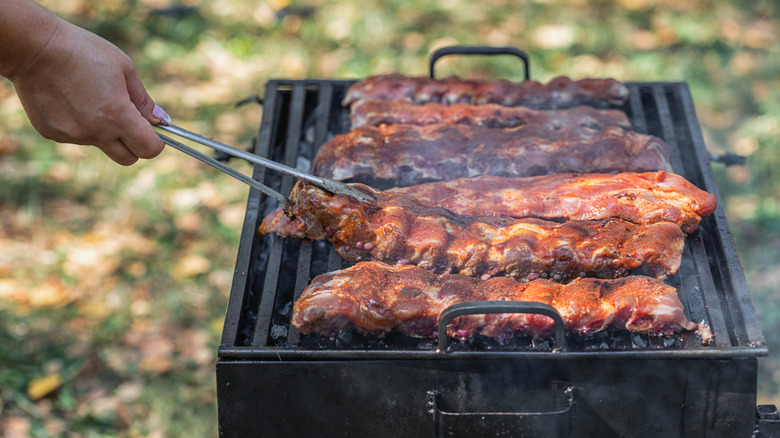
If you prefer the more textured take on barbecue ribs that's a favorite of pitmasters, Thomas has a method for that too. "For those that want something short of fall-off-the-bone, what some call 'competition style,' simply cut all the times in half," he explains. "We call it 90-60-30 ribs. 90 minutes in the smoke, 60 minutes in the foil or butcher paper, and 30 minutes back on the grill to firm up the bark on the outside."
Of course, all this is still done with indirect heat, which can look different depending on which method of cooking you prefer. "That could [mean] the coals banked to one side of the grill and the meat on the other side," Thomas suggests concerning common charcoal grills, also known as the 2-zone grilling method. Alternatively, you can use a drum smoker, which is big enough for the ribs to cook while being "hung from the top of the grill over the coals at the bottom."
Lastly, there is the increasingly common East Asian style of grill, the kamado grill. In this setup, Thomas explains, "The coals go in the bottom, and a plate setter or heat deflector is placed between the fire and the ribs." This allows the smoke (and some heat) to reach the ribs while the rest goes out a vent without much direct cooking.
Visual clues for perfectly tender barbecue ribs
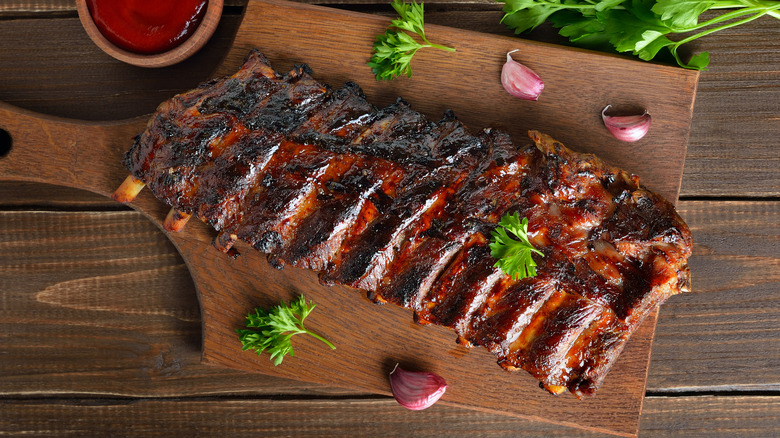
While knowing the time range for tender ribs is important going in, the inconsistent heat of a grill (and the size of your ribs) will always force you to rely on other clues to know when to take them off the grill. According to Thomas, there is one obvious clue to look out for. "Keep an eye on the bones. The bones know," he explains. "As the connective tissue breaks down and the meat contracts as the fat content slowly renders out, those bones start protruding from the meat."
When the ribs are sticking about a half inch out of the meat, they have reached that competition-style stage. They're tender, yes, but not "fall-off-the-bone." Thomas adds, "Once those bones are sticking out ¾ of an inch to a full inch, the ribs will be fall off the bone." You can also attempt the "bend test," where Thomas suggests trying to bend the whole rack: "They should fail the bend test in that the slab will not bend; the slab will actually break at the point of tension."
To make your ribs extra juicy, Thomas offers one last suggestion. Put a little something sweet or savory in the foil or butcher paper when wrapping your ribs. "That could be margarine, brown sugar, and some extra barbecue seasoning," he advises, "or butter, apple butter (or pumpkin butter), and some extra seasoning or maple syrup, butter, and barbecue seasoning." Just a little won't be too sweet, and the flavorings will mix with the fat as it renders, forming a slurry you can baste the ribs with as the end of cooking. If you want tender, juicy ribs, why not go all the way with it?