

The Best Coffee Maker For People Who Hate Complicated Controls
We may receive a commission on purchases made from links.
There is a time and place for complicated kitchen equipment. A food processor for chopping and grinding? Sure. A stand mixer for kneading dough and whipping cream? Absolutely. But when you've just rolled out of bed, the last thing you want to deal with is a series of flashing buttons and levers, especially when they're standing in the way of caffeine. For anyone who wants great coffee without a morning battle with the controls, a classic French press is hard to beat.
I've worked in numerous cafes and undergone barista training in both Europe and the U.S. The machines I've worked with are beautiful, expensive, and completely temperamental. When I first bought my own machine, I was excited to recreate specialty coffee at home, but lo and behold, it's my old French press that I've found myself reaching for again and again.
What I particularly love is that you don't need to buy pods or worry about descaling. My parents have Nespresso and Keurig machines, and while I enjoy them, I much prefer the taste of French press coffee. It's stronger, works out cheaper, and you have a lot more control over the brew. As for my Breville machine, the espresso is great, but there are a lot of steps, and the taste can be thrown off by the slightest issue. With a French press, the process is refreshingly simple: add coarsely ground coffee, pour in hot water, wait, and press.
French press coffee tips
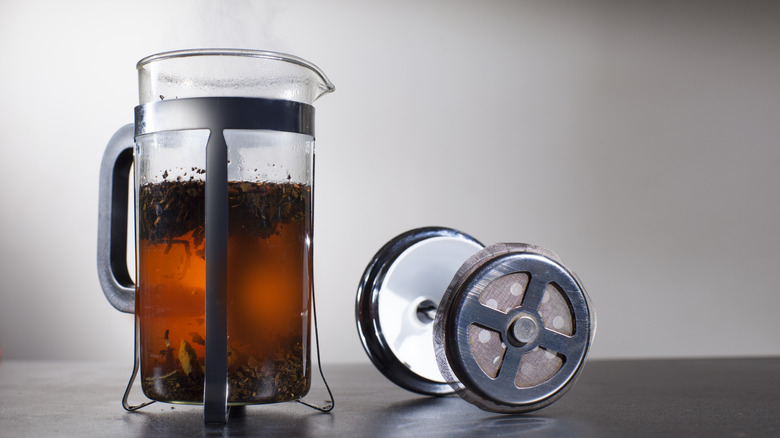
Also known as a cafetière, the French press was first patented in France in the 1850s before being redesigned in Italy. Featuring a carafe with a plunger and mesh filter attached to the lid, it's a full-immersion, manual coffee maker that requires no extra equipment. That's a big part of its appeal: there are no buttons to program, pods to load, or complicated settings to decipher.
When shopping for a French press, you'll find glass, ceramic, and stainless steel versions. Glass is the most traditional, but stainless steel is more durable and tends to keep the coffee warmer. I personally prefer the sleek look of a glass carafe, but I did just have to replace one that shattered in the sink. It was 10 years old, so it's not like they're particularly fragile, as long as you invest in a trusted brand like Bodum or Oxo. A French press is also extremely compact and compatible with nearly every type of coffee. For the easiest everyday option, choose a size that matches how much coffee you normally drink rather than buying the largest model.
However, you do need to use a coarse grind. Otherwise, the coffee will extract too quickly, leading to a weak, watery, and possibly sour cup. You could also be left with a gritty texture, as the fine beans will pass right through the filter. There are often French press symbols on grocery store grinders, and there should be some sort of indication on the bag if you're buying pre-packaged coffee. If it feels like it takes a lot of pressure to plunge the filter, the coffee is probably too fine, and vice versa. Getting the grind right is one of the few details that really matters, and once you've got it down, the rest is practically plug-and-play.
How to use a French press
It's good practice to weigh the coffee when you first start out. The typical guide is a 1:15 ratio, so about 15 grams of coffee for every 225 grams of water. Once you have an idea what that looks like, you can eyeball it. Water heated to around 205 degrees Fahrenheit will provide the best results. There's no need to worry too much, but just be careful with cooler water, as it could lead to a flatter taste.
A lot of people like to bloom the beans before pouring all of the water in. This allows some of the carbon dioxide to escape, resulting in a less acidic cup. It's not completely necessary, but it can help balance out the coffee, especially if it's been roasted recently. If you want to try, just pour in enough water to cover the beans and let it sit for 30 seconds before adding the rest. If you're after maximum simplicity, you can skip this step.
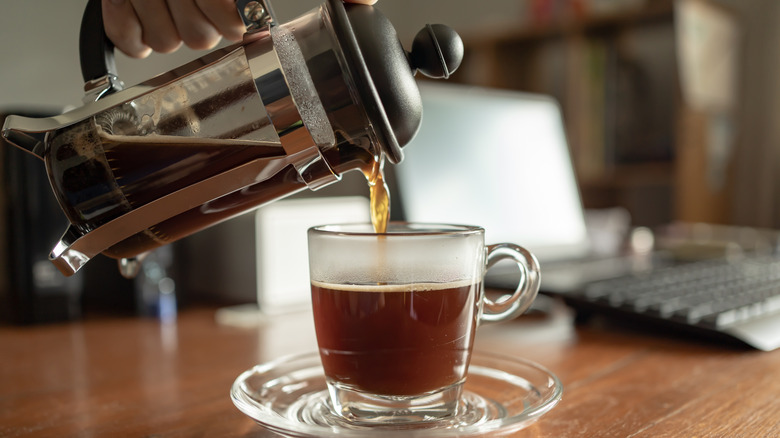
Stir gently and place the lid on top with the plunger pulled up. Now for the crucial timing tip — let the coffee steep for 4 minutes before pressing the plunger for the perfect French press coffee. Serve immediately or move it into another jug to avoid over-extraction. The result should be a bold, full-bodied cup. No pods, buttons, or levers needed. If not, play around with the grind size, coffee type, and temperature — one of the best parts of the French press is that it allows for a lot of experimentation. You get plenty of control when you want it, but none of the unnecessary complexity when you don't.