

How To Adjust The Temperature Of A Charcoal Grill Without Killing Your Flame
If you are new to charcoal grilling, one of the more daunting tasks can be figuring out how to adjust the temperature of the grill without killing the fire. Learning how charcoal burns and managing the temperature takes a bit of practice. The key is in understanding how to manage airflow through the vents.
The intake damper allows air to enter the grill, and if it's not open, your flame will die. Fire needs oxygen to survive, so the damper should always be open at least a little. The wider you open it, the more airflow you'll get and the hotter your fire will burn. There are even tricks to increase airflow right away for a hotter fire. If you need to lower the temperature, however, adjusting the damper is the best way to do it. How far to open it depends on your grill, the temperature you're trying to maintain, and the type of charcoal you're using. It may take some trial and error at first, but once you learn how your grill responds, controlling the temperature becomes much easier.
If you've reached the temperature you want to maintain, you may be able to hold it by closing the intake damper about halfway. Give the grill several minutes to stabilize before making any further adjustments. If you're still having trouble keeping the heat steady, consider trying a two-zone fire to keep your charcoal burning throughout the grilling process.
How to keep the air flowing
In addition to airflow, a thermometer is key to monitoring the temperature accurately. Most barbecues have a thermometer in the lid, which can give you a general idea of temperature in the grill chamber, but it can't always be trusted. A probe thermometer designed for high temperatures can more accurately show the temperature where your food is cooking so you can better adjust the airflow.
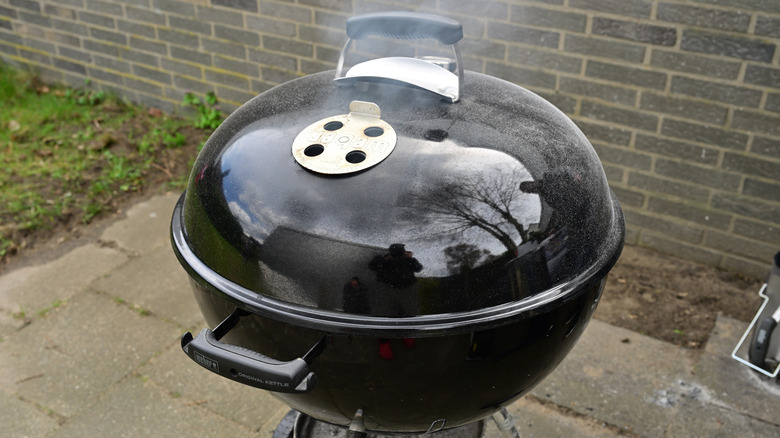
Most charcoal grills and smokers have multiple vents with different purposes that help control airflow through the grill chamber. A small kettle grill might have a pinwheel vent on top of the lid for exhaust and an intake damper on the bottom that can be adjusted to let in more or less air. Larger grills and smokers may have the intake damper on the side and an exhaust chimney extending from the grill chamber. When both are open, air enters through the intake vent while smoke and gases escape through the chimney, drawing more air through the chamber.
The exhaust damper is located above the cooking surface, and even if it's open, the flame can still die if the intake damper is closed. Heat and exhaust gases rise, so they escape through the exhaust vent rather than allowing air to flow in as it does through the lower intake vent. You can make fine temperature adjustments by closing the exhaust damper, but closing it completely will also snuff out the flame. Some grillers recommend leaving the exhaust fully open and not adjusting it at all, especially when smoking. For standard barbecuing, however, most recommend the opposite approach, making temperature adjustments only with the top vent.