

Granite Vs. Marble Vs. Quartz: Which Countertop Is Actually The Most Durable
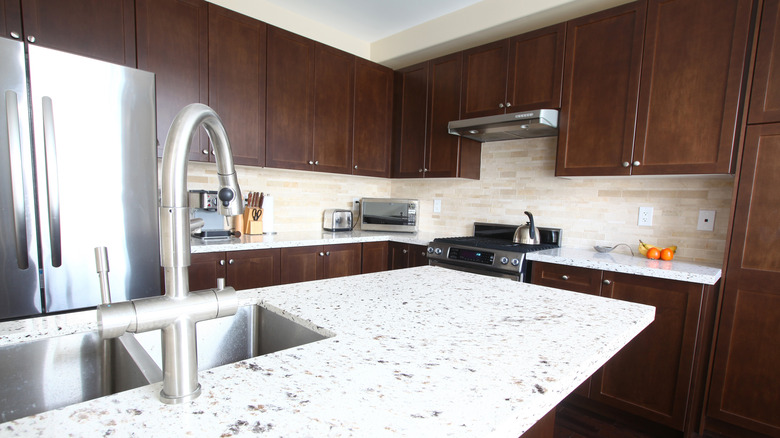
Scratches, dents, divots, smudges, stains — a kitchen countertop takes every kind of damage there is, so durability matters more than most buying guides let on. Consumer Reports tested 16 popular countertop materials against knife marks, heat, abrasion, staining, and impact, and against ever-popular marble and granite, quartz came out a fair bit ahead on most counts.
Quartz earned its top spot fair and square, which could be why it's the countertop everyone wants instead of granite. The material is engineered by grinding natural quartz and binding it with polymer resin. The resin fills in the stone's natural pores, leaving a nonporous surface that never needs resealing. As the resin is chemically inert, acid won't leave a dull, roughened mark called an etch. Against knife marks, heat, abrasion, and staining, quartz was Consumer Reports' highest rated countertop material, being chic as well as durable, after the outlet ran it against 20 household and food substances.
That's not the whole picture though, as quartz does suffer somewhat from chipping and hard impacts. While it excels at scratch resistance, it's not so outstanding when it comes to impact resistance. Quartz performs roughly the same as granite when something heavy was dropped on it. That's because hardness and toughness aren't the same thing — a material can pass one and shatter under the other if a hard enough blow lands at the wrong angle. But what about granite and marble?
Granite can take the heat, but needs regular upkeep
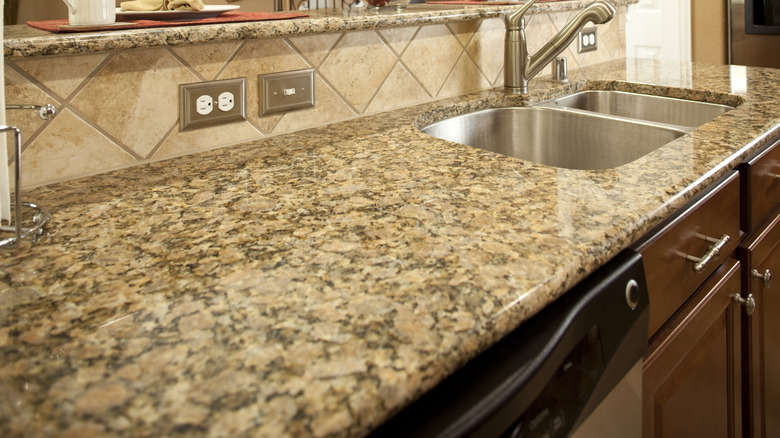
Of the three materials, Consumer Reports notes that granite's impact resistance and tendency to chip is on par with quartz, and superior to marble. Granite forms when molten materials, quartz included, cool and crystallize together over millions of years underground into an interlocked structure at a microscopic level. This is the reason the stone shrugs off scratches and abrasions so well. It's also why granite itself shrugs off heat that can trouble other surfaces. It has zero issue taking on a pan straight off the burner — after all, it's resisted worse heat underground.
Where granite falls off is in upkeep. It's naturally porous, so it soaks liquids to a degree (albeit not as bad as marble) — plenty of owners have learned this the hard way after a glass of wine turned their countertop into a crime scene. Sealant, a water-repellent coating, prevents this, but only with periodic reapplication. Think of granite as coming with a maintenance schedule attached. How well it performs over time depends on whether that schedule gets kept. Granite and marble land in different places on that same scale, for reasons rooted in their geology.
Marble doesn't handle acids well
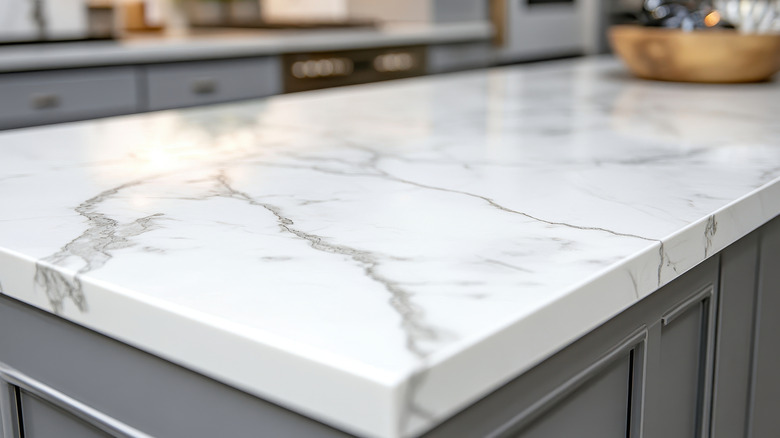
Marble forms when limestone, made mostly of a soft mineral called calcite, gets heated and compressed underground until the calcite recrystallizes into larger, interlocking grains. That softness — calcite rates just a three on the Mohs hardness scale, against quartz's seven — is why marble scratches so readily from gritty sponges, cookware, and utensils, in a way granite or quartz surfaces don't.
That's not all. Chemicals are marble's number one enemy, and it comes down to the same chemistry that makes marble ... marble. Calcite is formed from calcium carbonate, which it dissolves readily in weak acid. There's no shortage of weak acids in a kitchen: lemon or lime juice, vinegar, wine, or tomato sauce, for example. Any of them left sitting on marble can etch the surface that a good scrub won't undo. A sealed marble counter can still be etched by a wedge of lime; sealing addresses porosity and staining, but it does nothing for the acid-calcite reaction that causes etching.
In Consumer Reports' testing, marble also ranked poorly for impact damage, chipping and cracking more readily than either granite or quartz. Still, that fact hasn't dulled marble's appeal — it just means keeping vinegar and acids away from it, and staying on top of maintenance, in exchange for a visually appealing countertop. Ultimately, deciding on quartz, granite, or marble will depend on personal preference, cost, and which countertop material is best for your kitchen.