

Why Old-School Burger Stands Wrapped Everything In Paper
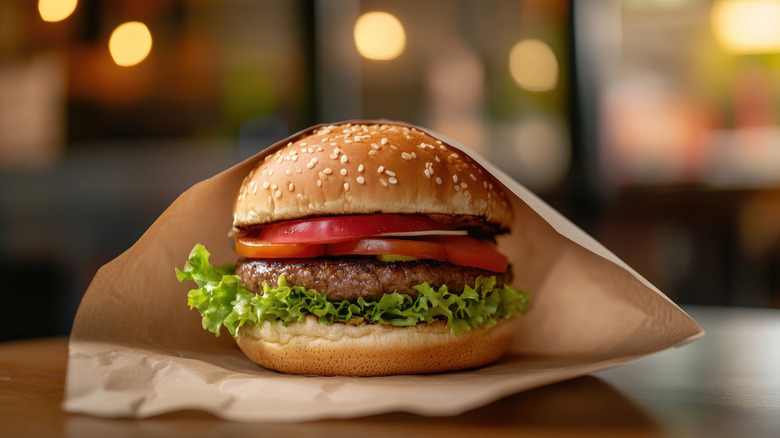
Whether the hamburger hails from Hamburg, Germany or owes its iconic status to an American flair that made it famous is still up for debate, but one thing's for sure — wrapping the burger in paper made it a legendary meal to take on-the-go. Of course, wrapping food in paper was not inaugurated by old-school burger stands. When a now-famous fish and chips duo made its 1860 London debut, the little combo was wrapped in — surprise! — newspaper. Food has in fact been wrapped and travel-ready since times of yore, with the practice of using leaves or husks across the ancient world as a way of making food portable.
Food on-the-go took on a whole new look, however, in the early 1900s, when greaseproof parchment paper was designed, quickly making it a lynchpin to the consistent portability of your friendly, neighborhood hamburger. The paper kept hands clean while it softened the burger bun (not steaming it into a soggy mess, like Styrofoam was later known to do) and insulated the burger to keep it warm(ish).
That's a lot to ask of a square little sheet, though this was no ordinary paper. It was treated with sulfuric acid, and its fibers blanketed with a semi-rigid, jelly-like coating that could handle serious food, like hot, greasy burgers. Add a bit of wood pulp to make the whole thing robust and voila! Butcher shop paper that neither leaked nor tore for burger stands to sell their sandwiches in portable, inexpensive little packages.
When burger wrappers became billboards
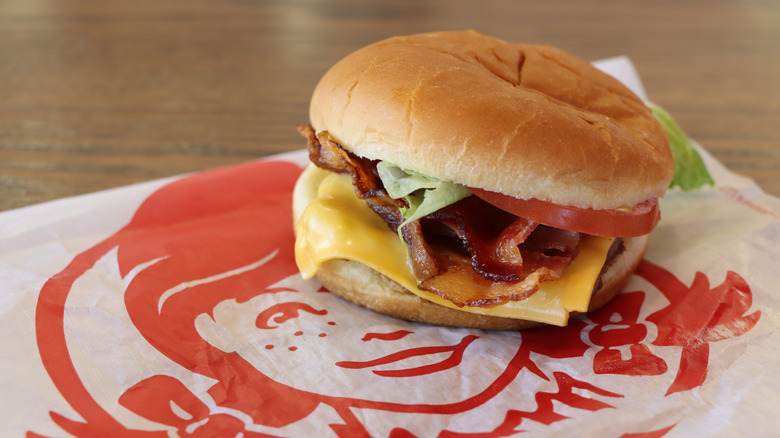
As if doing the job of a breathable, flexible, moisture-resistant, greaseproof, inexpensive, sturdy little vessel for burger stands' burgers wasn't enough, the burgeoning fast food industry eventually slapped the burger wrapper with a company logo and a new marketing outlet was born. When industry powerhouse, McDonald's, came up with the idea to pre-prepare its burgers then place them under a heating lamp for expeditious ordering time that would revolutionize the fast food industry, wrapping burgers in paper had long become common practice. By the early 1950s, businesses began recognizing toss-away burger wrappers as a way to spread the word about their brands. Back when McDonald's hamburgers were still at their original price of $.15, its early hamburger wrappers featured a new logo — a "Speedee" chef which it stamped on its burger wrappers.
Fast food chains hit the billion-burgers sold benchmark by the early 1960s, and there was no turning back the marketing machine needed to maintain that sales volume. Recently, Burger King, temporarily, listed its Whopper ingredients on its burger wrapper, to showcase its no-artificial ingredients. In-N-Out Burger added Bible verses. The practice of wrapping burgers that started off as a utilitarian endeavor early in the 1900s can now bring us inspiration, education, and, most importantly, a burger we can grab and go that still tastes really delicious.