

Is It Safe To Hose Down Your Grill?
We may receive a commission on purchases made from links.
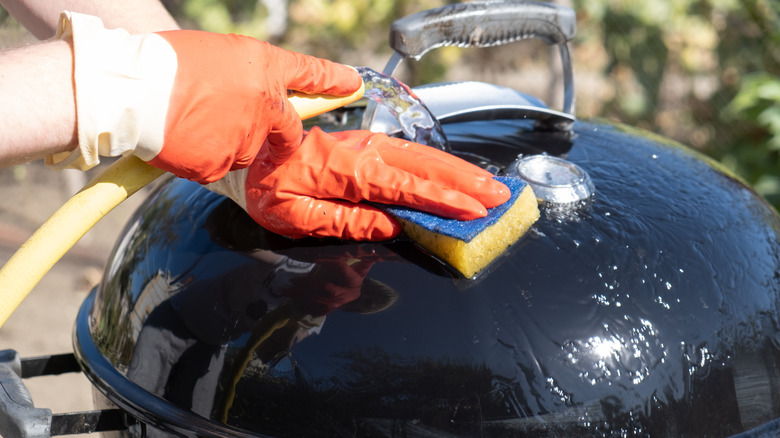
After a marathon grilling session, your previously pristine grill may be sitting covered in soot and grime. It can be very tempting to give it a good-old wash down with your garden hose to remove the blackened crusts sticking everywhere. It may be the fastest fix most people can come up with, and it's not entirely wrong. But, whether it's safe or not depends on the type of grill you're dealing with.
The most fuss-free type of grill to hose down is a charcoal grill. It's more or less a metal bucket, so after removing the grates and brushing off excess ash, feel free to hose it down. For owners of a gas-fired grill, however, things are more complicated. Within their cookbox and behind the control panel are sensitive mechanical and electronic parts — like the burner tubes, spark electrode, gas valves, and manifolds — none of which are designed to get wet. That's why instead of a garden hose, Weber recommends using a damp cloth or wet sponge for taking care of surface grime, and a brush or scraper for anything charred-on (pumice stones can also be used).
Grates, heat plates, grease trays, and Flavorizer bars can all be hosed down, with a spritz of grill cleaner, like Goo Gone, applied first if they're heavily soiled. That'll keep your grill sparkly.
Watch out for rust
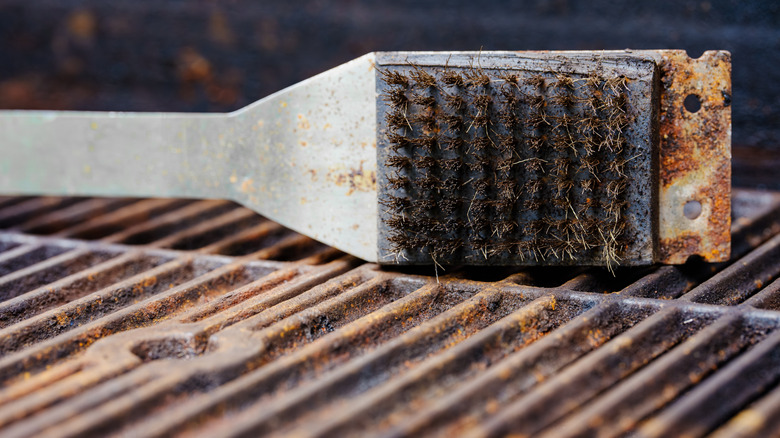
Soaking parts that shouldn't get wet is one risk. Rust is the other — bare steel rusts fast, but even coated steel, once scratched and weathered, can rust quicker than you'd think. A grill's interior also gives water plenty of places to hide: Within the seams where the firebox meets the cookbox, the underside of heat plates, and the ports along a burner tube. All these places trap moisture with zero drainage that, over time, will oxidize whatever metal surface it sits on.
Rust usually shows up on the grates first (which can ruin the taste of your food). From there it spreads to seams, joints, and the burner tubes, which are the biggest headache of the three simply because of how important they are for a good grilling session. Burner tubes mix fuel with air, then distribute the flame throughout the cookbox. Condensation and grease can cause surface rust that'll eventually clog the burner ports, choking off gas flow. This is usually a manageable issue — a stainless steel brush will clear it off the tubes without much trouble. Deeper corrosion is a different animal altogether: If it's gone untreated for a while, it can crack or split the tube, and at that point the "fix" is a replacement. This is also why, after you've hosed down your grill, make sure to thoroughly dry it afterward by toweling every nook and cranny you can reach before reassembling.